

Tabelog Silver #153
Our verdict
Wasa puts Tokyo Chinese dining in its small-counter, high-heat tier: compact, reservation-led, and priced for serious diners rather than casual Ebisu grazing. Masataka Yamashita’s kitchen sits within a citywide movement where Chinese technique is being tightened through Japanese seasonality, sommelier service, and tasting-menu discipline, backed by Tabelog Award Silver recognition and OAD Japan listings.

Pearl is the En Primeur Club membership app, where members save venues, book tables and use the concierge.
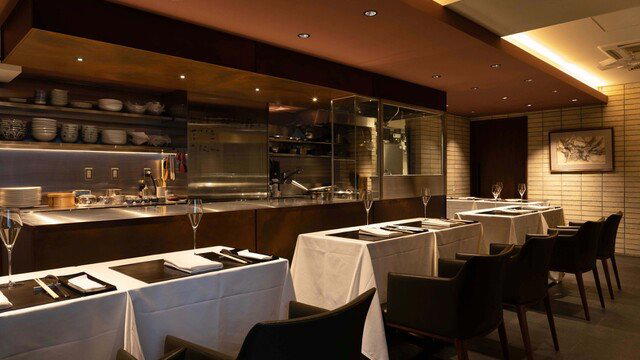
Ebisu’s restaurant geography changes quickly once station crowds thin: office towers give way to side streets, ground-floor dining rooms, and compact counters where Tokyo’s serious cooking happens close up. Here, Chinese cuisine is not banquet abundance or late-night comfort but a study in timing: oil temperature, wok movement, reduction, steam, and the brief gap between aromatic lift and overcooking. Wasa belongs to the Tokyo category where high-heat Chinese technique is pressed into the cadence of a Japanese tasting counter.
Read the room not as a standard Chinese restaurant with luxury ingredients, but as part of Tokyo’s broader move toward small-format precision. The city has long absorbed French, sushi, kaiseki, Italian, and Chinese traditions into formats built around sequence and control. Chinese cooking, especially wok-driven cooking, resists that structure because its force is immediate. The appeal is the friction: flame and speed meeting a city that prizes calibration.
Wok heat translated for Tokyo's counter-dining culture
At this level, Chinese cooking is judged less by ornament than command. Wok hei is often reduced in English to smokiness, but better read as momentum: heat transfer, aroma, and texture arriving together before the ingredient collapses. Tokyo’s newer Chinese counters make that momentum compatible with tasting-menu pacing, where each course must register clearly without becoming heavy sauce.
Wasa’s position rests on objective signals rather than mythology. It is a Tabelog Award 2026 Silver winner, has appeared in the Tabelog Chinese TOKYO “Tabelog 100” selections, and is listed by Opinionated About Dining in its 2026 Japan recommended restaurants. Those markers matter because Tokyo’s Chinese field is deep and uneven: established Cantonese dining, Sichuan-influenced kitchens, hotel rooms, wine-led modern Chinese counters, and chef-driven independents all compete for attention. A Silver placement and a Tabelog score in the mid-4 range put the restaurant in a serious bracket, especially in a category without the international shorthand of sushi or tempura.
Chef Masataka Yamashita matters as a credential, not a personality hook. The stronger story is how his kitchen fits a wider Tokyo pattern: Chinese technique tightened through limited seating, sommelier support, and a rhythm closer to kappo than banquet dining. That does not make the cuisine less Chinese; it makes it more exposed. In a small room with a fixed sequence, dishes cannot hide behind quantity or ceremony.
Where Wasa sits among Tokyo's modern Chinese rooms
Tokyo Chinese dining now divides into serious lanes: formal Cantonese rooms where service scale and private dining matter; ingredient-led modern counters courting wine drinkers; and high-heat kitchens built around wok immediacy. Wasa sits closest to the last two, with enough structure for tasting-menu diners and enough Chinese technique to avoid becoming a generic luxury counter.
For comparison, 4000 Chinese Restaurant and 4000 Chinese Restauranat show Tokyo’s appetite for Chinese cooking framed through tighter, chef-led formats. Chugoku Hanten Fureika and Canton Meisai Akasaka Rikyu occupy a more established register, useful for understanding how far Tokyo Chinese ranges from classic room-service polish to compact contemporary intensity. Choyo adds another lens on the city’s Chinese vocabulary: smaller, focused, and less dependent on banquet convention.
The distinction matters when planning a Tokyo dining run. Sushi and tempura counters have obvious itinerary roles; Chinese dining requires more intention because the category is less legible to visitors. Wasa rewards diners who want technique rather than spectacle. The sommelier also signals the intended audience. Modern Chinese cooking in Tokyo has become a strong wine category, partly because heat, acidity, fermented notes, and layered sauces can be more compelling with a cellar than with beer or tea alone.
The practical reading: small room, serious spend, narrow margins
Scale shapes the experience. Eight seats mean little slack, with consequences for pace, cancellation tolerance, and group planning. The format suits diners comfortable committing to a full evening more than those seeking a flexible Ebisu stop. The dinner budget sits in the upper Tokyo Chinese tier, with a separate service charge, so compare it with other counter-led destination restaurants rather than neighbourhood Chinese dining.
Ebisu works well before or after west-side Tokyo plans without Ginza’s ceremonial weight. The neighbourhood is mixed: polished enough for special-occasion rooms, relaxed enough for wine bars and late meals, and close to Shibuya without inheriting its constant movement. Tokyo’s adjacent culture is covered in Our full Tokyo experiences guide, while Our full Tokyo wineries guide is better read as a regional planning tool than a claim that the city is a wine-production destination.
The broader Japan map puts the category in perspective. Serious dining outside Tokyo can pull in sharply different directions, from -Grilled beef Sukiyaki- KAMAKURA TANUKIAN 鎌倉 たぬき庵 in Kamakura to [ki:] in Kyoto, Akihana, Chinese in Kyoto.cafe in Osaka.know in Kumamoto, (Shoku) Vietnam in Kawasaki, and [Curry Senmon Ten] Maruyama Kyoju. in Sapporo. Even an overseas Cantonese reference such as 888 Seafood, Chinese in Rosemead shows how far the Chinese dining spectrum can stretch between banquet scale and Tokyo’s concentrated counter model.
The editorial case for Wasa is clear: choose it when the point is Chinese technique under pressure, not a survey of regional dishes or a lavish room. The awards record confirms its standing, but the real interest is the format. Few cuisines reveal a kitchen’s reflexes as quickly as wok cooking, and few cities are as demanding about compression, sequence, and control as Tokyo. That tension puts this address on a serious Chinese-dining itinerary.
Frequently asked questions
Who is the chef at Wasa?
The chef associated with Wasa is Masataka Yamashita.
Is Wasa focused on a specific cuisine style?
Wasa serves Chinese cuisine.
What time does Wasa open and close?
Hours at Wasa: Mon: Closed; Tue: 5–7:30 PM, 8–10:30 PM; Wed: 5–7:30 PM, 8–10:30 PM; Thu: 5–7:30 PM, 8–10:30 PM; Fri: 5–7:30 PM, 8–10:30 PM; Sat: 5–7:30 PM, 8–10:30 PM; Sun: Closed.
What is Wasa known for?
Wasa is primarily known for Chinese in Tokyo.
In Context: Similar Options
Comparable venues to calibrate price, style, and recognition.
| Venue | Cuisine | Price | Awards | Notes |
|---|---|---|---|---|
| WasaThis venue (the venue you are viewing) | Modern Chinese Fine Dining | $300–500 | Tabelog Silver #153 | Not listed |
| Kan Coffee Fujifuji | Izakaya with Coffee | $30–50 | Michelin Plate | Shinjuku |
| Yamazaki | Seasonal Japanese Kaiseki Omakase | $300–500 | Tabelog Silver #156 | Minato |
| Afuri | Modern Yuzu Ramen | $10–20 | Not listed | Chiyoda |
| Rokurinsha | Tsukemen Ramen | $10–20 | Tabelog 100 #98 | Chiyoda |
| Good Vibes, The | Hamburgers | Not listed | Not listed | Shibuya |
Recognition history
Dated appearances from independent guides and award organizations, with the underlying list record or original source where available.
Opinionated About Dining Top Restaurants in Japan Recommended
Opinionated About Dining
Tabelog Silver #153
Tabelog
Full recognition history (7 entries)
Tabelog 100 #38 · No. 38
Tabelog · Tabelog 100 - Chinese cuisine - TOKYO - 2026
Opinionated About Dining Top Restaurants in Japan Ranked #283
Opinionated About Dining
Tabelog Silver
Tabelog
Opinionated About Dining Top Restaurants in Japan Ranked #249
Opinionated About Dining
Opinionated About Dining Top Restaurants in Japan Highly Recommended
Opinionated About Dining
Continue exploring
More in Tokyo
Restaurants in Tokyo
All restaurants in Tokyo →



Bars in Tokyo
All bars in Tokyo →





Details
- Intimate
- Sophisticated
- Modern
- Elegant
- Date Night
- Special Occasion
- Chefs Counter
- Standalone
- Extensive Wine List
- Sommelier Led
- Set Menu
- Counter Dining
- Wine
- Vegetarian Friendly
Current opening hours
- Monday
- Closed
- Tuesday
- 5–7:30 PM, 8–10:30 PM
- Wednesday
- 5–7:30 PM, 8–10:30 PM
- Thursday
- 5–7:30 PM, 8–10:30 PM
- Friday
- 5–7:30 PM, 8–10:30 PM
- Saturday
- 5–7:30 PM, 8–10:30 PM
- Sunday
- Closed
Hours can change for holidays and private events. Hours as of .
Compact, intimate, and reservation-driven with a serious fine-dining atmosphere.