

Michelin Plate · Tabelog 100 #94
Our verdict
Regalo sits in a Yoyogi basement and has held a Michelin Plate in 2024 and 2025. Chef Tomomi Ogura applies a two-principle framework to Italian cooking: Japanese seasonal ingredients only, and combinations kept to a minimum. The result is a set-menu format that reads Italian in structure but moves through Japan's seasons in its ingredients.

Pearl is the En Primeur Club membership app, where members save venues, book tables and use the concierge.
The menu
What to order
- Chargrilled_wagyu
- Sauteed_octopus_with_artichoke
- Spaghetti_with_clams
- Zucchini_flower
Italian Minimalism, Japanese Seasons
Tokyo's Italian dining scene has spent the past two decades sorting itself into distinct registers. At one end sit the grand-format rooms with European wine lists running to several hundred pages and menus that translate classical Italian regionalism with high fidelity. At the other, a smaller cohort of chef-led counters and basement rooms has developed something more specific: Italian structure applied to Japanese ingredients, season by season, with the editorial instinct of kaiseki rather than the abundance of a Milanese trattoria. Regalo, which has held a Michelin Plate in both 2024 and 2025, occupies a considered position within that second register.
The name translates from Italian as 'gift', and the framing holds: what arrives at the table is structured as a present of the current season rather than a survey of Italian technique. Chef Tomomi Ogura's stated philosophy rests on two principles, use Japanese seasonal ingredients, bamboo shoots, sweetfish, Pacific saury, and their equivalents throughout the year, and keep combinations to a minimum. That restraint is not a limitation; it is the method. The cuisine is known formally as cucina Ogura, literally 'Ogura's Kitchen', and the Michelin recognition across consecutive years confirms that the framework has held its coherence.
The Evolution of a Format
The trajectory that produced Regalo's current identity reflects a broader shift in how Italian cooking has developed in Tokyo. Through the 1990s and early 2000s, the prevailing model was essentially curatorial: Italian-trained chefs or Italian-born restaurateurs brought regional recipes to Japan with high-quality imported ingredients as the primary credential. The Japanese ingredient quietly entered the kitchen as accent or novelty. Over time, particularly as Japanese chefs returned from stages in Italy and began opening their own rooms, the proportion inverted. The Italian technique became the structural logic; the Japanese ingredient became the primary material.
That inversion is now sufficiently established in Tokyo that it constitutes its own category. What distinguishes Regalo within that category is the degree of reduction involved. Where comparable kitchens often allow themselves complex multi-element compositions, Ogura's two-principle framework enforces an editorial discipline that is closer to washoku minimalism than to the layered constructions that mark Italian fine dining elsewhere. The consecutive Michelin Plate recognitions suggest the format has matured rather than shifted; this is not a kitchen still working out its identity.
For context on the wider Japanese Italian scene, Aroma Fresca and Principio represent different points on the same spectrum in Tokyo, while cenci in Kyoto applies a related logic in a different regional context. The international comparison point is 8 1/2 Otto e Mezzo Bombana in Hong Kong, which pursues a different strategy entirely: European ingredient fidelity and classical Italian luxury, aimed at a cosmopolitan clientele.
What Sits on the Plate
The set menu format is the only format. That structural decision aligns Regalo with the kaiseki tradition more than with the à la carte flexibility most Italian restaurants preserve, and it matters for the kind of dining experience on offer. A set menu built around Japanese seasonality means that the menu in late spring, when bamboo shoots are at their peak, is a fundamentally different meal from the one served in autumn when Pacific saury arrives. Variety within each service is the second principle's purpose: Ogura uses minimum-combination plating so that each course registers as distinct rather than as a variation on a recurring theme.
The combination of Italian grammar and Japanese seasonal vocabulary creates a format that rewards prior knowledge of both traditions without requiring it. A diner fluent in kaiseki will read the seasonal sequencing immediately; a diner more at home in Italian tasting-menu culture will track the structural logic. Neither reading is wrong, and the kitchen does not appear to privilege one over the other.
Restaurants in Tokyo operating in adjacent formats include PRISMA and AlCeppo, both of which approach the Italian-Japanese intersection from different technical angles. Gucci Osteria da Massimo Bottura Tokyo operates at the same price tier but within a globally branded framework that produces a different kind of experience. Beyond Tokyo, the Italian-Japanese synthesis appears in different forms at HAJIME in Osaka and at akordu in Nara, where Western culinary structure meets Japanese ingredient provenance in a smaller-city context.
Where Regalo Sits in the Room
The address, basement level in a Yoyogi building, places Regalo in the Tokyo tradition of serious restaurants that make no concessions to street presence. Yoyogi sits between Shinjuku and Shibuya, accessible and well-connected, but not a dining district defined by foot traffic or visible restaurant density in the way that Ginza or Nishi-Azabu are. That geography is a signal: the restaurant is drawing a guest who has sought it out, not one who noticed it while walking past. The basement location reinforces the format; the focus is on what is on the table, not on the view.
The price range at ¥¥¥ places Regalo in a tier below the headline kaiseki rooms and multi-Michelin-starred Western kitchens that sit at ¥¥¥¥, including 1000 in Yokohama and Goh in Fukuoka at comparable ambition levels in other cities.
Planning Your Visit: Regalo vs. Comparable Formats
| Venue | Cuisine | Price Tier | Michelin Recognition | Format |
|---|---|---|---|---|
| Regalo | Italian (Japanese-ingredient focus) | ¥¥¥ | Plate 2024, 2025 | Set menu only |
| Aroma Fresca | Italian | ¥¥¥ | Michelin-recognised | Set menu |
| Gucci Osteria Tokyo | Italian | ¥¥¥ | Michelin-recognised | À la carte and set |
| Principio | Italian | ¥¥¥ | Michelin-recognised | Set menu |
Practical Details
For Japanese dining outside Tokyo at a similar level of ambition, Gion Sasaki in Kyoto and 6 in Okinawa represent contrasting regional approaches to seasonal precision.
Frequently asked questions
What dish is Regalo famous for?
Do they take walk-ins at Regalo?
What is the defining dish or idea at Regalo?
City Peers
| Venue | Cuisine | Price | Awards | Notes |
|---|---|---|---|---|
| RegaloThis venue (the venue you are viewing) | Modern Italian with Japanese Seasonal Influences | $200–300 | Michelin Plate · Tabelog 100 #94 | Not listed |
| Harutaka | Edo-Style Omakase Sushi | $200–300 | 3 Michelin Stars · World's 50 Best #76 | Sushi |
| RyuGin | Modern Kaiseki | $500+ | 3 Michelin Stars · World's 50 Best #41 | Kaiseki, Japanese |
| L'Effervescence | Modern French with Japanese Influences | $200–300 | 3 Michelin Stars · World's 50 Best #69 | French |
| HOMMAGE | Modern French with Japanese Influences | $150–200 | 2 Michelin Stars · World's 50 Best #78 | Innovtive French, French |
| MAZ | Innovative Peruvian-Japanese Fusion | $150–200 | 2 Michelin Stars · World's 50 Best #28 | Innovative |
Recognition history
Dated appearances from independent guides and award organizations, with the underlying list record or original source where available.
Michelin Plate
Michelin
Tabelog 100 #94 · No. 94
Tabelog · Tabelog 100 - Italian - TOKYO - 2025
Full recognition history (4 entries)
Michelin Plate
Michelin
Michelin Plate
Michelin
Continue exploring
More in Tokyo
Restaurants in Tokyo
All restaurants in Tokyo →



Bars in Tokyo
All bars in Tokyo →


Details
- Cozy
- Elegant
- Intimate
- Sophisticated
- Date Night
- Special Occasion
- Open Kitchen
- Extensive Wine List
- Set Menu
- A La Carte
- Italian Wine
Current opening hours
- Monday
- 7–11 PM
- Tuesday
- 7–11 PM
- Wednesday
- Closed
- Thursday
- Closed
- Friday
- 7–11:30 PM
- Saturday
- 12:30–11:30 PM
- Sunday
- 12:30–9 PM
Hours can change for holidays and private events. Hours as of .
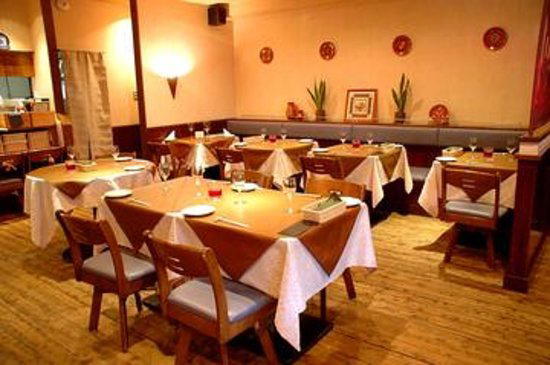
Warm, inviting, cozy atmosphere with controlled lighting, open kitchen, stylish and relaxing space.