



Gucci Osteria da Massimo Bottura Tokyo brings the Florentine fashion house's globally recognised restaurant format to Ginza, with a Michelin star confirming its place among the neighbourhood's serious Italian tables. Chef Antonio Iacoviello leads a kitchen where contemporary Italian technique meets a distinctly global sensibility, at a price point that sits a tier below Tokyo's ¥¥¥¥ omakase counters while delivering comparable critical recognition.
Pearl is the En Primeur Club membership app — saves, bookings, and concierge access live there. Same editors, same standards.
- Address
- 6 Chome-6-12 Ginza, 中央区 Chuo City, Tokyo 104-0061, Japan
- Phone
- +81 3-6264-6606
- Website
- gucciosteria.com
- Directions
- Get directions
 Saves & bookings on Pearl
Italian Fine Dining in Ginza: Where the Format Lands in Tokyo
Gucci Osteria da Massimo Bottura Tokyo is a 1-star Michelin restaurant in Ginza, Tokyo, with contemporary Italian cooking shaped by Japanese influences. The neighbourhood's dining tier has followed the same logic: the streets around 6-chome concentrate some of the city's most formally credentialled restaurants, where a Michelin star is table stakes rather than a differentiator. Into this context, Gucci Osteria da Massimo Bottura Tokyo occupies a specific and somewhat unusual position: a fashion-house restaurant that is also, by the standard measures, a serious dining destination in its own right.
The Gucci Osteria format originated in Florence as a collaboration between the Gucci brand and chef Massimo Bottura, whose three-Michelin-star Osteria Francescana in Modena is among the more documented restaurants in contemporary Italian cooking. The Tokyo outpost, along with branches in Beverly Hills, Dubai, and Seoul, extends that framework globally, with each kitchen led by a local executive chef interpreting the broader concept. In Tokyo, that responsibility sits with Chef Antonio Iacoviello. The 2024 Michelin star awarded to the Tokyo address confirms that the format travels with its critical standing intact.
What You Actually Get at This Price Point
The editorial angle here is value architecture. Tokyo's premium Italian tier, when you cross-reference it against the ¥¥¥¥ bracket occupied by addresses like Harutaka or L'Effervescence or RyuGin, involves a different set of commitments from the diner: longer lead times for reservations, no-choice tasting formats, and price-per-head figures that frequently exceed ¥50,000. Gucci Osteria sits at ¥¥¥, which in Ginza's competitive frame means it is priced against restaurants like Den rather than against the city's three-star counters.
What that price differential buys, or doesn't buy, is the right question. The Michelin single star places Gucci Osteria in a peer group that in Tokyo includes highly technical, often format-specific restaurants with strong critical consensus. The Michelin star adds a second credentialing layer.0 from 268 reviews is modest for a Michelin-starred address. That gap between critical recognition and broader consumer scoring is worth noting for anyone planning a visit: this is a kitchen that rewards guests who arrive with context about what contemporary Italian technique looks like in a global-format restaurant, rather than those expecting a more conventional trattoria experience.
For comparison, Aroma Fresca and AlCeppo both represent alternative approaches to Italian cooking in Tokyo, each with their own critical footing. PRISMA and ALTER EGO sit in Tokyo's innovative tier, while Principio addresses a more classically oriented Italian audience. Gucci Osteria's position among these is distinct: it is the one address where the brand identity of the parent company is a structurally present part of the dining environment, not a peripheral detail.
The Fashion-House Restaurant as a Format
The broader category of fashion-house restaurants is worth understanding before booking. These are not restaurants that happen to share a brand name with a fashion label. The Gucci Osteria format was conceived as a genuine culinary extension of the brand, which means the physical environment carries the house's visual codes, its green palette and archival references, into the dining room. The cuisine is positioned as playful and contemporary rather than formally regional, drawing on the Bottura kitchen's documented approach to Italian cooking: irreverence toward convention, technical precision in execution, and a tendency to treat Italian food history as material rather than scripture.
That approach places Gucci Osteria in the same broader category of Italian cooking as addresses like cenci in Kyoto, where the frame is contemporary and the reference points span beyond Italy. It diverges sharply from the more classically positioned end of Tokyo's Italian scene. Whether the fashion-house context adds or subtracts from the dining experience is a matter of personal preference, but it is not background noise. The Gucci identity is the concept, not decoration.
For context beyond Japan, 8 1/2 Otto e Mezzo Bombana in Hong Kong offers a useful comparative frame for how Italian fine dining operates at the summit tier of another major Asian city, with a different approach to formality and price.
Service Hours and Booking Logic
The restaurant is closed on Mondays and Tuesdays, operating Wednesday through Sunday with a lunch service from 11:30am to 3pm and a dinner service from 5pm to 11pm. The dual-service format on five days per week is operationally distinctive in Ginza's fine dining context, where many comparably credentialled addresses run dinner-only or limit lunch to a shorter set menu. The lunch window here represents a practical entry point: Michelin-starred Italian cooking at a ¥¥¥ price point during daytime hours in Ginza is a format that tends to attract a different guest profile than the evening service, and booking friction at lunch is typically lower than for prime dinner slots.
Tokyo's Italian Scene in a Broader Japan Context
Italian cooking has a longer and deeper history in Japan than most international visitors expect. The country's affinity for pasta technique, in particular, has produced a domestic tradition that diverges meaningfully from Italian precedent, with Tokyo functioning as the city where those influences concentrate most densely. In that context, a globally formatted Italian restaurant with direct lineage to one of Italy's most discussed chefs occupies a specific niche: it is not a Japanese interpretation of Italian cooking, nor a straightforwardly imported Italian restaurant. It is an Italian restaurant with a global operating model that has been awarded a Michelin star by the Tokyo guide, which applies its own exacting standards regardless of brand affiliation.
Elsewhere in Japan, the Italian influence takes different forms. akordu in Nara works with local Japanese ingredients through a European fine dining framework. HAJIME in Osaka and Gion Sasaki in Kyoto each represent the Japanese fine dining tradition at its most technically demanding, offering useful contrast for anyone building a multi-city Japan itinerary. Goh in Fukuoka, 1000 in Yokohama, and 6 in Okinawa each extend the picture of serious dining across Japan's geography.
Planning Your Visit: How It Compares
| Venue | Cuisine | Price Tier | Michelin | Days Open |
|---|---|---|---|---|
| Gucci Osteria da Massimo Bottura Tokyo | Italian (Contemporary) | ¥¥¥ | 1 Star (2024) | Wed–Sun |
| Den | Innovative Japanese | ¥¥¥ | 2 Stars | Varies |
| Crony | Innovative French | ¥¥¥¥ | 2 Stars | Varies |
| L'Effervescence | French | ¥¥¥¥ | 3 Stars | Varies |
| RyuGin | Kaiseki | ¥¥¥¥ | 3 Stars | Varies |
The table positions Gucci Osteria as the entry point into Michelin-recognised fine dining in Tokyo's international cuisine tier, at a price bracket that gives access to serious cooking without the full commitment of the city's ¥¥¥¥ counter formats. The five-day-per-week schedule with both lunch and dinner service adds flexibility that most comparably credentialled Ginza addresses do not offer.
What Gucci Osteria da Massimo Bottura Tokyo Is Known For
The kitchen's documented identity across the global Gucci Osteria network centres on contemporary Italian cooking that treats Italian regional traditions as reference points rather than constraints. The Bottura framework, established at Osteria Francescana, has produced dishes that reinterpret Italian classics through a technically precise and often conceptually self-aware lens. In Tokyo, that framework is applied by Chef Antonio Iacoviello, whose kitchen earned its Michelin star operating within the brand's broader culinary philosophy. The menu's character is contemporary Italian with Japanese influences, led by Chef Antonio Iacoviello and validated by the restaurant's Michelin star.
Compact Comparison
Comparable venues nearby, for context on price, style, and recognition.
| Venue | Cuisine | Price | Notes |
|---|---|---|---|
| Gucci Osteria da Massimo Bottura TokyoThis venue — the venue you are viewing | Italian | $$$$ | Not listed |
| Waketokuyama | Minato, Seasonal Omakase Kaiseki | $$$$ | Not listed |
| Il Ristorante - Niko Romito | Chūō, Contemporary Italian Fine Dining | $$$$ | Not listed |
| Primo Passo | Not listed | $$$$ | Chūō, Modern Italian with Japanese Ingredients |
| Principio | Minato, Modern Italian Fine Dining | $$$$ | Not listed |
| Kaiseki Komuro | Shinjuku, Traditional Cha-Kaiseki | $$$$ | Not listed |
Recognition history
Dated appearances from independent guides and award organizations, with the underlying list record or original source where available.
Gambero Rosso 2 Forchette
Gambero Rosso
Michelin 1 Star
Michelin
Opinionated About Dining Top Restaurants in Japan Recommended
Opinionated About Dining
Opinionated About Dining Top Restaurants in Japan Ranked #277
Opinionated About Dining
Tabelog 100 #18 · No. 18
Tabelog · Tabelog 100 - Italian - TOKYO - 2025
Michelin 1 Star
Michelin
Opinionated About Dining Top Restaurants in Japan Ranked #269
Opinionated About Dining










At a Glance
- Elegant
- Sophisticated
- Modern
- Ornate
- Trendy
- Date Night
- Special Occasion
- Celebration
- Business Dinner
- Private Dining
- Design Destination
- Hotel Restaurant
- Extensive Wine List
- Sake Program
- Craft Cocktails
Current opening hours
- Monday
- Closed
- Tuesday
- 11:30 AM–3 PM, 5–11 PM
- Wednesday
- 11:30 AM–3 PM, 5–11 PM
- Thursday
- 11:30 AM–3 PM, 5–11 PM
- Friday
- 11:30 AM–3 PM, 5–11 PM
- Saturday
- 11:30 AM–3 PM, 5–11 PM
- Sunday
- 11:30 AM–3 PM, 5–11 PM
Hours can change for holidays and private events. Last verified .
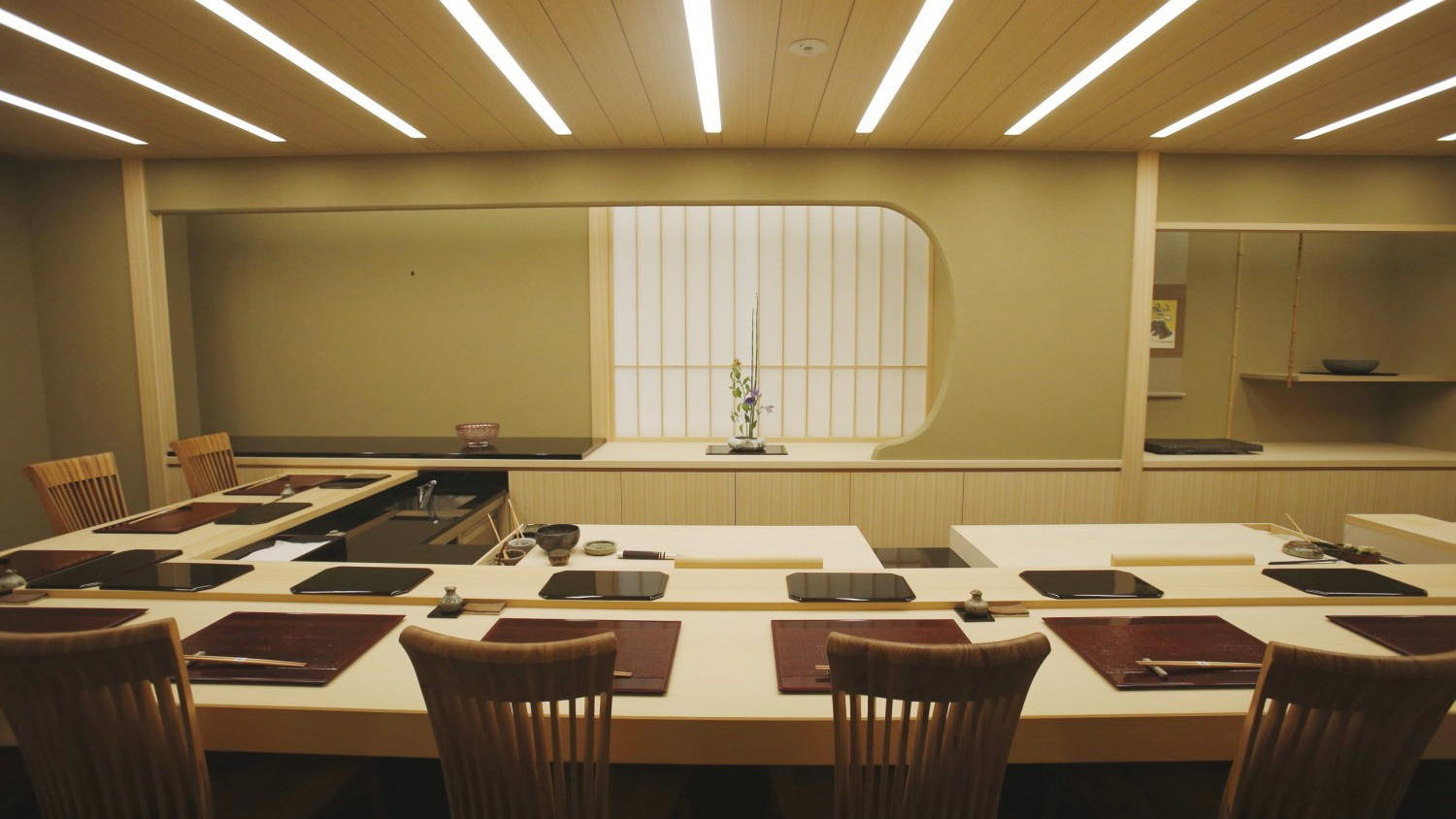
Luxurious and sophisticated with Gucci's signature green tones, emerald seats, stylish Western European furniture, and relaxing spacious seating.