

Michelin Bib Gourmand · Tabelog 100 #3
Our verdict
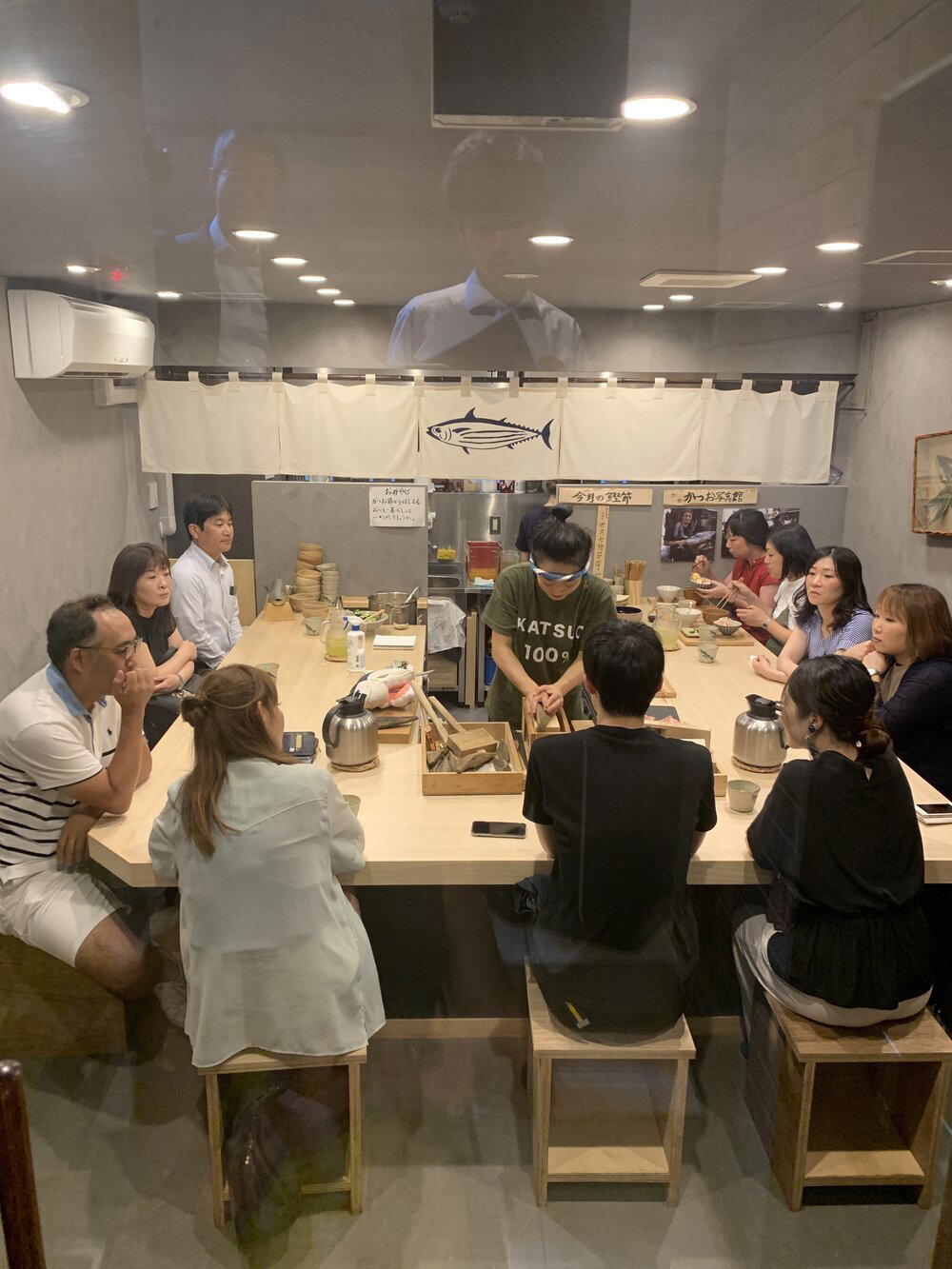
A Michelin Bib Gourmand counter in Shibuya's GranDuo building where a single ingredient, katsuobushi, structures the entire set menu. The chef's bonito shaver sits at the centre of service, and the meal moves from grilled bonito through shaved bonito on rice to a closing miso broth. At the ¥ price point, this is one of Tokyo's most focused expressions of Japanese larder tradition.

Pearl is the En Primeur Club membership app, where members save venues, book tables and use the concierge.
The menu
What to order
- Freshly Shaved Bonito Set Meal
- Grilled Bonito
- Bonito Flakes over Rice
A Single Ingredient, Seriously Considered
Tokyo's restaurant culture rewards specialists. The city has long sustained counters and shokudo built around one product, eel at a kabayaki-ya, tofu at a yudofu specialist, clams at a hamaguri house, and the rigour applied to that single ingredient often exceeds what broader menus achieve across a dozen. Katsuo Shokudo, in the basement of the GranDuo building in Shibuya's Uguisudani district, belongs firmly in that specialist tradition. The subject here is katsuobushi: dried, fermented, smoked bonito shavings that underpin Japanese cooking as completely as butter underpins French sauces, yet rarely receive the focused attention given to them here.
The eye settles immediately on the bonito shaver positioned at the centre of the counter. That placement is a deliberate editorial statement about what the meal will be. Where other counters display knife rolls or sake collections as visual anchors, this one foregrounds the tool that converts a dried loaf of cured bonito into the translucent, trembling flakes that flavour the broth, finish the rice, and define the experience. In Tokyo's broader dining scene, where RyuGin and Kagurazaka Ishikawa operate at the kaiseki register and counter sushi like Myojaku commands multi-course premium pricing, Katsuo Shokudo occupies a different position entirely: affordable, ingredient-specific, and quietly instructive about the depth of Japanese food culture.
The Set Menu as Argument
The format here is a set menu structured entirely around bonito in its various states. Grilled bonito anchors the main course, placing the fish in its most direct, least processed form. Shaved katsuobushi over rice follows, shifting the ingredient register toward the dried and fermented expression that most diners encounter only as a background flavour in dashi. The meal closes with miso soup made from bonito broth, which reframes what might feel like a supporting dish into the conclusion of an argument: that katsuobushi is complex enough to carry a meal from first course to last without repetition or exhaustion.
This progression is not accidental. The sequence moves from recognisable (grilled fish) through transformed (shaved dried bonito) to foundational (broth), giving diners a structured education in how a single product changes character across different applications. At the ¥ price tier, where comparison venues like Jingumae Higuchi and Ginza Fukuju operate at considerably higher price points, this level of conceptual coherence is notable. The Michelin Bib Gourmand recognition in 2024 confirms what the format already implies: that the value proposition here is genuine and the cooking is taken seriously by the guide's inspectors.
The Counter as Teaching Space
Counter dining in Tokyo often functions as implicit theatre, the diner watches technique, the chef performs precision, and the space between them carries meaning. At Katsuo Shokudo, that dynamic tilts slightly toward something closer to education. The shaving of katsuobushi at the counter is not incidental to service; it is service. The chef's connection to the ingredient is, by the venue's own account, rooted in her grandmother's miso soup, a domestic origin story that positions katsuobushi not as a restaurant ingredient but as household patrimony refined into focused practice.
This framing matters because it shapes how the front-of-house encounter works. The stories told during service about katsuobushi's history and production, how bonito is cured through a process of repeated smoking and mould cultivation over months, how the grade and shave thickness alter flavour and texture, how regional traditions in Japan differ in their approach to the ingredient, are as much a part of the experience as the food itself. That kind of narrative integration between the kitchen and the counter is what separates ingredient-specialist formats from ordinary lunch counters. Tokyo has examples of this in the kaiseki tradition through venues like Azabu Kadowaki, but those operate at a price and formality level that filters their audience considerably. Katsuo Shokudo makes the same depth of ingredient focus available at a fraction of the cost.
Shibuya Basement, Accessible Register
The GranDuo building in Uguisudanicho is not Shibuya's obvious dining address. The neighbourhood sits just north of Shibuya's main scramble zone, and the basement restaurant location places Katsuo Shokudo in a setting that prioritises the food over the address. That positioning is consistent with the Bib Gourmand tier across Tokyo more broadly: the guide's inspectors have long rewarded venues that channel their resources into the plate rather than the postcode.
For visitors building a Tokyo itinerary that spans price points and registers, perhaps combining a kaiseki counter like Kagurazaka Ishikawa with more accessible specialist formats, Katsuo Shokudo represents the kind of stop that adds genuine culinary intelligence to a trip rather than simply adding a meal. Across Japan more broadly, similar values of ingredient focus and affordable precision appear at venues like Goh in Fukuoka and akordu in Nara, each working within tight conceptual frames to significant effect. For context on the wider range of Tokyo dining at the Michelin-recognised tier, venues like HAJIME in Osaka and Gion Sasaki in Kyoto offer useful regional comparisons for how Japanese ingredient traditions are being re-examined across the country.
Those planning a wider Tokyo visit can reference our full Tokyo restaurants guide, as well as our full Tokyo hotels guide, our full Tokyo bars guide, our full Tokyo wineries guide, and our full Tokyo experiences guide for broader itinerary context. Additional specialist Japanese counter dining worth considering includes Isshisoden Nakamura in Kyoto and Kashiwaya Osaka Senriyama, both of which work within the kaiseki tradition that katsuobushi so fundamentally supports. For those staying in the broader Kanto region, 1000 in Yokohama and 6 in Okinawa extend the range of specialist Japanese formats worth considering.
Planning Your Visit
Katsuo Shokudo is located in the basement of GranDuo Shibuya at 7-12 Uguisudanicho, Shibuya, Tokyo. The venue holds a Michelin Bib Gourmand (2024) and operates at the ¥ price tier. The set menu format means walk-in availability is unlikely to be consistent; advance booking is the practical approach.
Quick reference:
Frequently asked questions
Is Katsuo Shokudo award-winning?
Katsuo Shokudo has received recognition including: The eye is drawn to the shaver placed at the centre of the counter. The chef first encountered katsuobushi through the deliciousness of miso soup prepared by her grandmother. Overlaying her own image with that of her grandmother, she gently….
What should I eat at Katsuo Shokudo?
The set menu is the only format, structured around bonito across three registers: grilled bonito as the main course, shaved katsuobushi over rice, and miso soup made with bonito broth. The shaving itself is a counter-side ritual, the chef works the katsuobushi block by hand, tracing a method rooted in her grandmother's kitchen. There is no à la carte decision to make; the menu is the argument.
What does dinner at Katsuo Shokudo typically cost?
Pricing at Katsuo Shokudo is listed as ¥.
A Pricing-First Comparison
A quick peer reference to anchor this venue in its category.
| Venue | Cuisine | Price | Awards | Notes |
|---|---|---|---|---|
| Katsuo ShokudoThis venue (the venue you are viewing) | Bonito Specialty Japanese Cafeteria | $20–30 | Michelin Bib Gourmand · Tabelog 100 #3 | Not listed |
| Harutaka | Edo-Style Omakase Sushi | $200–300 | 3 Michelin Stars · World's 50 Best #76 | Sushi |
| RyuGin | Modern Kaiseki | $500+ | 3 Michelin Stars · World's 50 Best #41 | Kaiseki, Japanese |
| L'Effervescence | Modern French with Japanese Influences | $200–300 | 3 Michelin Stars · World's 50 Best #69 | French |
| HOMMAGE | Modern French with Japanese Influences | $150–200 | 2 Michelin Stars · World's 50 Best #78 | Innovtive French, French |
| MAZ | Innovative Peruvian-Japanese Fusion | $150–200 | 2 Michelin Stars · World's 50 Best #28 | Innovative |
Recognition history
Dated appearances from independent guides and award organizations, with the underlying list record or original source where available.
Michelin Bib Gourmand
Michelin
Tabelog 100 #3 · No. 3
Tabelog · Tabelog 100 - Diner - 2026
Full recognition history (3 entries)
Michelin Bib Gourmand
Michelin
Continue exploring
More in Tokyo
Restaurants in Tokyo
All restaurants in Tokyo →


Bars in Tokyo
All bars in Tokyo →






Details
- Quiet
- Cozy
- Minimalist
- Solo
- Family
- Casual Hangout
- Sake Program
- Set Menu
Current opening hours
- Monday
- 8:30 AM–1 PM
- Tuesday
- 8:30 AM–1 PM
- Wednesday
- Closed
- Thursday
- Closed
- Friday
- 8:30 AM–1 PM
- Saturday
- 8:30 AM–1 PM
- Sunday
- 8:30 AM–1 PM
Hours can change for holidays and private events. Hours as of .
Quiet counter seating with a minimalist, sunlit terrace-like atmosphere filled with the gentle aroma of dashi and soft murmurs of diners.