




3 Michelin Stars · La Liste Top Restaurants · The Best Chef Two Knives
Our verdict
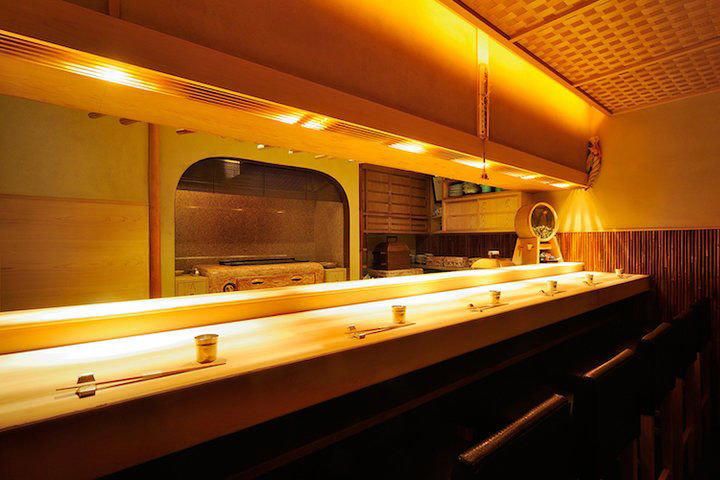
Azabu Kadowaki holds three Michelin stars and scores 92 points on La Liste 2026, operating from a six-seat counter in Azabu-Juban that draws direct comparisons with the tea-ceremony tradition. Chef Toshiya Kadowaki builds seasonal Japanese menus around transient ingredient pairings, with truffle rice among the dishes cited most often by guests and critics. Evenings run Tuesday through Saturday from 17:30.

Pearl is the En Primeur Club membership app, where members save venues, book tables and use the concierge.
The menu
What to order
- Truffle Rice
- Fried Shark Fin
- Somen Noodles with Sea Urchin and Caviar
A Counter Built on Tea-Ceremony Principles
Tokyo's top-tier kaiseki and Japanese fine dining rooms have spent the past decade splitting into two distinct formats: the theatrical multi-room establishment where ceremony is performed at scale, and the deliberately contracted counter where physical intimacy is the entire argument. Azabu Kadowaki belongs firmly to the second school. The six-seat counter at 2 Chome-7-2 Azabujuban in Minato City is not a design choice made for trend-following reasons, it reflects a structural philosophy rooted in the spirit of the tea ceremony, where the proportions of a room determine the quality of attention that can be given and received. La Liste, which ranked the restaurant at 92 points in both its 2025 and 2026 editions, described the counter distance between guest and chef as calibrated, and the private room's low ceiling as deliberately suggestive of a tearoom, intimate to the point where guests can register each other's breathing. That is a very specific kind of spatial ambition.
The tea-ceremony connection matters here not as decoration but as operating logic. In that tradition, the host's awareness of every element, the season, the vessel, the temperature of the room, the guest's presence, is the discipline. Applied to a six-seat counter, it produces a dining format where the ratio of chef attention to guest is structurally higher than at peer three-Michelin-star restaurants operating at thirty or forty covers. For context, three-star rooms such as RyuGin operate with considerably larger brigades and cover counts; the Azabu Kadowaki model pushes further toward the micro-format end of the spectrum, closer in some ways to the private dining rooms that define the upper bracket of Kyoto kaiseki than to a conventional Tokyo restaurant.
Seasonal Ingredients and the Logic of Fleeting Combinations
The menu at Azabu Kadowaki is organised around a principle that is easier to state than to execute: ingredients in season, brought together to create sensations that are by nature temporary. This is not an unusual ambition in Japanese fine dining, but the specific editorial framing from La Liste, "fleeting sensations that linger in the memory", points at something more precise than standard seasonality marketing. The implication is that the combinations are not repeatable in the same form; the dish exists because two or three ingredients happen to align at a specific moment in the calendar, and the job of the kitchen is to recognise that alignment and act on it.
Dish most consistently cited across critical and guest sources is truffle rice, described in the La Liste record as enriching the meal in both aroma and flavour. Truffle appears in Japanese fine dining with increasing frequency, but its use here as a rice component rather than a protein garnish places it in a different register, one where it functions as a structural part of a course rather than a finishing luxury. This kind of ingredient repositioning is characteristic of the better contemporary kaiseki counters in Tokyo, where European luxury ingredients are absorbed into Japanese formats rather than imported wholesale.
Where Sake and the Beverage Programme Connect
Beverage tradition at counters of this scale and format in Tokyo has shifted considerably over the past decade. Where international wine lists once dominated fine dining in the city, the movement toward sake pairing at kaiseki and Japanese-format restaurants has become significant enough that some three-star kitchens now build their menus partly around what specific junmai daiginjo or koshu expressions can do to a given course. The spatial intimacy of a six-seat counter is, logically, the format well suited to this kind of beverage integration: the chef and guest are close enough that pacing, temperature, and the sequencing of drinks can be handled with a granularity that is simply not possible at larger covers.
Sake's structural role in a pairing context at this level of Japanese dining is distinct from wine's. Where wine pairing often works through contrast or complementary flavour bridging, sake pairing at a kaiseki counter tends to work through register alignment, matching the weight, minerality, and umami depth of a sake to the dashi intensity or fat content of a given course. A delicate shinko (young yellowtail) preparation calls for a lighter, more aromatic ginjo; a simmered dish with concentrated broth can take a fuller, aged koshu without either element overpowering the other.
For guests planning around beverages, the Azabu Kadowaki counter format means the conversation with the chef or service team about pairing preferences is not a sidebar, it is built into the physical structure of the meal. Six guests, one counter, and courses timed to the kitchen's output: this is, in effect, a private pairing dinner at the scale of a small club.
Awards Position and Critical Standing
The awards record here is specific and worth reading carefully. Azabu Kadowaki holds three Michelin stars in both 2024 and 2025, scored 92.5 points on La Liste 2025 and 92 points on La Liste 2026, and carries a Tabelog Bronze Award with a score of 3.85, a score that places it in the upper tier of Tokyo's Japanese restaurants on that platform, which skews conservative by design.
What differentiates Azabu Kadowaki within that peer group is the counter scale, six seats places it at the contracted end of the format range, with structural consequences for how the meal is paced and how much chef-to-guest attention is available per cover. Rooms like Myojaku and Jingumae Higuchi work in related Japanese fine dining registers and are worth considering alongside Azabu Kadowaki when building a Tokyo dining itinerary at this price tier.
Planning a Visit
Azabu Kadowaki operates Tuesday through Saturday, with service beginning at 17:30 and last orders at 22:00. The Azabu-Juban address puts the restaurant in Minato City, one of Tokyo's higher-density fine dining wards, where three-star and two-star rooms cluster around the Azabu, Roppongi, and Hiroo neighbourhoods. The price range is ¥¥¥¥, consistent with the Tokyo three-star bracket, and the counter's six-seat capacity means availability is structurally limited rather than circumstantially so. Advance planning is essential; the Tabelog record confirms the phone number as 03-5772-2553 for those booking directly. Guests who want to layer additional reservations around the visit will find Kioicho Fukudaya and the broader Tokyo restaurant guide useful for building out a full stay. For context on how Tokyo's fine dining compares to other Japanese cities, HAJIME in Osaka, Gion Sasaki in Kyoto, akordu in Nara, Goh in Fukuoka, 1000 in Yokohama, and 6 in Okinawa each represent the formal dining culture of their respective cities. For planning beyond restaurants, the Tokyo hotels guide, Tokyo bars guide, Tokyo wineries guide, and Tokyo experiences guide cover the rest of the city's premium offer.
Two further Japanese restaurants worth cross-referencing for their kaiseki depth are Isshisoden Nakamura in Kyoto and Kashiwaya Osaka Senriyama in Osaka, both of which operate in the formal seasonal Japanese tradition and sit at comparable award levels.
Frequently asked questions
What do people recommend at Azabu Kadowaki?
Truffle rice is the dish most consistently cited by critics and guests across La Liste editorial, Tabelog reviews, and the broader written record. La Liste specifically describes it as enriching the meal in both aroma and flavour, its placement as a rice course rather than a protein garnish sets it apart from how truffle tends to function in European fine dining contexts. Beyond that specific dish, the seasonal Japanese menu is built around transient ingredient pairings, so what is served changes with the calendar; the six-seat counter and tea-ceremony-influenced format mean that Chef Toshiya Kadowaki's three-Michelin-star kitchen is operating at very close range to each guest throughout the meal. The Opinionated About Dining ranking (number 127 in Japan for 2024, number 142 in 2025) and the Tabelog Bronze Award with a 3.85 score both reflect sustained approval across a wide base of critical and guest opinion rather than a single notable dish or moment.
In Context: Similar Options
| Venue | Cuisine | Price | Awards | Notes |
|---|---|---|---|---|
| Azabu KadowakiThis venue (the venue you are viewing) | Modern Japanese Kaiseki with Truffle Rice | $300–500 | 3 Michelin Stars · La Liste Top Restaurants | Not listed |
| Harutaka | Edo-Style Omakase Sushi | $200–300 | 3 Michelin Stars · World's 50 Best #76 | Sushi |
| RyuGin | Modern Kaiseki | $500+ | 3 Michelin Stars · World's 50 Best #41 | Kaiseki, Japanese |
| L'Effervescence | Modern French with Japanese Influences | $200–300 | 3 Michelin Stars · World's 50 Best #69 | French |
| HOMMAGE | Modern French with Japanese Influences | $150–200 | 2 Michelin Stars · World's 50 Best #78 | Innovtive French, French |
| MAZ | Innovative Peruvian-Japanese Fusion | $150–200 | 2 Michelin Stars · World's 50 Best #28 | Innovative |
Recognition history
Dated appearances from independent guides and award organizations, with the underlying list record or original source where available.
Michelin 3 Stars
Michelin
La Liste Top Restaurants
La Liste
Opinionated About Dining Top Restaurants in Japan Highly Recommended
Opinionated About Dining
Tabelog 100 #60 · No. 60
Tabelog · Tabelog 100 - Japanese cuisine - TOKYO - 2025
The Best Chef Two Knives
The Best Chef
Full recognition history (12 entries)
La Liste Top Restaurants
La Liste
Michelin 3 Stars
Michelin
Opinionated About Dining Top Restaurants in Japan Ranked #142
Opinionated About Dining
Tabelog Bronze
Tabelog
Michelin 3 Stars
Michelin
Opinionated About Dining Top Restaurants in Japan Ranked #127
Opinionated About Dining
Opinionated About Dining Top Restaurants in Japan Highly Recommended
Opinionated About Dining
Continue exploring
More in Tokyo
Restaurants in Tokyo
All restaurants in Tokyo →



Bars in Tokyo
All bars in Tokyo →





Details
- Elegant
- Intimate
- Sophisticated
- Special Occasion
- Business Dinner
- Date Night
- Chefs Counter
- Private Dining
- Sake Program
- Tasting Menu
- Omakase
- Counter Dining
- Sake Program
- Vegetarian Friendly
Current opening hours
- Monday
- 5:30 AM–11 PM
- Tuesday
- 5:30 AM–11 PM
- Wednesday
- 5:30 AM–11 PM
- Thursday
- 5:30 AM–11 PM
- Friday
- 5:30 AM–11 PM
- Saturday
- 5:30 AM–11 PM
- Sunday
- 5:30 AM–11 PM
Hours can change for holidays and private events. Hours as of .
Refined and intimate with a counter seating 6 and private rooms featuring low ceilings evoking a traditional tearoom atmosphere, offering an elegant hideaway setting.