Our verdict
Hakushū Teppanyaki occupies a ground-floor address in Shibuya's Sakuragaokachō, a neighbourhood that has quietly become one of Tokyo's more concentrated pockets of specialist dining. The teppanyaki format here fits a city where counter cooking and direct chef-to-guest interaction have long defined the premium end of the market. Arrive with time to settle into the space before the iron plate takes over.

Pearl is the En Primeur Club membership app — saves, bookings, and concierge access live there. Same editors, same standards.
The menu
What to order
- Kobe Beef Sirloin
- Kobe Beef Fillet
- Garlic Fried Rice
The Counter as Stage: Teppanyaki in Tokyo's Shibuya Ward
In Tokyo's hierarchy of counter-driven dining, teppanyaki occupies a distinct and often underappreciated tier. Where omakase sushi counters like Harutaka place the chef's knife-work at the centre of attention, and kaiseki rooms like RyuGin frame each course within a seasonal narrative, teppanyaki makes the cooking itself the spectacle. The iron griddle is both kitchen and theatre, and the physical proximity between cook and guest is non-negotiable. That architecture of intimacy is the defining structural feature of the format, regardless of which restaurant you are sitting in.
Hakushū Teppanyaki sits in Sakuragaokachō, a sub-district of Shibuya that has drawn enough specialist restaurants to function as a genuine dining neighbourhood rather than simply an overflow from the main commercial grid. The address is ground-floor, which matters in a city where basement and upper-floor venues can feel deliberately removed from the street. Ground-floor teppanyaki rooms tend to operate with a slightly different energy: the street is closer, the light is different at dusk, and the spatial relationship between room and city feels less sealed-off than the subterranean counters that populate so much of central Tokyo's premium dining.
The Physical Logic of a Teppanyaki Room
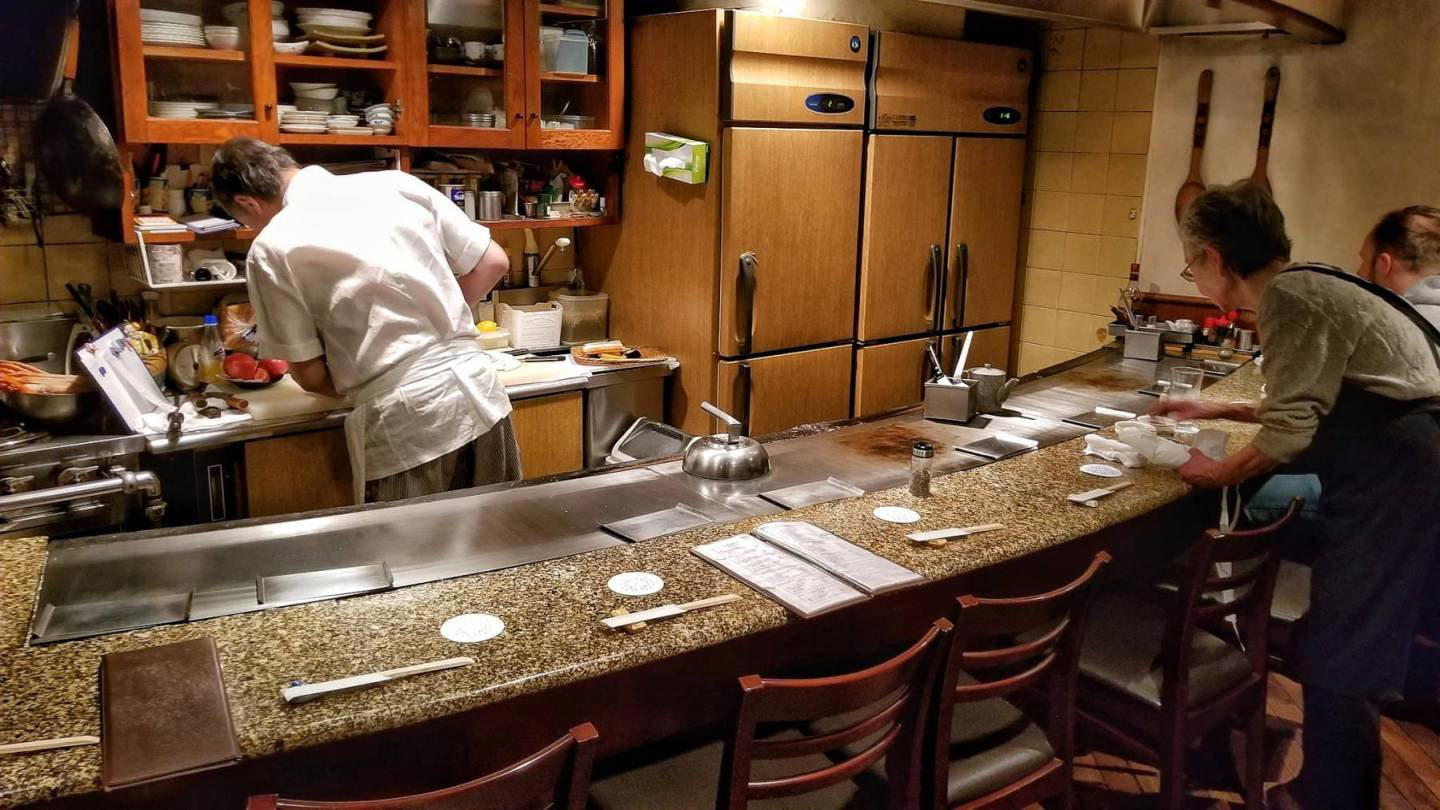
The design logic of a teppanyaki counter is more constrained than most other formats, and that constraint produces something architecturally specific. The iron plate is fixed; the chef cannot move away from it. Guests arrange themselves around three sides at most, and often just one or two, meaning every seat is, in effect, a front-row position. There is nowhere to hide a less interesting vantage point, and no seat hierarchy of the kind that defines larger dining rooms.
This physical arrangement has practical consequences. Sight lines are short and deliberate. The visual field for a seated guest is dominated by the surface of the griddle, the movement of the chef's hands, and whatever proteins and vegetables are mid-preparation at any given moment. Sound is part of the contract: the sear of fat against iron, the adjustment of temperature controls, the occasional flicker of flame. Japanese teppanyaki rooms generally absorb this noise through careful material choices, with timber, stone, or lacquered surfaces doing acoustic work that open-plan Western steakhouses rarely attempt.
For a format built on spectacle, the leading teppanyaki interiors in Tokyo tend to suppress decoration. The griddle is the focal point, and anything that competes with it is a design error. This keeps the material palette narrow: dark wood, brushed metal, neutral stone, minimal wall art. The effect is that the cooking itself becomes the room's moving element, the thing that changes while everything else stays still.
Shibuya's Quieter Dining Geography
Sakuragaokachō sits on the south-western slope of Shibuya Station's immediate catchment, and its character diverges noticeably from the station's noisier commercial face. The street grid here is finer, the buildings lower, and the rhythm of foot traffic slower. It is the kind of location that rewards guests who arrive a few minutes early and walk the block rather than descending directly from the station exits.
Shibuya as a whole has been repositioning its upper-tier dining offer over the past decade. The ward now holds a range of formats across French, Japanese, and hybrid traditions. L'Effervescence and Sézanne represent the French end of Tokyo's premium counter dining, while more experimental addresses like Crony have introduced hybrid French-Japanese approaches that complicate easy category distinctions. Teppanyaki sits outside all of these reference points. It is neither a borrowed European format nor a codified Japanese tradition in the way that kaiseki or sushi are. It is something more specific to mid-twentieth-century Japan, designed for a particular kind of theatrical generosity toward guests.
Teppanyaki in the Context of Japan's Broader Counter Culture
Tokyo is the most obvious entry point for Japan's counter-dining traditions, but the format extends across the country in ways that are worth understanding before visiting any single address. HAJIME in Osaka and Gion Sasaki in Kyoto demonstrate how premium Japanese restaurants in other cities have built distinct identities around fixed counter formats, even where the cuisine type differs entirely from teppanyaki. Further afield, akordu in Nara and Goh in Fukuoka show how the counter model has been adopted and adapted across regional Japan, each with a different relationship to local ingredients and cooking traditions.
Specialty teppanyaki, at its strongest, draws on Wagyu beef from specific prefectural producers, seasonal seafood, and vegetables that shift with the calendar. This is not a format built on a fixed menu. The better rooms change their sourcing regularly and treat the griddle as a precision instrument rather than simply a heat source. The difference between a restaurant using its iron plate as a cooking surface and one using it as a tool for exact temperature management across multiple ingredients is significant, and it tends to show up in the texture of proteins and the caramelisation of surfaces in ways that are immediately legible to an attentive guest.
For those building a wider picture of Japan's specialist dining, the restaurants in Nanao, Sapporo, Takashima, and Nishikawa Machi offer context for how regional cooking traditions sit alongside the Tokyo-centric narrative that dominates most international coverage. Birdland in Sakai and Bistro Ange in Toyohashi extend the picture further into the speciality and regional bistro categories.
For international comparison, the counter-driven precision of Le Bernardin in New York City and the tasting-counter format of Atomix illustrate how similar spatial philosophies produce very different results depending on culinary tradition and cultural context.
Our full Tokyo restaurants guide maps the city's premium dining across formats, neighbourhoods, and price tiers for those planning a more comprehensive visit.
Know Before You Go
Location: Sakuragaokachō, Shibuya, Tokyo (ground floor, MCD Building 1F)
Format: Teppanyaki counter
Neighbourhood: South-west of Shibuya Station; walkable from the Sakuragaoka exits
Booking: Contact details not currently listed; check third-party reservation platforms for availability
Price tier: Not confirmed in; teppanyaki at this address tier and neighbourhood typically sits in the mid-to-upper range for Tokyo counter dining
Dress: Smart casual is appropriate for most Tokyo teppanyaki counters at this level
Frequently asked questions
What do people recommend at Hakushū Teppanyaki?
The teppanyaki format centres on griddle-cooked proteins and vegetables prepared in front of guests at the counter. Across Tokyo's teppanyaki rooms at this address tier, Wagyu beef preparations and seasonal seafood are the most consistently ordered items.
How hard is it to get a table at Hakushū Teppanyaki?
Shibuya teppanyaki counters at the specialist end of the market rarely hold large seat counts, which means availability can tighten quickly around weekends and public holidays. Tokyo's premium counter dining scene, across sushi, kaiseki, and teppanyaki alike, generally rewards advance planning: addresses in this neighbourhood and format tier often work through reservation platforms or direct contact.
Is Hakushū Teppanyaki suitable for a special occasion dinner in Tokyo?
The teppanyaki counter format, with its fixed seating arrangement and chef-facing orientation, is structurally well-suited to occasions where the meal itself is the event rather than the backdrop. In Tokyo's Shibuya ward, ground-floor counter restaurants in the Sakuragaokachō area tend to draw a mix of local regulars and visitors with a specific interest in the format rather than walk-in trade. For those comparing this format against other special-occasion options in the city, the kaiseki counter at RyuGin and the sushi counter at Harutaka represent adjacent tiers with different cuisine traditions but a comparable commitment to counter-led hospitality.
Reputation First
Comparable venues nearby, for context on price, style, and recognition.
| Venue | Cuisine | Price | Awards | Notes |
|---|---|---|---|---|
| Hakushū TeppanyakiThis venue — the venue you are viewing | Kobe Beef Teppanyaki | $50–100 | Not listed | Not listed |
| Matsuki Ya | Traditional Sukiyaki with Kuroge Wagyu | $50–100 | Tabelog 100 #10 | Shibuya |
| カサハラ | Traditional Yakitori Omakase | $200–300 | Tabelog Gold #11 | Minato |
| Sushi Oochi | Traditional Sushi Omakase | Not listed | Not listed | Minato |
| Iwasawa | Edo-style Omakase Sushi | $200–300 | Tabelog 100 #14 | Shinagawa |
| green glass | Handmade Soba & Shizuoka Sake | $50–100 | Tabelog 100 #2 | Shinjuku |
Continue exploring
More in Tokyo
Restaurants in Tokyo
All restaurants in Tokyo →



Bars in Tokyo
All bars in Tokyo →








Details
- Intimate
- Elegant
- Cozy
- Date Night
- Special Occasion
- Chefs Counter
- Open Kitchen
- Sake Program
- A La Carte
- Counter Dining
Current opening hours
- Monday
- Closed
- Tuesday
- 5:30–10:30 PM
- Wednesday
- 5:30–10:30 PM
- Thursday
- 5:30–10:30 PM
- Friday
- 5:30–10:30 PM
- Saturday
- 5:30–10:30 PM
- Sunday
- 5:30–10:30 PM
Hours can change for holidays and private events. Last verified .
Cozy and warm with the sizzle of the grill and aromas of garlic butter and cognac-infused Kobe beef creating an engaging atmosphere.