
1 Michelin Star
Our verdict
A Michelin-starred kaiseki counter in the residential quiet of Meguro, Yakumo Uezu operates at the intersection of classical Japanese technique and restless experimentation. The kitchen draws on an Okinawan culinary heritage, evident in Miyako miso and brown sugar preparations, while integrating Western ingredients including caviar and truffles.

Pearl is the En Primeur Club membership app, where members save venues, book tables and use the concierge.
Getting to Yakumo Uezu: What the Location Tells You About the Restaurant
Meguro's residential streets are not where Tokyo's dining press usually looks. The area sits south of Shibuya's commercial pull and west of the kaiseki corridor that runs through Minami-Azabu and Hiroo. That geography is the first thing a prospective diner should understand: Yakumo Uezu is not positioned for discovery. It rewards deliberate pursuit.
The address, 1 Chome-3-9 Yakumo, Meguro City, sits in one of Tokyo's quieter residential pockets, the kind of block where lunch counters are scarce and the surrounding streets function as context rather than competition. For visitors, that means planning the trip with more precision than a centrally located room would require. Factor in the journey from central Tokyo, verify opening times directly before booking, and treat the reservation as the fixed point around which the rest of your day is arranged.
The Competitive Position: One Star in a City of Many
Tokyo has more Michelin stars than any other city on earth, and the ¥¥¥ price tier sits in an interesting middle register. Rooms like Kagurazaka Ishikawa and Azabu Kadowaki represent the higher end of traditional kaiseki ambition, while newer formats such as Myojaku push the category in different directions. Yakumo Uezu occupies a distinct position within this field: a one-star room operating at the ¥¥¥ tier with an approach that is neither purely classical nor straightforwardly fusion, but something closer to an ongoing personal experiment with Japanese form.
The comparison is worth extending beyond Tokyo. Across Japan, a cohort of single-star rooms is doing the more interesting conceptual work precisely because they are not constrained by the expectations that come with higher ratings and higher prices. Goh in Fukuoka and akordu in Nara operate in this same creative register. At the two- and three-star level, rooms like HAJIME in Osaka carry a different kind of institutional weight. Yakumo Uezu is closer in spirit to the former group: driven by invention, lighter on ceremony.
What the Menu Tells You About the Philosophy
The Michelin citation for Yakumo Uezu is more descriptive than most. It notes that the chef works with unwritten recipes, meaning the menu is not a fixed document but an evolving practice, dishes developed and refined without the safety net of a standardised written form. That is an unusual working method in any kitchen, and a significant practical signal for the diner: what arrives at the table on a given evening reflects the kitchen's current thinking, not an archived version of it.
Approach to sashimi is individual rather than collective. Each piece is seasoned separately, which is not standard practice even at starred counters where fish quality is the primary signal. This kind of per-piece attention to seasoning implies a kitchen interested in the specific character of each cut rather than in a uniform presentation.
Okinawan lineage is evident in preparations involving Miyako miso and brown sugar, used to marinate beef. Miyako is a traditional Okinawan miso with a deeper, slightly sweeter fermented profile than the more common Kyoto white or Sendai red varieties. Its appearance in a Tokyo kaiseki counter reflects a regional specificity that is not common in the capital's more homogenised high-end dining scene. Western ingredients, caviar, truffles, appear alongside these regional Japanese elements, but the Michelin framing positions them as absorbed into an expanded Japanese cuisine rather than presented as contrast or novelty. Dishes like takikomi-gohan (rice cooked with ingredients incorporated during the boiling process) and pureed vegetable soup suggest the menu also retains grounding in classical Japanese home cooking forms, even as the broader register pushes outward.
For reference within the Tokyo landscape, Ginza Fukuju and Jingumae Higuchi represent other starred rooms where the cuisine is in active dialogue with tradition rather than simply executing it. The category of Japanese restaurants in Tokyo that genuinely extend the form, rather than refine it within established parameters, is smaller than the city's overall star count suggests.
Planning the Booking
Booking information for Yakumo Uezu is not centrally published in English-language sources. That means securing a table requires either a Japanese-speaking contact, a hotel concierge with established relationships in the city, or a specialised reservation service. For visitors without those resources, this is the practical constraint that most needs solving before anything else.
Tokyo's better-known concierge desks at luxury hotels have long-standing relationships with starred counters that do not accept direct international bookings. If your accommodation lacks that infrastructure, specialist services that operate specifically in the Tokyo fine dining market are a more reliable route than attempting contact directly.
Timing within Tokyo's dining calendar is also worth considering. Booking three to four weeks ahead is a reasonable planning assumption for a one-star room at this price tier, though this can compress further during major holiday periods.
For broader context on where Yakumo Uezu sits within Tokyo's dining map, see our full Tokyo restaurants guide. If you are building a wider Japan itinerary, Gion Sasaki in Kyoto, Isshisoden Nakamura in Kyoto, Kashiwaya Osaka Senriyama, and 1000 in Yokohama are rooms worth considering at comparable or adjacent tiers. For Okinawa specifically, 6 in Okinawa offers useful regional context for the culinary traditions informing this kitchen.
Explore further with our full Tokyo hotels guide, our full Tokyo bars guide, our full Tokyo wineries guide, and our full Tokyo experiences guide.
Know Before You Go
- Location: 1 Chome-3-9 Yakumo, Meguro City, Tokyo 152-0023, Japan
- Cuisine: Japanese (creative, Okinawa-influenced)
- Price tier: ¥¥¥
- Awards: Michelin 1 Star (2024)
- Booking: Recommend hotel concierge or specialist reservation service
- Dress code: Not published; smart casual is appropriate for a starred counter in this context
- Languages: English-language booking and service not confirmed; concierge assistance advised
Frequently asked questions
What dish is Yakumo Uezu famous for?
Yakumo Uezu does not have a single fixed signature dish in the way some counters anchor their identity around one preparation. The kitchen operates with unwritten recipes that evolve over time, making any single item a snapshot rather than a constant. What the Michelin record identifies as characteristic: individually seasoned sashimi, beef marinated in Miyako miso and brown sugar (reflecting the chef's Okinawan background), takikomi-gohan, and pureed vegetable soup. The incorporation of caviar and truffles into an otherwise Japanese framework is also noted as part of the kitchen's current direction.
What's the vibe at Yakumo Uezu?
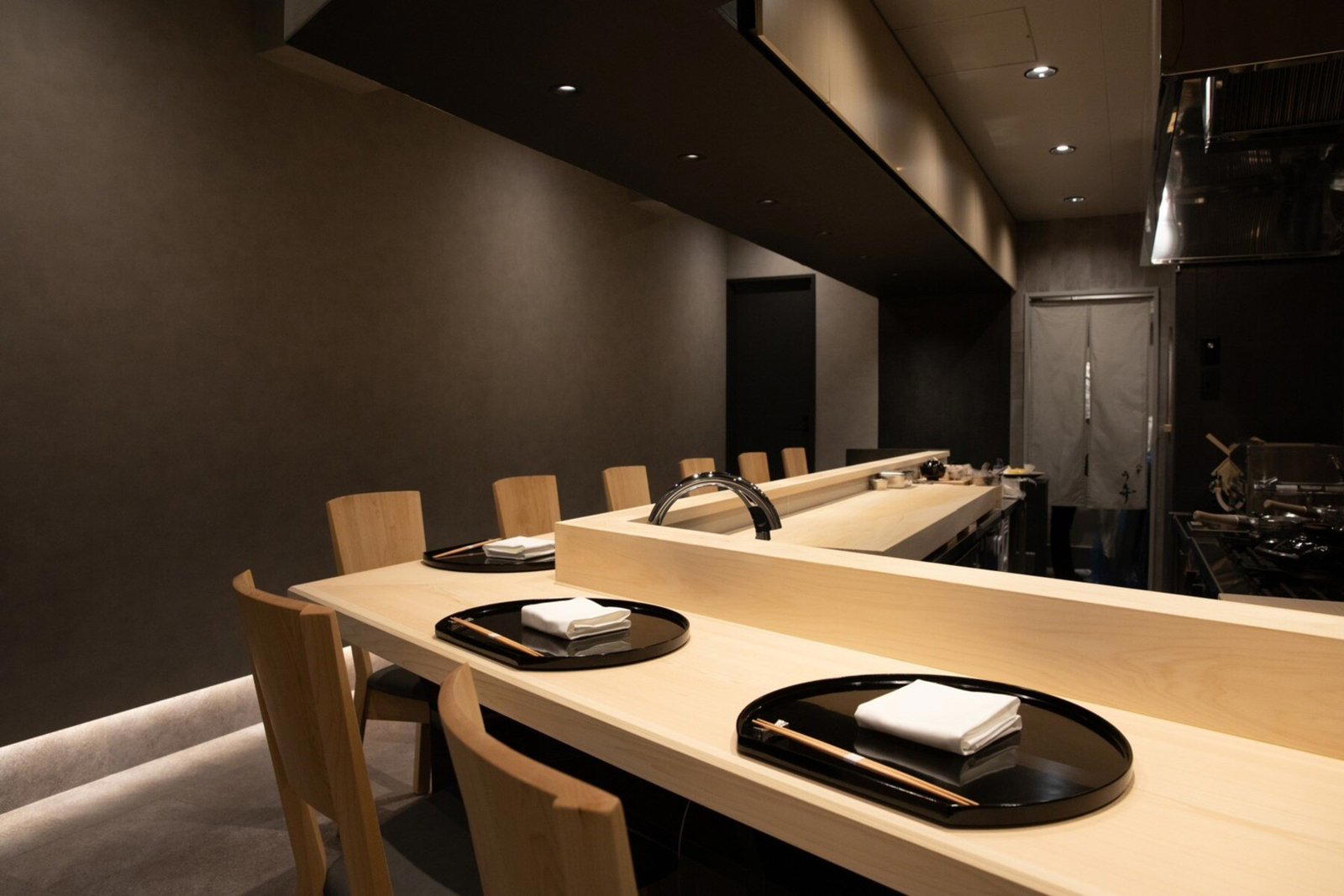
Tokyo's ¥¥¥-tier starred rooms tend to operate with less ceremony than the rooms above them. At this price point in a residential neighbourhood with limited public visibility, the setting is more intimate than theatrical. The kitchen's working method, unwritten recipes, individually seasoned courses, a cuisine in active development, suggests a room where the food carries the occasion rather than the room's design or service formality. For context, this contrasts with the more architecturally considered spaces at the ¥¥¥¥ tier and aligns with counters where the chef's attention to the plate is the primary signal.
Is Yakumo Uezu child-friendly?
Yakumo Uezu is a Michelin-starred counter at the ¥¥¥ price tier in Tokyo. Counters at this level in the city generally suit guests who can engage with a multi-course progression, follow the kitchen's pace, and maintain the room's tone. There is no published policy on children, but the format and price point are consistent with venues that attract adult diners specifically. Families visiting Tokyo with children who are comfortable in formal restaurant settings could consider enquiring at the time of booking; those travelling with younger children would likely find the format a poor fit.
Price and Positioning
| Venue | Cuisine | Price | Awards | Notes |
|---|---|---|---|---|
| Yakumo UezuThis venue (the venue you are viewing) | Seasonal Japanese Kaiseki | $150–200 | 1 Michelin Star | Not listed |
| Harutaka | Edo-Style Omakase Sushi | $200–300 | 3 Michelin Stars · World's 50 Best #76 | Sushi |
| RyuGin | Modern Kaiseki | $500+ | 3 Michelin Stars · World's 50 Best #41 | Kaiseki, Japanese |
| L'Effervescence | Modern French with Japanese Influences | $200–300 | 3 Michelin Stars · World's 50 Best #69 | French |
| HOMMAGE | Modern French with Japanese Influences | $150–200 | 2 Michelin Stars · World's 50 Best #78 | Innovtive French, French |
| MAZ | Innovative Peruvian-Japanese Fusion | $150–200 | 2 Michelin Stars · World's 50 Best #28 | Innovative |
Recognition history
Dated appearances from independent guides and award organizations, with the underlying list record or original source where available.
Michelin 1 Star
Michelin
Full recognition history (2 entries)
Michelin 1 Star
Michelin
Continue exploring
More in Tokyo
Restaurants in Tokyo
All restaurants in Tokyo →
Bars in Tokyo
All bars in Tokyo →
Details
- Quiet
- Intimate
- Elegant
- Sophisticated
- Date Night
- Special Occasion
- Private Event
- Business Dinner
- Chefs Counter
- Standalone
- Sake Program
- Local Sourcing
- Set Menu
- Counter Dining
- Sake
- Wine
- Vegetarian Friendly
- Vegan Options
- Allergy Accommodating
Current opening hours
- Monday
- 6–11 PM
- Tuesday
- 6–11 PM
- Wednesday
- 6–11 PM
- Thursday
- 6–11 PM
- Friday
- 6–11 PM
- Saturday
- 6–11 PM
- Sunday
- Closed
Hours can change for holidays and private events. Hours as of .
Calm, refined, and intimate, with a relaxed counter-focused atmosphere in a quiet residential neighborhood.