Tabelog 100 #60
Our verdict
A basement-level yakiniku specialist in Nakameguro, Beef Kitchen sits within a neighbourhood that has become one of Tokyo's more considered dining corridors. The format centres on wagyu beef grilled tableside, placing it in a category where the quality of sourcing and the cut selection matter more than theatrical presentation. Visitors planning an evening here should book ahead and expect a focused, meat-forward menu.

Pearl is the En Primeur Club membership app, where members save venues, book tables and use the concierge.
The menu
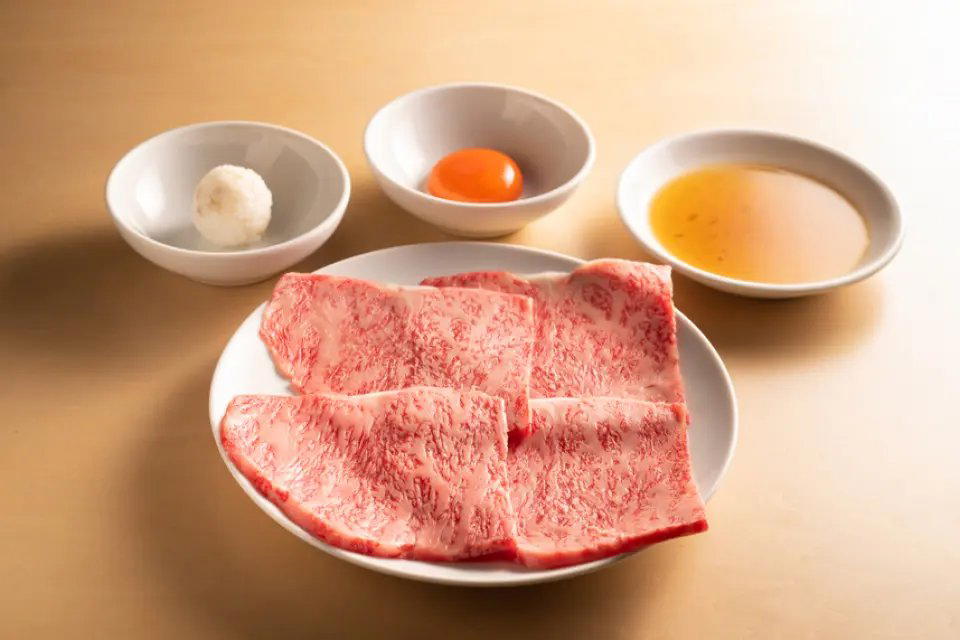
What to order
- Shin-shin
- Tomo-sankaku
- Salted thick-cut tongue
- Thick-sliced fillet steak
Nakameguro's Yakiniku Register
Tokyo's yakiniku scene has stratified considerably over the past decade. At the lower end, neighbourhood grills serve domestic beef at accessible prices and operate with a casual, high-turnover logic. At the upper end, a smaller tier of specialist houses works with premium wagyu cuts, curates narrow menus, and prices against the leading teppanyaki and kaiseki counters in the city. Beef Kitchen Nakameguro sits somewhere in that middle-to-upper band, occupying a basement unit on Kamimeguro's residential stretch, a corridor that has quietly accumulated credible dining addresses without the foot-traffic noise of Daikanyama or the density of Ebisu.
Nakameguro itself rewards that kind of positioning. The neighbourhood's dining character skews independent and deliberate: fewer chain outposts, more owner-operated rooms where the format reflects a specific point of view. Against that backdrop, a wagyu yakiniku specialist in a basement feels less like a hidden operation and more like the neighbourhood doing what it does. Diners arriving via the Tokyu Toyoko Line or the Hibiya Line find the area walkable from the station, with the canal-side streets giving way quickly to quieter residential blocks where the restaurant sits.
The Yakiniku Format and What It Demands
Yakiniku, as a format, puts more interpretive weight on the diner than almost any other Japanese dining category. The kitchen's role is sourcing, butchering, and sequencing. The diner's role is attention: managing the grill temperature, reading the meat's colour shift, pulling each piece at the right moment. At venues where the beef quality is the primary investment, that interactive element becomes the entire point. There is no sauce or preparation complexity to compensate for sourcing shortcuts.
Wagyu, the category of beef that Beef Kitchen Nakameguro anchors itself to, covers a range of grades and regional designations. In Tokyo restaurants operating in the premium tier, the conversation generally centres on marbling grade (the BMS scale running from 6 to 12 under the Japanese grading system) and prefecture of origin, with Kagoshima, Miyazaki, and Ōmi prefectures each commanding distinct reputations. The cut selection at a serious yakiniku house typically moves through a progression: leaner cuts early, fattier marbled sections later, offal as counterpoint throughout. That sequencing logic mirrors the kaiseki approach to pacing, applied to smoke rather than broth.
Lunch and Evening: Two Different Propositions
The lunch-versus-dinner divide matters in yakiniku more than in most categories. Evening service at Tokyo's better wagyu grills tends to be the fuller commitment: longer menus, higher spend, and a pace that allows the meal to unfold across two hours or more. Lunchtime, where it is offered, typically compresses that into a set format, fewer cuts, a fixed sequence, and a price point designed to bring in diners who want the core experience without the full evening investment.
For Beef Kitchen Nakameguro, the basement setting reinforces the evening character. Basement dining rooms in Tokyo operate at a different register from street-level or refined spaces: lower ceilings, contained acoustics, and an atmosphere that tends toward intensity rather than openness. That suits yakiniku well. The smoke from the charcoal grills, the close quarters, and the focused attention the format demands all read more naturally in an enclosed room than in a bright, open dining room. If the venue offers a lunch service, it likely functions as a tighter, more workmanlike version of the evening proposition, useful, but not where the format performs at its fullest.
For first-time visitors, the evening sitting is the more instructive visit. It gives the kitchen the time to sequence cuts properly, and it gives the diner the space to move through the grilling process without the clock pressure that a midday session implies.
Placing It in Tokyo's Broader Dining Map
A useful frame for understanding where Beef Kitchen Nakameguro sits is to consider what surrounds it in the city's dining ecosystem. Tokyo's most-discussed restaurants currently occupy a set of categories that skew toward either technical Japanese tradition or French-influenced innovation. Harutaka represents the omakase sushi tier at its most demanding. L'Effervescence and Sézanne anchor the French fine dining conversation. RyuGin and Crony sit in the innovative Japanese and French-inflected spaces respectively. Yakiniku operates differently from all of these: it is format-driven rather than chef-driven, and its appeal rests on product quality and grill craft rather than composed plating or sauce work.
That distinction matters when comparing spend. A wagyu yakiniku evening at a serious specialist can reach comparable totals to omakase or kaiseki, but the experience logic is different. You are paying for the beef itself and for the conditions in which to cook it, not for the chef's interpretive vision. For some diners, that directness is the appeal. For others, the lack of a composed narrative may feel like an absence. Knowing which camp you fall into is the most useful piece of pre-visit thinking.
For those building a broader Japan itinerary, the dining registers shift considerably beyond Tokyo. HAJIME in Osaka, Gion Sasaki in Kyoto, and akordu in Nara represent markedly different dining philosophies, while Goh in Fukuoka and Abon in Ashiya each anchor strong regional scenes. Further afield, affetto akita in Akita, Aji Arai in Oita, Ajidocoro in Yubari District, Akakichi in Imabari, and aki nagao in Sapporo demonstrate how far Japan's dining depth extends beyond the capital. Our full Tokyo restaurants guide maps the city's full range for those building a longer stay.
For international context, the format contrast is worth noting: the tableside cooking ritual at a Tokyo yakiniku house has something in common with the communal focus of places like Lazy Bear in San Francisco, where the diner's participation shapes the meal, even if the cuisine logic is entirely different. And the premium protein focus, at its most serious, edges toward the sourcing rigour you find at Le Bernardin in New York City, where the quality of the primary ingredient is treated as non-negotiable.
Planning the Visit
Beef Kitchen Nakameguro is located at 2 Chome-44-8 Kamimeguro, in a basement unit of the Lo Casa Kamimeguro building in Meguro City. The address puts it within walking distance of Nakameguro Station, served by both the Tokyu Toyoko Line and the Tokyo Metro Hibiya Line. Booking ahead is advisable, particularly for evening sittings on weekends, when Nakameguro's dining rooms fill early. Phone and online booking details are best confirmed directly with the venue, as contact information is subject to change. Dress code at this type of neighbourhood specialist tends to be relaxed, though the basement environment means smoke from the grills is part of the experience, arriving in anything you would prefer not to smell of charcoal afterward is worth factoring in.
Frequently asked questions
Does Wagyu beef Yakiniku Beef Kitchen Nakameguro work for a family meal?
Yakiniku is structurally one of the more family-friendly formats in Japanese dining, the tabletop grill format lets everyone cook at their own pace and share cuts without committing to a set sequence. The basement setting at Lo Casa Kamimeguro in Meguro City is more intimate than sprawling, so a large group may feel the room's proportions. Younger children accustomed to Japanese restaurant etiquette will generally fare better here than those unfamiliar with grill-at-table dining.
What should I expect atmosphere-wise at Wagyu beef Yakiniku Beef Kitchen Nakameguro?
The venue occupies a basement unit of the Lo Casa Kamimeguro building at 2 Chome-44-8 Kamimeguro in Meguro City, a below-street-level position that in Tokyo typically signals a more enclosed, focused dining environment rather than an open, casual one. Nakameguro itself draws a design-conscious local crowd, and the yakiniku bars and grills in this pocket of the city tend to reflect that. Expect a quieter register than the loud communal grills of Shinjuku's yakiniku strips.
Is Beef Kitchen Nakameguro in Tokyo a good option for wagyu yakiniku near the Meguro River area?
The venue is located at 2 Chome-44-8 Kamimeguro in Meguro City, placing it within the broader Nakameguro neighbourhood that flanks the Meguro River corridor, one of Tokyo's most walkable dining districts. For visitors exploring that area, it represents a wagyu-focused yakiniku option with a basement setting that differs from the street-level cafes and bistros that dominate the river's immediate edge. The yakiniku format at this address is specifically centred on wagyu beef, distinguishing it from multi-protein grill spots in the same district.
What's the best thing to order at Wagyu beef Yakiniku Beef Kitchen Nakameguro?
What is established is the venue's wagyu yakiniku focus, which at serious grills in Tokyo typically centres on premium domestic beef, often with cuts ranging from tongue to short rib to higher-grade loin. Ask staff which cuts are available that day and in what grade, as sourcing at focused yakiniku spots shifts with availability.
Where exactly is Wagyu beef Yakiniku Beef Kitchen Nakameguro?
Wagyu beef Yakiniku Beef Kitchen Nakameguro is located at Japan, 〒153-0051 Tokyo, Meguro City, Kamimeguro, 2 Chome−44−8 ロ・カーサ上目黒 B1, Tokyo.
How hard is it to get a table at Wagyu beef Yakiniku Beef Kitchen Nakameguro?
No booking policy or advance reservation data is confirmed for Beef Kitchen Nakameguro, and phone and website details are not publicly listed in verified sources. Basement yakiniku spots in Nakameguro with a wagyu focus and limited seating tend to fill quickly on weekends, arriving early or enquiring via the venue directly on the day is the practical approach until booking channels are confirmed.
What makes Wagyu beef Yakiniku Beef Kitchen Nakameguro worth seeking out?
The address places it in Nakameguro, one of Tokyo's more considered dining neighbourhoods, a district where the grill format tends to attract operators with a clear sourcing position rather than volume throughput. The wagyu yakiniku category in Tokyo is competitive at the upper end, but Kamimeguro's basement dining spots occupy a distinct register: less tourist-facing than central Ginza or Shibuya grills, more neighbourhood-committed. That positioning alone filters the clientele and, typically, the product quality.
Booking and Cost Snapshot
Comparable venues nearby, for context on price, style, and recognition.
| Venue | Cuisine | Price | Awards | Notes |
|---|---|---|---|---|
| Wagyu beef Yakiniku Beef Kitchen NakameguroThis venue (the venue you are viewing) | Premium Wagyu Yakiniku | $50–100 | Tabelog 100 #60 | Not listed |
| Mishuku Toraji | Yakiniku (Japanese BBQ) | Not listed | Tabelog 100 #30 | Meguro, Yakiniku (Japanese BBQ) |
| Kirin | Yakitori | $50–100 | Tabelog 100 #36 | Shibuya, Yakitori |
| Kourai Tei | Korean-style Yakiniku (Japanese BBQ) | $100–150 | Tabelog 100 #87 | Shibuya, Korean-style Yakiniku (Japanese BBQ) |
| MO-MO-PARADISE Shibuya Koendori | Japanese Shabu-Shabu & Sukiyaki | $30–50 | Not listed | Shibuya, Shabu-Shabu & Sukiyaki All-You-Can-Eat |
| Tori Ryori Fuji | Japanese chicken cuisine (tori ryori) | $50–100 | Tabelog 100 #37 | Shinagawa, Japanese chicken cuisine (tori ryori) |
Recognition history
Dated appearances from independent guides and award organizations, with the underlying list record or original source where available.
Tabelog 100 #60 · No. 60
Tabelog · Tabelog 100 - Yakiniku - TOKYO - 2025