
Mishuku Toraji sits in Tokyo’s serious yakiniku bracket: small-scale, smoke-forward, and recognised in Tabelog’s Yakiniku Tokyo 100 for 2025, with selections dating back to 2021. In Yutenji, away from the city’s luxury-hotel dining orbit, it reflects a Tokyo tradition where beef, grill control, and table tempo matter more than ceremony.
Pearl is the En Primeur Club membership app — saves, bookings, and concierge access live there. Same editors, same standards.
- Address
- Japan, 〒153-0052 Tokyo, Meguro City, Yutenji, 2 Chome−14−7 AI祐天寺ビル
- Phone
- +81 3-3713-0010
- Website
- tabelog.com
 Saves & bookings on Pearl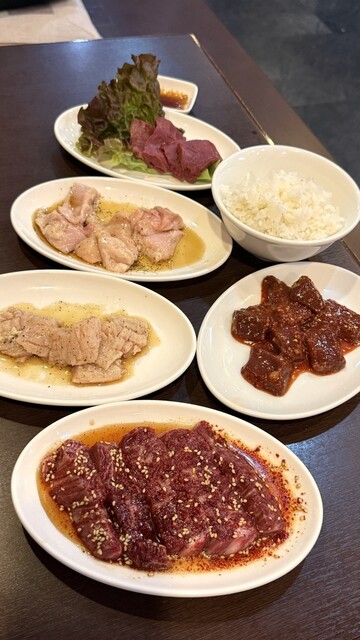
Yutenji slows the pace before dinner. The station area has none of Ginza’s theatre or Roppongi’s international gloss; it is residential Tokyo: narrow streets, local trains, and restaurants built on repeat custom. Here, yakiniku means a shared table, grill, sequence of beef cuts, and a room shaped by diners as much as the kitchen, not a chef-led counter or luxury steakhouse performance.
Mishuku Toraji fits that Tokyo grammar. Recognition in Tabelog’s Yakiniku Tokyo 100 for 2025 places it within a defined citywide group, not the wider mass of casual grill rooms. In a crowded category where chains, neighbourhood specialists, Korean-influenced rooms, wagyu-focused houses, and late-night grill counters compete around the same ritual, the question is whether sourcing, cut selection, seasoning, and service pace hold together across dinner.
Yakiniku in Yutenji: a shared grill tradition with serious local credentials
Yakiniku’s modern Japanese form is social before formal. The table grill gives diners control over doneness, but exposes weak meat and careless preparation fast. Thin cuts need timing; fattier pieces need heat management; sauces and salt should sharpen beef, not bury it. Tokyo’s spectrum runs from inexpensive beer-and-grill rooms to tightly run specialists with small dining rooms and loyal regulars.
Mishuku Toraji’s Yutenji address gives it a useful editorial position. This is not tourist-facing Tokyo beef culture, and that is the point. The city’s more interesting yakiniku meals often sit outside the luxury hotel circuit, in neighbourhoods serving friends, office groups, and locals who know a good grill dinner from a merely expensive one. Tabelog lists the restaurant at 3.73 and includes it in the 2025 Yakiniku Tokyo 100; both matter in a category shaped by repeat dining rather than one-off ceremony.
There is long-tail consistency too. The restaurant’s selection history spans Tabelog Yakiniku Tokyo 100 entries for 2021, 2022, 2023, 2024, and 2025, with the 2024 listing under the Grill Tokyo 100 name. Awards can overstate importance alone, but repeated category recognition suggests it has stayed visible while new Tokyo beef rooms open and attention moves quickly.
The appeal is format discipline, not chef mythology
Tokyo’s premium dining coverage often leans on chef biography, lineage, and counter choreography. Yakiniku is better read operationally: seats, private dining, payment, smoke, and how the meal fits an evening. Mishuku Toraji is a compact 28-seat restaurant with a private room for six, a scale suited to the cuisine. Too large and the grill turns anonymous; too small and it starts behaving like omakase, which is not yakiniku’s cultural logic.
The stated dinner spend is JPY 6,000 to JPY 7,999, while review-based spend also shows a higher JPY 10,000 to JPY 14,999 bracket. That split is common because the bill moves with cut choices, drinks, and whether the table orders conservatively or treats beef as the main event. For travellers, this differs from soba, sushi, or French dining at the same budget. A nearby specialist such as Soba Ya Tsukigokoro, in a similar dinner band, asks diners to read restraint and craft through noodles and broth; yakiniku asks the table to manage appetite, heat, and sequencing.
Smoking is allowed, placing the room within an older Tokyo dining texture rather than the polished non-smoking norm of newer luxury projects. The detail will divide readers: for some, adult local character; for others, a practical reason to dine elsewhere. Yakiniku already has smoke built in, and a smoking-permitted room changes the comfort equation, especially for families or travellers sensitive to air quality.
Reservations are available, and the neighbourhood location makes planning unlike a central hotel-dining itinerary. Yutenji sits on the Tokyu Toyoko Line, giving the meal a local-train cadence rather than a taxi-first feel. The restaurant has moved from its earlier Setagaya address, a useful temporal marker: not a newly manufactured concept chasing a fashionable postcode, but one with documented relocation and continued category recognition after the move.
How it fits into a Tokyo dining itinerary
For visitors building a Tokyo food schedule, Mishuku Toraji works better as a neighbourhood dinner than a trophy reservation. That is a compliment. Tokyo can flatten dining into difficult bookings and ranked counters; yakiniku is a communal counterweight. The table participates, conversation survives, and the grill sets the pace. Culturally, the meal is closer to after-work Tokyo and local group dining than high-end sushi’s hushed theatre.
That makes it useful against other Tokyo categories. A curry specialist such as 3 Chome no Curry Ya San reads Tokyo through comfort and spice; a yakitori room such as 124. KAGURAZAKA (Yakitori) turns skewers and charcoal into a more linear progression; 12/10 Shinjuku ten returns the diner to a denser central district. The restaurant’s narrower proposition is beef over flame, in a compact Yutenji room, with enough recognition to separate it from countless casual grill options.
The surrounding itinerary can stay grounded rather than overplanned. Travellers can compare it with . 鮪と炭火焼き うお炭 秋葉原店 for seafood and charcoal, 2D Cafe for a completely different visual café format, or the citywide curation in Our full Tokyo restaurants guide. For trip planning beyond dinner, EP Club’s Tokyo coverage also includes Our full Tokyo hotels guide, Our full Tokyo bars guide, Our full Tokyo wineries guide, and Our full Tokyo experiences guide.
Outside Tokyo, the comparison becomes cultural rather than competitive. Beef-focused dining in the region can mean sukiyaki-style grilling at -Grilled beef Sukiyaki- KAMAKURA TANUKIAN 鎌倉 たぬき庵 in Kamakura, while Japan’s casual and specialist spectrum stretches from.cafe in Osaka and.know in Kumamoto to (Shoku) Vietnam in Kawasaki, [Curry Senmon Ten] Maruyama Kyoju. in Sapporo, and [ki:] in Kyoto. Japanese food culture abroad pulls the thread further, from sake-led dining at Jōdo Saké Bar in Los Angeles to the everyday precision of Onigiri Time in Pasadena.
The editorial read is clear: choose this for a Tokyo yakiniku dinner with local weight, category recognition, and a format that rewards a small group more than a solo diner chasing ceremony. It is not the polished international face of Japanese beef, but the city’s lived dining culture, where the grill sits at the centre and the meal earns its reputation through repetition.
A Tight Comparison
Comparable venues in the metro at similar price points.
| Venue | Cuisine | Price |
|---|---|---|
| Mishuku TorajiThis venue — the venue you are viewing | Not listed | $$$ |
| Iruka Tokyo Roppongi | Roppongi, Modern Ramen | $$$ |
| Manten Sushi (まんてん鮨) | Marunouchi, Edomae Omakase Sushi | $$$ |
| 麺尊RAGE | Suginami, Modern Shamo Shoyu Ramen | $$$ |
| Wagyu beef Yakiniku Beef Kitchen Nakameguro | Meguro, Premium Wagyu Yakiniku | $$$ |
| Shoto Ran Kan | Shibuya, Refined Japanese Izakaya | $$$ |
Recognition history
Dated appearances from independent guides and award organizations, with the underlying list record or original source where available.
Tabelog 100 #30 · No. 30
Tabelog · Tabelog 100 - Yakiniku - TOKYO - 2025











At a Glance
- Cozy
- Classic
- Intimate
- Group Dining
- Special Occasion
- Casual Hangout
- Business Dinner
- Standalone
- Private Dining
- Beer Program
- Sake Program
Current opening hours
- Monday
- Closed
- Tuesday
- 6–10 PM
- Wednesday
- 6–10 PM
- Thursday
- 6–10 PM
- Friday
- 6–10 PM
- Saturday
- 6–10 PM
- Sunday
- Closed
Hours can change for holidays and private events. Last verified .
An underground yakiniku spot with a cozy, intimate feel and a focused barbecue atmosphere rather than a scenic or expansive dining room.