

Michelin Bib Gourmand · Tabelog 100 #89
Our verdict
Among Tokyo's Bib Gourmand tonkatsu counters, Enraku in Ota City's Ikegami neighbourhood operates at the quieter, craft-first end of the spectrum. The owner-chef applies decades of repetition to pork loin and fillet fried in a copper pot, with hand-chopped cabbage as the only accompaniment that needs to be. Michelin's inspectors have taken notice, awarding the Bib Gourmand in 2024.

Pearl is the En Primeur Club membership app, where members save venues, book tables and use the concierge.
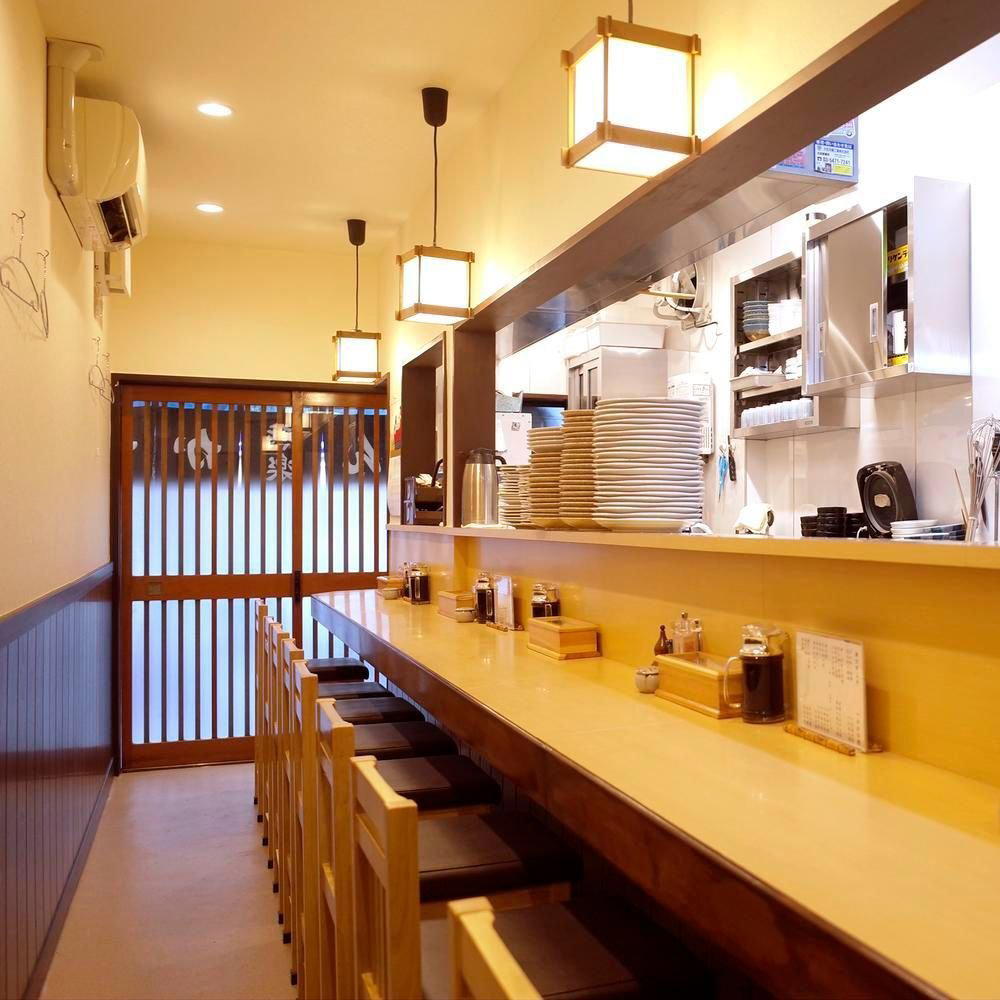
Where Tokyo's Tonkatsu Tradition Gets Serious
Tokyo's tonkatsu scene divides more sharply than most visitors expect. At one end sit the polished, high-volume chains and mid-tier restaurants that have made the breaded pork cutlet a weekday staple across the city. At the other end, a smaller group of specialist counters treat the same dish as a lifelong technical discipline, where the difference between a good and a considered result lies in oil temperature, bread-crumb grade, and the precise moment the coat changes colour. Butagumi, Ginza Katsukami, and Katsuyoshi occupy the upper tier of that second category. Tonkatsu Enraku, located in Ikegami in Ota City, sits within that same discipline-led bracket, and Michelin's 2024 Bib Gourmand recognition confirms the inspectors reached the same conclusion.
The Case for Ikegami
Ikegami is not a neighbourhood that appears on most first-time Tokyo itineraries. It sits in the southwestern reach of Ota City, centred on the ancient Ikegami Honmon-ji temple complex, and its restaurant culture reflects a local, repeat-customer logic rather than destination dining driven by tourism. Restaurants here earn recognition through sustained quality assessed by the people who eat there regularly, which is a different and arguably more demanding test than impressing a passing reviewer once. That residential, neighbourhood-level accountability is part of what gives the Bib Gourmand award at a place like Enraku particular weight: it suggests consistent execution over time, not a single impressive service.
For visitors making the trip from central Tokyo, Ikegami is reachable via the Tokyu Ikegami Line from Gotanda or Senzoku-Ike, placing it roughly thirty to forty minutes from most central accommodation. The area rewards the effort with a quieter, more local experience than the tonkatsu counters closer to Shinjuku or Ginza.
What the Bib Gourmand Signals Here
Michelin's Bib Gourmand category identifies cooking that represents good value without the formality or price point of starred restaurants. In Tokyo's tonkatsu context, the award is meaningful precisely because it is competitive: the city has hundreds of tonkatsu restaurants, and the inspectors are evaluating against that full field. Enraku's 2024 recognition places it in a select group of tonkatsu specialists that Michelin considers worth a specific detour, not just a convenient neighbourhood option.
Comparison venues in Tokyo's broader fine-dining tier, including multi-starred kaiseki counters like RyuGin and destination omakase operations charging multiples of what Enraku asks, operate in a different economic register entirely. The single yen-sign price bracket at Enraku is part of the editorial point Michelin makes with a Bib Gourmand: craft and rigour do not require a high-spending entry point to be present in the kitchen.
The Work at the Fryer
Tonkatsu's apparent simplicity is where its difficulty lives. The dish requires a pork loin or fillet, a coat of panko breadcrumbs, and hot oil. The variables within those three elements, including the breed and cut of pork, the coarseness and freshness of the crumb, the fat composition and temperature of the oil, and the timing of the fry, produce outcomes that range from adequate to technically precise. At the specialist end of the category, practitioners spend years calibrating those variables rather than standardising them away.
The account of Enraku's owner-chef watching the changing colour of the coating and listening to the hiss of oil in the copper pot is not incidental atmosphere. It describes the actual method: the fryer reads the state of the cook through visual and auditory signals rather than timers. Cabbage chopped by hand as the pork sizzles is the kind of procedural detail that matters at this level, because it ties the preparation of the accompaniment to the rhythm of the cook. The result, when the discipline holds, is a cutlet that arrives at the right temperature with a crust that has not softened from sitting.
That approach reflects a particular strand of Japanese craft tradition in which mastery is accumulated through apprenticeship and repetition rather than through creative reinvention. It places Enraku in a lineage shared by other long-running Tokyo specialists, including Katsusen and Fry-ya, where the standard is set by how consistently the fundamental technique is executed, not by how far the menu departs from the original form. The same tradition appears in Kyoto at Jukuseibuta Kawamura and in Osaka at Kyomachibori Nakamura, where regional pork sourcing and fryer discipline define the category in similar ways.
Planning a Visit
Enraku sits at 6 Chome-1-4 Ikegami, Ota City, Tokyo 146-0082.
The single yen-sign price bracket places Enraku among the most accessible Michelin-recognised counters in the city, which is part of its editorial significance. At a moment when Tokyo's dining conversation tends to concentrate on omakase counters charging ¥30,000 and above, a Bib Gourmand at this price point is a reminder that the city's depth runs in both directions.
For a broader view of where Enraku sits in Tokyo's dining picture, the full Tokyo restaurants guide covers the range of cuisines and price tiers. Those planning a longer visit can supplement with the Tokyo hotels guide, Tokyo bars guide, Tokyo wineries guide, and Tokyo experiences guide. For those building a Japan itinerary beyond the capital, comparable craft-led restaurants operate across the country, including HAJIME in Osaka, Gion Sasaki in Kyoto, akordu in Nara, Goh in Fukuoka, 1000 in Yokohama, and 6 in Okinawa.
Frequently asked questions
What should I eat at Tonkatsu Enraku?
Order the tonkatsu. The menu centres on pork loin and fillet cutlets fried in a copper pot by an owner-chef who has spent a career on that specific discipline. The Michelin Bib Gourmand recognises the cooking at this level, and both cuts represent the reason for the visit. Hand-chopped cabbage is the standard accompaniment in the tonkatsu tradition, and at a counter operating at this standard it is prepared as part of the same careful process as the fry itself. There is no case for ordering around the core offer here.
At a Glance
| Venue | Cuisine | Price | Awards | Notes |
|---|---|---|---|---|
| Tonkatsu EnrakuThis venue (the venue you are viewing) | Traditional Tonkatsu | $10–20 | Michelin Bib Gourmand · Tabelog 100 #89 | Not listed |
| Harutaka | Edo-Style Omakase Sushi | $200–300 | 3 Michelin Stars · World's 50 Best #76 | Sushi |
| RyuGin | Modern Kaiseki | $500+ | 3 Michelin Stars · World's 50 Best #41 | Kaiseki, Japanese |
| L'Effervescence | Modern French with Japanese Influences | $200–300 | 3 Michelin Stars · World's 50 Best #69 | French |
| HOMMAGE | Modern French with Japanese Influences | $150–200 | 2 Michelin Stars · World's 50 Best #78 | Innovtive French, French |
| MAZ | Innovative Peruvian-Japanese Fusion | $150–200 | 2 Michelin Stars · World's 50 Best #28 | Innovative |
Recognition history
Dated appearances from independent guides and award organizations, with the underlying list record or original source where available.
Michelin Bib Gourmand
Michelin
Tabelog 100 #89 · No. 89
Tabelog · Tabelog 100 - Tonkatsu - 2026
Full recognition history (3 entries)
Michelin Bib Gourmand
Michelin
Continue exploring
More in Tokyo
Restaurants in Tokyo
All restaurants in Tokyo →



Bars in Tokyo
All bars in Tokyo →




Details
- Classic
- Cozy
- Solo
- Family
- Casual Hangout
- Sake Program
- A La Carte
Current opening hours
- Monday
- Closed
- Tuesday
- 11 AM–2:30 PM, 5–9 PM
- Wednesday
- 11 AM–2:30 PM, 5–9 PM
- Thursday
- 11 AM–2:30 PM, 5–9 PM
- Friday
- 11 AM–2:30 PM, 5–9 PM
- Saturday
- 11 AM–2:30 PM, 5–9 PM
- Sunday
- Closed
Hours can change for holidays and private events. Hours as of .
Warm, inviting traditional setting with sizzling kitchen sounds and cozy counter and tatami seating.