

Tabelog Bronze #443
Our verdict
A tea kaiseki counter in Kita-Aoyama's basement tier, Tagetsu has earned consecutive Tabelog Bronze recognition every year from 2019 through 2026, plus three selections to the Tabelog Japanese Cuisine Tokyo 100. Chef Hideo Mochizuki's approach is rooted in cha-kaiseki discipline, with dinner running JPY 40,000–49,999 and a notably accessible lunch at JPY 10,000–14,999. Nineteen seats and a reservation-only policy keep the room controlled and quiet.

Pearl is the En Primeur Club membership app, where members save venues, book tables and use the concierge.
The menu
What to order
- Karasumi from premium mullet roe
- Shabu-shabu with sansho pepper
- Ayu in summer
- Crab and fugu in winter
From Silver to Bronze: How Tagetsu Found Its Register
When Tagetsu opened on 26 August 2013 in the basement of the Sekine Building in Kita-Aoyama, the kaiseki tier it entered was already competitive. Tokyo's Minato Ward had long been home to formal Japanese dining rooms that operated at the intersection of tradition and theatre. What followed over the next decade is instructive about how a kaiseki counter earns sustained recognition without chasing the most visible tier of awards.
Tagetsu's Tabelog trajectory tells a clear story: Silver recognition in both 2017 and 2018, then a step down to Bronze from 2019 through 2026. That arc is worth examining carefully. Tabelog's Silver band sits above Bronze in absolute score terms, but the platform's methodology is sensitive to volume and consistency of reviews over time. A Silver-to-Bronze reclassification does not signal decline, for many restaurants in this format and size, it reflects a stabilisation in review density as the room fills with regulars whose opinions rarely migrate online.
For context, the Tabelog 100 selection is the platform's curated shortlist of the most consistently rated Japanese cuisine restaurants across Tokyo, not a ranked list, but a recognition that a restaurant has maintained quality signals across multiple review cycles. Appearing there in three consecutive assessment years places Tagetsu alongside counters that are often cited by Opinionated About Dining, which ranked it #172 among Japan's leading restaurants in 2024 and #234 in 2025.
Tea Kaiseki in an Aoyama Basement
Kaiseki in Tokyo splits across several distinct traditions. The most prominent is the Kyoto-derived honzen kaiseki associated with formal banquet culture, and the version practised at high-profile counters like Kikunoi Tokyo or Hirosaku. The less often discussed strand is cha-kaiseki, the meal tradition that developed in parallel with the Japanese tea ceremony. Its grammar is different: smaller, quieter, restrained to the point of severity, with the seasonal ingredient rather than the technical flourish doing the primary work.
Tagetsu operates in that cha-kaiseki register. The Tabelog listing's own description references "delicate skills" and "seasonal flavours honed through tea kaiseki", language that signals a deliberate positioning away from the performative end of the format. At 19 seats, the room is sized for a specific kind of dining: concentrated, unhurried, and oriented toward the sequence of the meal rather than individual theatrical moments. The Tabelog record notes a focus specifically on fish, and the drinks program leans on carefully selected sake and wine, with a sommelier available for guidance.
This is not the kaiseki register of RyuGin, where Seiji Yamamoto's cooking is explicitly contemporary and technique-driven. Nor does it share a price point: RyuGin operates at a higher dinner bracket, while Tagetsu's dinner average of JPY 40,000–49,999 places it in a tier that also includes counters like Ajihiro and Akasaka Ogino. The lunch format, at JPY 10,000–14,999, offers access to the same kitchen at roughly a quarter of the dinner spend, an entry point that very few formal kaiseki rooms in this neighbourhood maintain.
The Kita-Aoyama Context
Kita-Aoyama is not a traditional fine dining district in the way that Ginza or Akasaka are. The neighbourhood is better known for fashion retail and design studios. That context matters for kaiseki specifically: a basement-level counter here operates with less foot traffic pressure than it would in Ginza, and without the same expectation of visible exterior presence. The Tabelog record categorises the location as a "hideout", apt for a room that does not announce itself from the street.
The five-minute walk from Omotesando Station (or three minutes from the underground passage B2 exit) keeps the counter accessible without placing it on a busy dining corridor. Nearby competitors in the formal Japanese dining category include Aoyama Jin, which operates in a similar neighbourhood register. The Sekine Building basement address is consistent with a pattern seen across Tokyo's mid-tier kaiseki rooms: ground-floor rents in Minato Ward have pushed serious cooking operations downward, and basement counters in well-connected side streets have become a reliable format for sustained, reservation-led operations.
Structure of the Experience
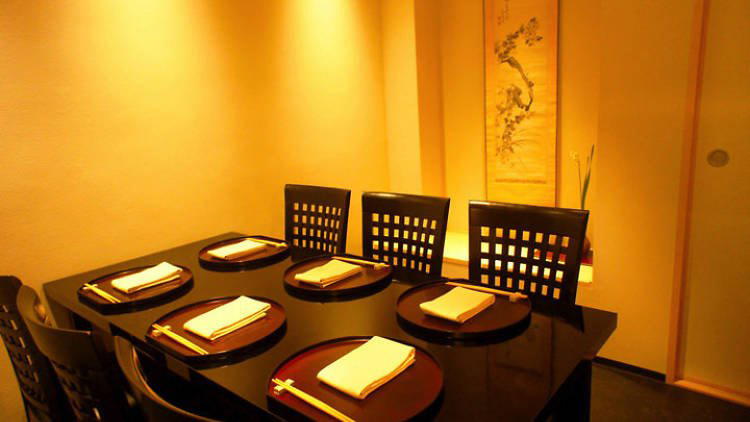
The room holds 19 seats across counter and table configurations, with private rooms available for parties of 2, 4, 6, or 8. Full private use is available for groups up to 20 people, which effectively covers the entire restaurant. This makes Tagetsu a plausible choice for business dinners where confidentiality and an unhurried pace matter, a use case the Tabelog data explicitly flags as recommended by frequent visitors.
Service runs long by design: the platform notes parties of over 2.5 hours as a standard feature, and the last order at dinner is 21:00 against an 18:00 opening, which allows for a three-hour window. Lunch last order is 12:00 against an 11:30 opening, the tightest booking in the schedule, and worth noting for travellers with afternoon commitments.
The drinks program is notable for a kaiseki room of this size. Sake is the primary focus, with the listing marking the restaurant as "particular about sake" alongside a wine selection and sommelier service. BYO is permitted, which is uncommon at this price point and practical for guests travelling with a specific bottle. A 5% service charge applies at lunch; dinner carries a 10% service charge.
Private room reservations carry a per-person surcharge: JPY 550 at lunch, JPY 1,100 at dinner, a transparent cost structure that avoids the ambiguity found at rooms that bundle privacy fees into a broader spend. Payment accepts VISA, Mastercard, JCB, AMEX, Diners, and PayPay; electronic money is not accepted. Smart casual dress is expected.
Where Tagetsu Sits in the Wider Japan Kaiseki Map
Kaiseki at this level is not a Tokyo-only conversation. The formal Japanese cuisine tradition runs through Kyoto most directly, and visitors comparing options across Japan will encounter counters like Ifuki and Ankyu in Kyoto, as well as Gion Sasaki, which operates at a higher price bracket and different seasonal register. Beyond Kyoto, Japanese cuisine at this level appears at HAJIME in Osaka (where the format is more explicitly contemporary), Goh in Fukuoka, and further afield at akordu in Nara, 1000 in Yokohama, and 6 in Okinawa.
Within Tokyo specifically, the cha-kaiseki tradition that Tagetsu represents is a smaller category than the broader honzen kaiseki scene. That specificity is part of what has sustained its Tabelog 100 selections, reviewers on the platform respond to precision of focus, and a room that does one thing consistently over more than a decade accumulates a different kind of credibility than one chasing broader trend cycles.
Planning Your Visit
Tagetsu operates Tuesday through Saturday, open for both lunch (11:30–14:00, last order 12:00) and dinner (18:00–23:00, last order 21:00). The restaurant is closed Sundays, public holidays, and over year-end and New Year periods. Reservations are required and carry a structured cancellation policy; changes to date, time, or party size after booking incur a fee based on how far in advance the change is requested. The restaurant is a five-minute walk from Omotesando Station on the Tokyo Metro Ginza, Chiyoda, and Hanzomon lines, or three minutes from the B2 underground exit.
For broader Tokyo planning, see our full Tokyo restaurants guide, our full Tokyo hotels guide, our full Tokyo bars guide, our full Tokyo wineries guide, and our full Tokyo experiences guide.
Quick reference: Tagetsu, Kita-Aoyama B1F, Minato-ku Tokyo. Reservation only. Dinner JPY 40,000–49,999; lunch JPY 10,000–14,999. Closed Sundays and public holidays. Tabelog Bronze 2019–2026; Tabelog Japanese Cuisine Tokyo 100 (2021, 2023, 2025).
Frequently asked questions
at Tagetsu?
Tagetsu does not publish a fixed à la carte menu, this is a kaiseki counter, and the format is sequential courses determined by the kitchen. The Tabelog record notes a particular focus on fish, and the wider cha-kaiseki tradition means the progression is calibrated to the season rather than to individual showpiece dishes. The most substantive way to engage with the kitchen is at dinner, where the full course runs within the JPY 40,000–49,999 bracket and the BYO policy allows you to bring a specific sake or wine that has personal significance. The lunch format, at JPY 10,000–14,999, is a structurally different proposition, a shorter, more compressed version of the same approach, with the same seasonal discipline applied to a smaller number of courses. Both have earned recognition across the restaurant's eight consecutive Tabelog Bronze years and three Tabelog 100 selections, which suggests the kitchen's consistency applies across both services. Chef Hideo Mochizuki's background in tea kaiseki is the consistent thread across both formats.
Comparable Spots
A short peer table to compare basics side-by-side.
| Venue | Cuisine | Price | Awards | Notes |
|---|---|---|---|---|
| TagetsuThis venue (the venue you are viewing) | Modern Seasonal Kaiseki | $150–200 | Tabelog Bronze #443 | Not listed |
| Harutaka | Edo-Style Omakase Sushi | $200–300 | 3 Michelin Stars · World's 50 Best #76 | Sushi |
| RyuGin | Modern Kaiseki | $500+ | 3 Michelin Stars · World's 50 Best #41 | Kaiseki, Japanese |
| L'Effervescence | Modern French with Japanese Influences | $200–300 | 3 Michelin Stars · World's 50 Best #69 | French |
| HOMMAGE | Modern French with Japanese Influences | $150–200 | 2 Michelin Stars · World's 50 Best #78 | Innovtive French, French |
| MAZ | Innovative Peruvian-Japanese Fusion | $150–200 | 2 Michelin Stars · World's 50 Best #28 | Innovative |
Recognition history
Dated appearances from independent guides and award organizations, with the underlying list record or original source where available.
Opinionated About Dining Top Restaurants in Japan Recommended
Opinionated About Dining
Tabelog Bronze #443
Tabelog
Full recognition history (7 entries)
Opinionated About Dining Top Restaurants in Japan Ranked #234
Opinionated About Dining
Tabelog 100 #83 · No. 83
Tabelog · Tabelog 100 - Japanese cuisine - TOKYO - 2025
Tabelog Bronze
Tabelog
Opinionated About Dining Top Restaurants in Japan Ranked #172
Opinionated About Dining
Opinionated About Dining Top Restaurants in Japan Highly Recommended
Opinionated About Dining
Continue exploring
More in Tokyo
Restaurants in Tokyo
All restaurants in Tokyo →


Bars in Tokyo
All bars in Tokyo →





Details
- Elegant
- Intimate
- Quiet
- Sophisticated
- Date Night
- Special Occasion
- Celebration
- Business Dinner
- Chefs Counter
- Private Dining
- Open Kitchen
- Sake Program
- Local Sourcing
- Tasting Menu
- Counter Dining
- Set Menu
- Sake
- Vegetarian Friendly
- Allergy Accommodating
Current opening hours
- Monday
- 11:30 AM–2 PM, 6–11 PM
- Tuesday
- 11:30 AM–2 PM, 6–11 PM
- Wednesday
- 11:30 AM–2 PM, 6–11 PM
- Thursday
- 11:30 AM–2 PM, 6–11 PM
- Friday
- 11:30 AM–2 PM, 6–11 PM
- Saturday
- 11:30 AM–2 PM, 6–11 PM
- Sunday
- Closed
Hours can change for holidays and private events. Hours as of .
Bright and clean interior with simple wooden decor, counter seating and private rooms in a quiet back alley location, creating an intimate and refined dining atmosphere.