

Tabelog 100 #18
Our verdict
Sushi Murase operates from a Nishiazabu address that places it among Tokyo's quieter, more considered omakase counters, away from the Ginza circuit's high visibility. In a city where premium sushi increasingly signals itself through accolades and foot traffic, Murase occupies a register defined by restraint and sourcing discipline. For travellers moving through Tokyo's serious dining tier, it merits the same research attention as the neighbourhood's better-documented peers.

Pearl is the En Primeur Club membership app, where members save venues, book tables and use the concierge.
The menu
What to order
- Aged kohada
- Sea urchin sea grape hand-roll
- Tuna otoro
- Squid stuffed with squid eggs
Nishiazabu and the Omakase Tier It Belongs To
Tokyo's premium sushi scene has consolidated around two geographic poles: the high-visibility Ginza corridor, where three-Michelin-star counters operate at price points that benchmark against each other, and a more dispersed set of addresses in Minato and Shibuya wards that attract a different kind of attention. Nishiazabu sits in the second category. The neighbourhood's restaurant culture runs quieter than Ginza's, with fewer tourists and more regulars who treat a booking as a standing arrangement rather than a special occasion. Sushi Murase, at 1 Chome-2-3 Nishiazabu, operates inside that register.
The physical approach to counters in this part of the city tends to share a grammar: a discreet ground-floor entrance, often unmarked or lightly signed, that requires some local knowledge or a confirmed reservation to locate with confidence. That architecture of understatement is not accidental. It reflects a broader division in how Tokyo's serious omakase addresses present themselves. The counters with the loudest institutional profiles, like Harutaka, have absorbed the scrutiny of international press and awards panels. Others, including Murase, have built their reputations through a narrower, more insular circuit.
Sustainability as Sourcing Discipline in Tokyo Sushi
The conversation around sustainability in high-end Japanese cuisine has matured considerably over the past decade. For a long time, the premium sushi world operated under a logic that prized rarity above all else: the most sought-after fish, from the most celebrated markets, regardless of what that extraction pattern meant at scale. That logic has not disappeared, but it has begun to encounter pressure from within the industry itself. A cohort of Tokyo counters now treat sourcing relationships, seasonal rotation, and waste reduction not as marketing positions but as operating principles.
This shift is visible in how progressive omakase programs structure their menus. Rather than anchoring around a fixed hierarchy of prestige ingredients, some counters move their courses according to what the season and their supplier network can provide without strain. Bluefin tuna, for instance, has come under increased scrutiny from conservation bodies, and some chefs have responded by rotating in alternatives during specific windows or working with certified fisheries. The counters that have made this adjustment tend not to advertise it prominently; it surfaces instead in conversations at the counter or in the granular detail of what appears in front of you on a given evening.
For context on how Japanese cuisine engages these questions beyond Tokyo, Gion Sasaki in Kyoto represents a kaiseki tradition where seasonal constraint is structural rather than optional, and HAJIME in Osaka has built an internationally documented program around ecological sourcing as a first principle. Tokyo's sushi counters are working through an analogous set of questions from a different culinary starting point.
Where Murase Sits in the Competitive Set
The venue operates without a publicised award profile, without a visible web presence, and without a price range in circulation. In Tokyo's omakase world, that combination of signals tends to indicate one of two things: a counter that is genuinely early in its trajectory, or one that has chosen to operate at a remove from the institutional recognition machinery. Either reading places Murase in a different bracket from the Ginza flagship counters.
The relevant peer comparison for a Nishiazabu address without Michelin documentation is the tier of counters that maintain consistent bookings through word-of-mouth and concierge networks rather than guidebook visibility. These are venues where the absence of a star is not necessarily a quality signal in either direction; it may simply reflect a counter that has not sought, or not yet received, formal assessment. Compared with fully documented peers at the ¥¥¥¥ tier, such as Harutaka, Murase occupies a position of greater opacity, which carries its own kind of appeal for certain travellers.
For readers whose Tokyo itinerary extends to the broader fine dining spectrum, the Nishiazabu and Azabu Juban corridor also supports strong French and innovative programs. L'Effervescence and Crony both operate in this part of the city and represent the French-influenced end of Tokyo's serious dining tier. Sézanne and RyuGin extend the comparison set further into the award-documented upper bracket.
The Omakase Format and What It Demands of the Diner
Omakase as a format has been exported and explained so extensively that it risks losing its operational specificity in translation. At its core, the format hands sequencing, pacing, and selection entirely to the chef. For the diner, this means arriving without a preference agenda. The counter becomes a conversation conducted through food rather than words, and the quality of that conversation depends as much on the diner's attention as on the chef's technique.
In practice, this places a premium on timing. Tokyo's serious counters typically run two seatings per evening, with the earlier seating often running longer and the later seating more compressed. Advance booking through a hotel concierge or a Japan-based reservation service remains the most reliable access point for counters without English-language booking infrastructure. For a Nishiazabu address with limited public-facing information, that intermediary layer is not optional; it is the primary access mechanism.
Japan's broader serious dining circuit offers useful reference points for those building a multi-city itinerary. akordu in Nara and Goh in Fukuoka each represent regional expressions of the same discipline around sourcing and seasonal precision. Further afield, a counter in Nanao and a restaurant in Takashima point toward the provincial tier of Japanese serious dining, where proximity to primary producers shapes menus in ways that urban kitchens cannot replicate. For those exploring outside the main cities, a Nishikawa Machi address and venues in Sapporo complete a picture of how Japan's serious food culture distributes itself geographically.
For those building around Tokyo as a base, our full Tokyo restaurants guide maps the city's serious dining options across all major categories and price tiers. International comparisons for technically demanding tasting-menu formats include Le Bernardin in New York and Atomix, which approach similar questions of sourcing rigour and seasonal precision from a different culinary tradition. Additional regional context comes from Birdland in Sakai and Bistro Ange in Toyohashi, both of which represent the serious regional dining tier outside the major urban centres.
Planning Your Visit
Sushi Murase is located at 1 Chome-2-3 Nishiazabu, Minato City, Tokyo. Given the absence of a public website or published phone number, reservations are most reliably secured through a hotel concierge or a Japan-specialist reservation platform. The Nishiazabu address is walkable from Hiroo station on the Hibiya Line and a short taxi ride from the Roppongi or Azabu Juban nodes.
Quick reference: 1 Chome-2-3 Nishiazabu, Minato City, Tokyo 106-0031. Book via hotel concierge or specialist platform; no public reservation channel confirmed.
Frequently asked questions
Where is Sushi Murase in Tokyo?
Sushi Murase is located at 1 Chome-2-3 Nishiazabu, Minato City, Tokyo 106-0031, Japan, Tokyo.
How does Sushi Murase differ from Ginza omakase counters at a similar price point?
Geography shapes the experience before the first piece of nigiri arrives. Nishiazabu, in Minato City, draws a quieter, more local crowd than the Ginza corridor, where counters like Saito and Sukiyabashi Jiro carry significant tourist and media traffic. Murase operates without a public-facing booking channel, a structural choice that filters the guest list toward those already embedded in Tokyo's dining network. The result is a counter that functions less as a destination and more as a regular appointment for those who know to keep it.
What's the must-try dish at Sushi Murase?
Omakase counters in the Nishiazabu tier do not publish fixed menus, and Sushi Murase follows that convention. The chef dictates the sequence based on what the market yields that day, so the question of a signature dish is structurally beside the point. The counter's value is in surrendering that choice entirely.
Do they take walk-ins at Sushi Murase?
Sushi Murase has no public website or listed phone number, which places it firmly outside the walk-in model. Counters operating at this level in Nishiazabu, Minato City run on advance reservations, typically arranged through a hotel concierge or a third-party booking service such as Tableall or Omakase. Arriving without a booking is not a viable strategy.
What's Sushi Murase best at?
The counter's positioning within the Nishiazabu dining circuit points toward the sourcing-led, season-sensitive approach that defines this tier of Tokyo sushi. Where Ginza venues often carry the weight of public reputation and awards visibility, Nishiazabu counters like Murase tend to attract guests through word-of-mouth and repeat visits rather than external ratings. That pattern itself signals a particular kind of consistency.
A Minimal comparable set
Comparable venues nearby, for context on price, style, and recognition.
| Venue | Cuisine | Price | Awards | Notes |
|---|---|---|---|---|
| Sushi MuraseThis venue (the venue you are viewing) | Aged Edomae Omakase | $200–300 | Tabelog 100 #18 | Not listed |
| Isana sushi bar | Traditional Edomae Sushi Omakase | $150–200 | Not listed | Minato, Edomae Omakase Sushi |
| 赤坂 菊乃井 | Kyo-Kaiseki | $150–200 | 2 Michelin Stars · La Liste Top Restaurants | Minato, Edomae Sushi Omakase |
| Sushi Kenshin | Edomae Omakase Sushi | $200–300 | Not listed | Shibuya, Edomae Omakase Sushi |
| CHIKAMINE | Seasonal Tempura Omakase | $100–150 | Tabelog 100 #76 | Shibuya, Seasonal Tempura Omakase |
| Tsuruhachi | Classic Edomae Sushi | $100–150 | Tabelog 100 #12 | Minato, Classic Edomae Sushi |
Recognition history
Dated appearances from independent guides and award organizations, with the underlying list record or original source where available.
Opinionated About Dining Top Restaurants in Japan Recommended
Opinionated About Dining
Tabelog 100 #18 · No. 18
Tabelog · Tabelog 100 - Sushi - TOKYO - 2025
Continue exploring
More in Tokyo
Restaurants in Tokyo
All restaurants in Tokyo →








Details
- Elegant
- Intimate
- Sophisticated
- Date Night
- Special Occasion
- Business Dinner
- Chefs Counter
- Sake Program
- Sustainable Seafood
- Garden
- Omakase
- Counter Dining
- Sake
Current opening hours
- Monday
- Closed
- Tuesday
- 6–11 PM
- Wednesday
- 6–11 PM
- Thursday
- 6–11 PM
- Friday
- 6–11 PM
- Saturday
- 6–11 PM
- Sunday
- 6–11 PM
Hours can change for holidays and private events. Hours as of .
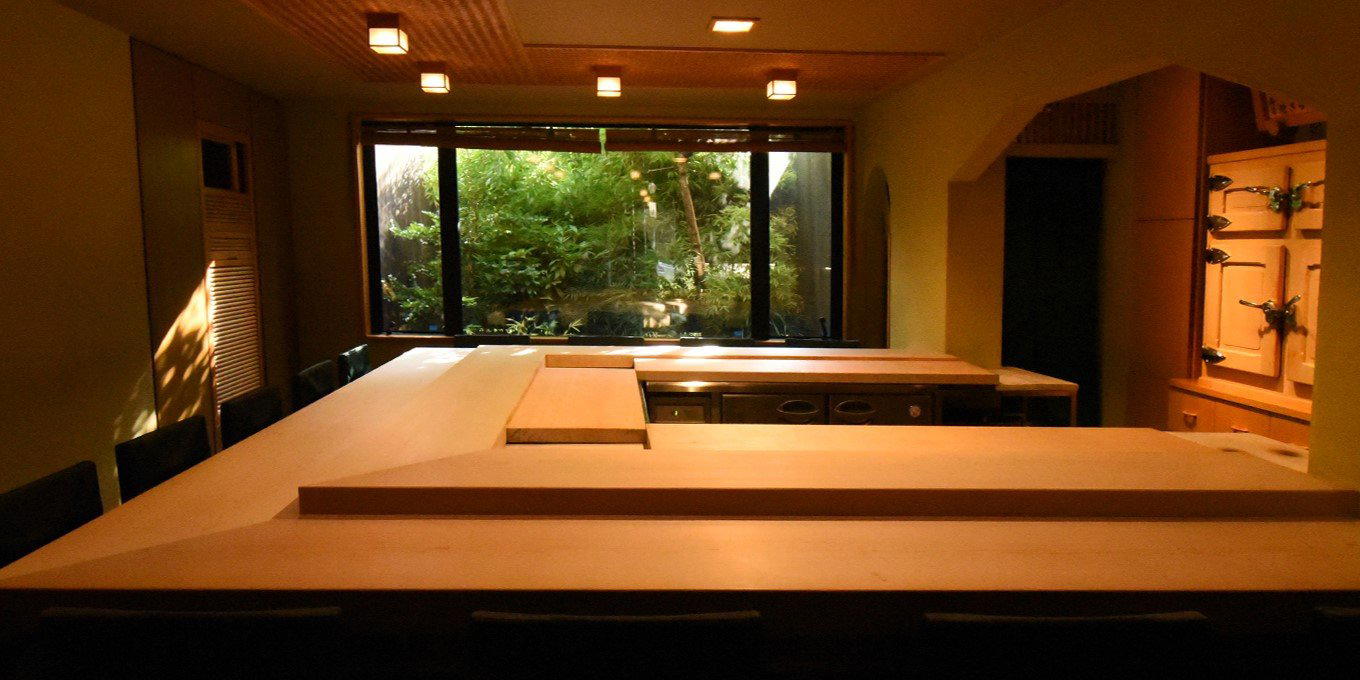
Warm lighting in a quiet alley hideaway with plain wood counter, subtle wood scent, and view of a small tsuboniwa garden evoking traditional Japanese serenity.