Our verdict
Robot Restaurant in Tokyo's Shinjuku district sits at the far end of the entertainment-dining spectrum, trading quiet refinement for sensory overload: blinding LED arrays, mechanical performers, and theatrical spectacle on a scale that places it in a different category from Tokyo's kaiseki counters and omakase rooms entirely. It is a show that happens to serve food, not a restaurant that happens to have a show.

Pearl is the En Primeur Club membership app — saves, bookings, and concierge access live there. Same editors, same standards.
- Address
- Tokyo, Japan
- Directions
- Get directions
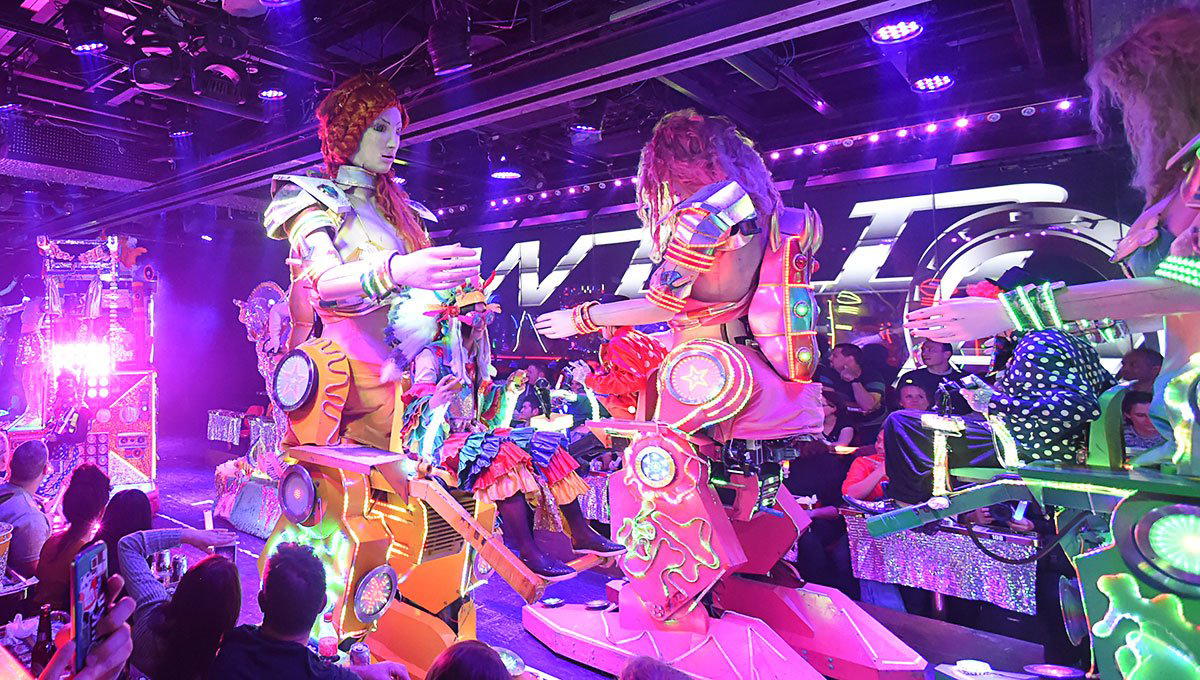
Where Entertainment Overwrites the Menu
Tokyo's dining spectrum runs an unusually wide range. At one end sit the eight-seat omakase counters of Ginza and Minami-Aoyama, where silence, precision, and decades of technique define the experience. Places like Harutaka or RyuGin treat the room itself as an instrument of focus. At the opposite end sits Robot Restaurant, a venue in Shinjuku's Kabukicho district that approaches the question of dining from an entirely different direction: spectacle first, food second, quiet never.
That positioning is not a criticism. It is a description of a format that occupies its own category in Tokyo's hospitality ecosystem. Where L'Effervescence or Sézanne ask you to attend to nuance, Robot Restaurant asks you to surrender to volume. The two impulses are not in competition; they serve entirely different audiences and entirely different needs within the same city.
The Sensory Architecture of Kabukicho's Most Talked-About Room
Kabukicho, the entertainment quarter that extends north from Shinjuku station's east exit, is one of the densest concentrations of neon, noise, and foot traffic in any city in the world. The streets surrounding the venue are already operating at a sensory pitch that would register as extreme in most other urban contexts. Robot Restaurant manages to exceed that pitch once you step inside.
The interior design is built around LED lighting on an industrial scale. Walls, ceilings, and performance stages are lined with programmable lights cycling through colour sequences that shift faster than the eye processes them as individual states. The effect is less like being in a room and more like being inside a display screen. Sound levels during performances operate at the kind of register that makes conversation across a table impossible without raising your voice significantly. This is by design: the production is the foreground, and everything else, including the food and any attempt at quiet dining, recedes to background.
The format is structured around a performance show rather than a meal progression. Performers in elaborate mechanical costumes, oversized robotic props, and choreographed sequences occupy a central stage area while guests sit at banked rows of seating with bento-style food and drinks service running alongside the performance rather than as the primary event. The experience is closer in structure to dinner theatre or a Las Vegas production show than to a restaurant in any conventional sense, and that framing is the most useful one for setting expectations.
Where Robot Restaurant Sits in Tokyo's Broader Scene
Tokyo's entertainment-dining sector has a smaller but real footprint. The city's dominant dining culture tends toward craft and restraint: the kaiseki tradition, the long apprenticeships of sushi, the French technique that venues like Crony bring to a local context. Robot Restaurant operates outside that tradition entirely, in a niche that targets visitors seeking a distinctly Tokyo-branded spectacle rather than a meal that reflects the city's culinary depth.
That distinction matters for understanding who the venue serves well. Guests arriving from overseas who want a single evening that compresses the visual intensity of Japanese pop culture, robotics aesthetics, and theatrical performance into one setting will find the format delivers on that premise. Guests arriving with the same expectations they would bring to Gion Sasaki in Kyoto or HAJIME in Osaka will find the experience disorienting in a way that is not easily recovered from mid-show.
Across Japan's broader dining geography, from Goh in Fukuoka to akordu in Nara to aki nagao in Sapporo, the defining pattern of the country's recognised dining culture is intimacy, technique, and the kind of attention that only comes in rooms where the format actively suppresses distraction. Robot Restaurant is the explicit inversion of that pattern. It is worth understanding it as such rather than measuring it against a standard it has no interest in meeting.
Planning a Visit: What the Format Requires
Advance booking is the standard approach particularly during peak tourist periods in spring (March to May, coinciding with cherry blossom season) and autumn (October to November), when Shinjuku operates at its highest visitor volumes and popular entertainment venues fill well ahead of time. The area around Kabukicho is accessible on foot from Shinjuku station, one of the busiest transit hubs in Japan, served by JR lines, Tokyo Metro, and multiple private rail operators, making logistics from most parts of central Tokyo direct.
The show format typically runs in defined sessions rather than continuous service, which means arriving at the correct time for your booked session matters more than it would at a standard restaurant. Food and drink service is included in the admission structure in most formats, though the food is not the draw and should not be treated as one.
For visitors building a broader Tokyo itinerary, Robot Restaurant occupies an evening slot that works as a counterpoint to the city's quieter cultural programming. Pair it with daytime visits to temples or markets rather than on the same evening as a serious dinner reservation, as the sensory contrast would be difficult to navigate in either direction. For reference, our full Tokyo restaurants guide maps the city's dining options across formats and price points, from counter omakase to neighbourhood izakaya.
The Honest Case For and Against
The format generates strong reactions in both directions, and both reactions tend to be accurate. Guests who arrive calibrated to its actual premise, a high-production entertainment show with food as a side element, typically find the spectacle delivers what it promises. Guests who arrive expecting a restaurant with an interesting theme typically find the noise, the pace, and the food quality leave them flat. The experience is not poorly executed for what it is; the question is whether what it is matches what you are looking for on a given evening in Tokyo.
In the international context of dinner-and-show formats, Robot Restaurant sits alongside venues like Lazy Bear in San Francisco or Le Bernardin in New York City only in the broadest sense that all three venues involve food and an environment designed to produce a specific feeling. The actual experiences diverge sharply from there.
For visitors extending beyond Tokyo, the quieter end of Japan's dining spectrum is accessible in cities like Akita, Oita, Imabari, and Ashiya, where the format priorities shift entirely toward ingredient and technique. That range, from Kabukicho spectacle to regional omakase, is part of what makes Japan's food culture impossible to flatten into a single narrative.
Frequently asked questions
What is the signature dish at Robot Restaurant?
Do they take walk-ins at Robot Restaurant?
What is Robot Restaurant leading at?
Do they accommodate allergies at Robot Restaurant?
Is Robot Restaurant worth the price?
When is the ideal time to visit Robot Restaurant?
How does Robot Restaurant fit into a first-time Tokyo itinerary?
A Lean Comparison
A quick snapshot of similar venues for side-by-side context.
| Venue | Cuisine | Price | Awards | Notes |
|---|---|---|---|---|
| Robot RestaurantThis venue — the venue you are viewing | Robot Cabaret Show | $50–100 | Not listed | Not listed |
| Harutaka | Edo-Style Omakase Sushi | $200–300 | 3 Michelin Stars · World's 50 Best #76 | Sushi |
| L'Effervescence | Modern French with Japanese Influences | $200–300 | 3 Michelin Stars · World's 50 Best #69 | French |
| RyuGin | Modern Kaiseki | $500+ | 3 Michelin Stars · World's 50 Best #41 | Kaiseki, Japanese |
| Crony | Modern French with Japanese Influences | $150–200 | 2 Michelin Stars · World's 50 Best #34 | Innovative, French |
| Den | Modern Japanese Kaiseki | $150–200 | 2 Michelin Stars · World's 50 Best #51 | Innovative, Japanese |










Details
- Lively
- Energetic
- Trendy
- Well Known
- Whimsical
- Celebration
- Special Occasion
- Group Dining
- Live Music
- Sake Program
- Set Menu
- Sake Program
Gaudy and futuristic with mirrors, crystals, LEDs, strobe lights, neon colors, and holographic elements creating a chaotic, high-energy atmosphere.