.png)


Nakiryu sits in Toshima's Minamiotsuka district, a neighbourhood that rarely draws visitors chasing Tokyo's fine-dining circuit, yet this ramen counter holds a Michelin star that puts it in a different competitive tier from the city's casual noodle shops. The bowl here is a precise, multi-element composition that rewards attention to sequencing and pacing rather than speed.
Pearl is the En Primeur Club membership app — saves, bookings, and concierge access live there. Same editors, same standards.
- Address
- Japan, 〒170-0005 Tokyo, Toshima City, Minamiotsuka, 2 Chome−34−4 SKY南大塚 1F
- Phone
- +81363041811
- Website
- gf8f400.gorp.jp
 Saves & bookings on Pearl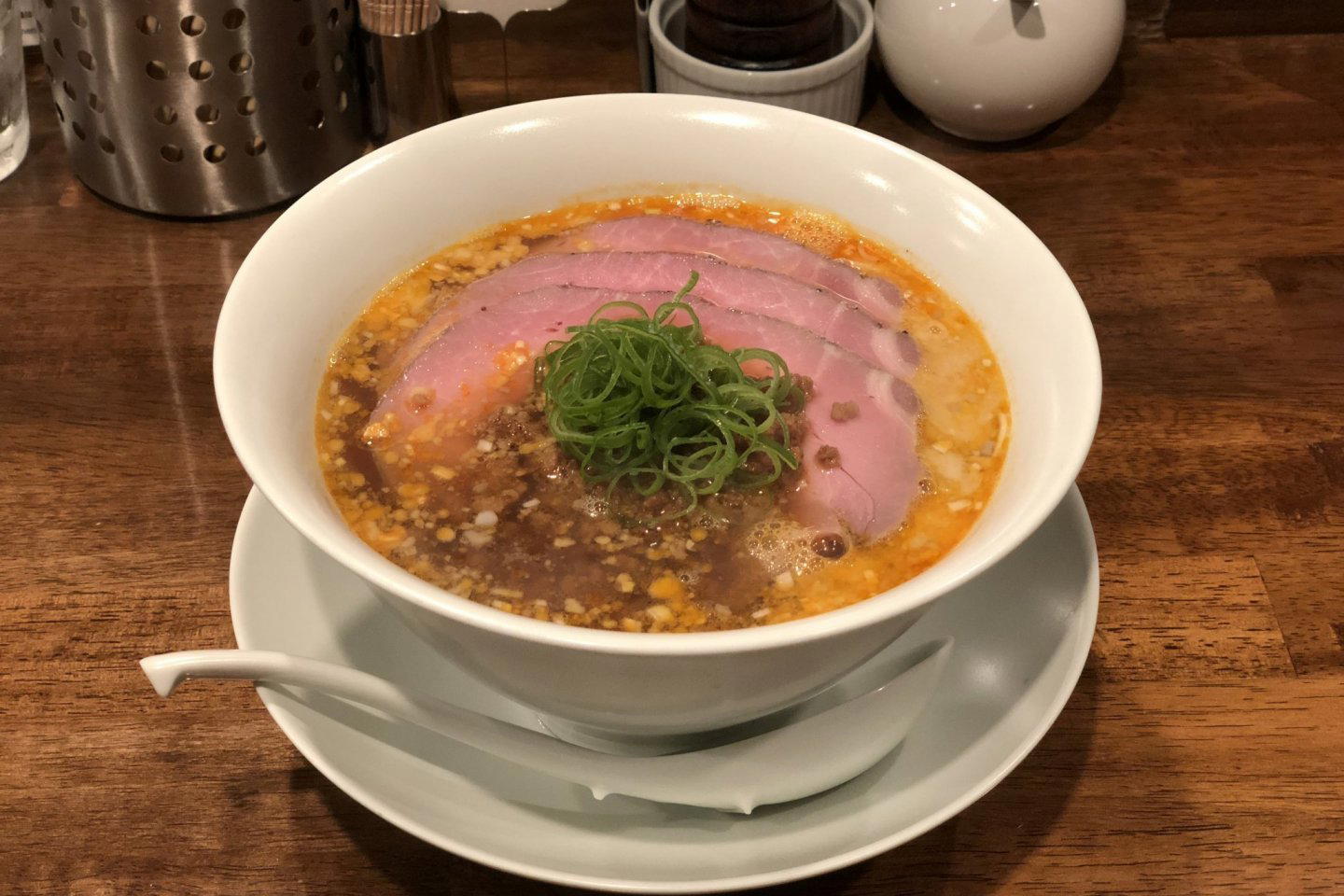
Where Tokyo's Ramen Hierarchy Gets Complicated
Tokyo's ramen scene is among the more stratified in the world. At one end sits the ¥800 counter-service bowl eaten standing up; at the other, a small cluster of shops that have attracted serious critical attention, Michelin recognition, and the kind of queues that require pre-dawn planning. Nakiryu occupies this upper tier, located in Toshima's Minamiotsuka neighbourhood, an area that sits well outside the standard tourist routing of Ginza, Shinjuku, and Shibuya. The address itself is part of the story: serious ramen in Tokyo has rarely correlated with prestigious postcodes, and Nakiryu is no exception.
Michelin's inclusion of ramen in its Tokyo guide was, when it first happened, a statement about how Japan's inspectors read the category. A bowl of noodles in broth, if executed with the same precision and ingredient discipline as a kaiseki course, qualifies for the same evaluative framework. Nakiryu's star reflects that logic.
The Arc of the Bowl
The editorial angle that applies to Nakiryu is less about a single dish and more about sequence and pace. Ramen, in its most considered form, is not a static thing. It changes as the temperature drops, as the fat emulsifies further, as the noodles absorb broth. The experience at a Michelin-recognised counter like this one is designed to be read in phases, much like a tasting menu structured to move through weight, acid, and richness. The opening sip of broth sets the register: how saline, how aromatic, how deep the base stock runs. The noodles arrive with a specific texture calibrated to hold that broth rather than compete with it. What separates the upper tier of Tokyo ramen from its mid-range counterparts is this kind of intentionality in construction, where each element is considered in relation to the others rather than assembled for volume or speed.
This is the register in which Nakiryu operates. The bowl is a composition, not a convenience food. Comparing this experience to the top end of Tokyo's broader dining circuit, which includes kaiseki houses like RyuGin or French tasting menus at L'Effervescence and Sézanne, the ramen counter works within severe constraints: one or two core formats, a single temperature arc, no room for mid-meal palate resets with bread or sorbet. The discipline required to produce something Michelin-worthy within those constraints is considerable.
Toshima as a Dining Destination
Minamiotsuka sits in Toshima ward, a district that most international visitors associate with Ikebukuro's commercial density rather than serious eating. That gap between expectation and reality is precisely why Nakiryu draws from beyond its immediate neighbourhood. Tokyo's most interesting food discoveries have rarely been concentrated in the obvious districts. The city's dining geography rewards lateral movement: a sushi counter of note in a residential pocket of Minato, a French kitchen earning recognition in a commercial block in Shinjuku, a ramen shop with a Michelin star in Toshima.
How Nakiryu Sits Against Its Peers
Within Tokyo's Michelin-starred dining tier, Nakiryu occupies a specific and somewhat unusual position. The starred restaurants across Harutaka (sushi), Crony (innovative French), and the kaiseki and French formats referenced above all operate at higher price points, with covers priced accordingly. Nakiryu, as a ramen counter, sits at a fraction of that price, which creates an interesting question about value within the Michelin framework. The star signals technical achievement and ingredient quality; it does not require that the experience carry the same price weight as an omakase or multi-course tasting menu. For a reader weighing multiple starred dinners in a Tokyo trip, a Nakiryu visit occupies a different budget and time slot without sacrificing critical credibility.
| Venue | Format | Price Tier | Location | Booking Approach |
|---|---|---|---|---|
| Nakiryu | Ramen counter | ¥ | Toshima (Minamiotsuka) | Queue-based; arrival timing essential |
| Harutaka | Sushi omakase | ¥¥¥¥ | Ginza | Advance reservation |
| RyuGin | Kaiseki | ¥¥¥¥ | Roppongi | Advance reservation |
| L'Effervescence | French tasting menu | ¥¥¥¥ | Nishi-Azabu | Advance reservation |
| Sézanne | French tasting menu | ¥¥¥¥ | Marunouchi | Advance reservation |
Japan's Wider Starred Dining Picture
Tokyo holds more Michelin stars than any other city, but the pattern of starred ramen shops extends beyond the capital. Japan's regional dining scene includes its own tier of serious, recognised kitchens: HAJIME in Osaka, Gion Sasaki in Kyoto, akordu in Nara, and Goh in Fukuoka all represent the depth of Japan's culinary infrastructure outside the capital. Smaller regional entries worth tracking include 一本木 有川製 in Nanao, 夕佳亭山乃 in Sapporo, 湖鄰庵 in Takashima, 岳羽屋 in Nishikawa Machi, and Birdland in Sakai. The argument that serious eating in Japan requires Tokyo is one the country's regional kitchens have spent a decade dismantling. Regional Japanese dining also extends to approachable formats: Bistro Ange in Toyohashi represents the kind of neighbourhood-level quality that Japan maintains across prefectures rather than concentrating exclusively in its major cities.
Planning a Visit
Nakiryu is located at 2-34-4 Minamiotsuka, Toshima City, Tokyo. The nearest transit access is via the Otsuka or Sugamo areas. As with the majority of Tokyo's Michelin-starred ramen counters, the operational model is queue-based rather than reservation-based, which means arrival time is the primary planning variable.
A Lean Comparison
Comparable venues nearby, for context on price, style, and recognition.
| Venue | Cuisine | Price | Notes |
|---|---|---|---|
| NakiryuThis venue — the venue you are viewing | Not listed | $$ | Not listed |
| HIKINIKU TO COME (挽肉と米) | Not listed | $$ | Shibuya, Japanese Hamburger Steak with Rice |
| Kinozen | Kagurazaka, Traditional Japanese Sweets | $$ | Not listed |
| Mendokoro Kinari | Nakano, Modern Shoyu Ramen | $$ | Not listed |
| Takenoshita Soba | Shibuya, Traditional Japanese Soba | $$ | Not listed |
| Shimbashi Ippashi | Minato, Seafood-focused Japanese Izakaya | $$ | Not listed |
Recognition history
Dated appearances from independent guides and award organizations, with the underlying list record or original source where available.
Michelin Bib Gourmand
Michelin
Opinionated About Dining Casual in Japan Ranked #146
Opinionated About Dining
Tabelog 100 #92 · No. 92
Tabelog · Tabelog 100 - Ramen - TOKYO - 2025





At a Glance
- Well Known
- Lively
- Casual Hangout
- Solo
- Group Dining
- Open Kitchen
- Sake Program
Current opening hours
- Monday
- 11 AM–3:30 PM
- Tuesday
- 11 AM–3:30 PM
- Wednesday
- 11 AM–3:30 PM
- Thursday
- 11 AM–3:30 PM
- Friday
- 11 AM–3:30 PM
- Saturday
- 11 AM–3:30 PM
- Sunday
- Closed
Hours can change for holidays and private events. Last verified .
Casual, energetic counter-service ramen shop with a simple vending machine ordering system and minimal decor typical of Tokyo ramen joints.