

A Michelin Plate French restaurant in Hiroo, Tokyo, where the format is structured around light, fruit-forward cuisine built on fermentation and salt-pickling, with Hokkaido game as a seasonal anchor. The owner-sommelier serves personally, and the English manor house interior signals an approach to hospitality closer to a private dinner than a commercial sitting. Google-rated 4.6 across 224 reviews.
Pearl is the En Primeur Club membership app — saves, bookings, and concierge access live there. Same editors, same standards.
- Address
- Japan, 〒150-0012 Tokyo, Shibuya, Hiroo, 1 Chome−10−6 広尾ピア寿々 1階
- Phone
- +81 3-6432-5015
- Website
- manoir-restaurant.jp
- Directions
- Get directions
 Saves & bookings on Pearl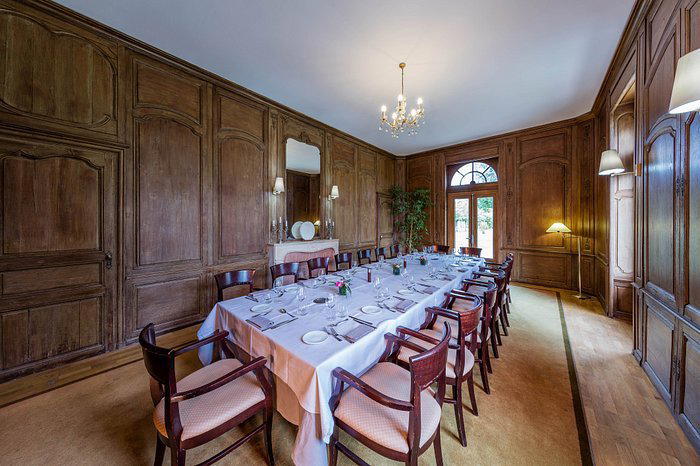
French Dining in Hiroo: The Mid-Tier That Earns Its Place
Tokyo's French restaurant scene is not a single market. At one end sit the grand expressions: Château Restaurant Joël Robuchon and the Michelin-starred progressives like L'Effervescence, Sézanne, and ESqUISSE, all priced at ¥¥¥¥ and requiring advance planning measured in weeks or months. At the other end sits the casual bistro circuit. Between those poles, a smaller tier operates: structured multi-course French, with serious sourcing and a genuine wine program, at a price point that invites repeat visits rather than rationing them. MANOIR, in Hiroo's quiet residential edge of Shibuya, occupies that middle register and does so with enough editorial specificity, fermented fruit accents, wild game from Hokkaido hunters, an owner-sommelier working the room personally, to justify its Michelin Plate recognition in 2025.
The Logic of the Structured Meal Here
The prix fixe format suits MANOIR's sourcing model directly. Wild game delivered by hunters from Hokkaido and other regions across Japan does not arrive on a predictable schedule, which makes a fixed seasonal menu more honest than an à la carte list that pretends consistency. The kitchen's stated approach, light French technique, with fruit sweetness and tartness layered over umami derived from fermentation and salt-pickling, requires sequence and pacing to read clearly. Served as separate plates with gaps between, those flavour contrasts would be easy to miss. Across a structured sitting, they accumulate into something the diner can track course by course.
This is the underlying logic of multi-course dining that Tokyo's French scene has understood for decades: a tasting menu is not about volume but about argument. Each dish is an edit, and the edit only makes sense in order. MANOIR's particular argument, as far as the sourcing signals indicate, is that Japanese fermentation and pickling traditions can be absorbed into a French framework without the result feeling like fusion. The fruit-umami axis is a flavour position, not a concept board.
For readers considering the full range of the city's French options, Florilège operates a comparable structured-meal approach in the ¥¥¥¥ tier with a stronger emphasis on Japanese vegetable sourcing. MANOIR's ¥¥¥ price point and game-led seasonal program represent a distinct competitive position: less conceptually ambitious in presentation, more direct in seasonal ingredient argument.
The Room and Its Hospitality Register
The English manor house interior is not incidental decoration. In a city where French restaurants tend toward either minimalist modernism or formal European classicism, fitting out a Hiroo ground-floor space with manor house references sends a specific hospitality signal: the register here is private home, not institution. That framing is reinforced by the owner-sommelier's decision to serve guests personally. In most restaurants at this price point, the sommelier is a specialist who circulates; here, the owner's presence at the table throughout the sitting is a structural hospitality choice, not a staffing quirk.
The effect, when it works, is that the wine conversation happens inside the meal rather than around it. The sommelier's proximity to both the kitchen's sourcing logic and the individual diner's glass creates conditions for pairing decisions that respond to what is actually being eaten that evening, including whatever game has arrived from the north that week. French wine, listed as the program's anchor, is the natural pairing for a kitchen working in the French technical tradition, however locally the ingredients are sourced.
Hiroo as a Location for This Kind of Dining
Hiroo sits between Ebisu and Roppongi in Shibuya's residential-commercial zone, at a remove from the tourist and business circuits that concentrate dining foot traffic in Shinjuku, Ginza, and Marunouchi. The neighbourhood has historically supported a stable of mid-to-upper-tier international restaurants, partly because of its proximity to the embassy district and the international residential community it has housed since the post-war period. A French restaurant format premised on an intimate, home-like hospitality register makes structural sense in this neighbourhood in a way it might not in Ginza, where the commercial density and expectation of spectacle work against it.
MANOIR's address at 1 Chome-10-6 Hiroo places it on the quieter residential side of the neighbourhood, away from the main Hiroo shopping street. That location reinforces the atmospheric ambition: this is a sitting that requires the diner to travel to it deliberately, not one that captures passing trade.
Planning a Visit
MANOIR carries a ¥¥¥ price designation, which in Tokyo's French tier places it below the ¥¥¥¥ bracket occupied by peers such as L'Effervescence and Sézanne. The Michelin Plate recognition in the 2025 guide indicates it has been assessed and noted, without the star designation that would trigger the acute booking pressure those neighbours face.6 across 234 reviews suggest consistent execution at the level the format promises.
The game sourcing from Hokkaido and other regions means the autumn and winter months, when Japanese game season runs, are the natural peak period for the menu to be at its most complete. A visit timed to that window will reflect the kitchen's stated sourcing priorities most accurately.
For anyone building a broader Japan itinerary around serious dining, the EP Club also covers HAJIME in Osaka, Gion Sasaki in Kyoto, akordu in Nara, Goh in Fukuoka, 1000 in Yokohama, and 6 in Okinawa. For French dining in the wider Asia-Pacific region, Les Amis in Singapore and Hotel de Ville Crissier in Switzerland represent strong reference points at the upper end of the French formal tradition. Full city guides are available for Tokyo restaurants, Tokyo hotels, Tokyo bars, Tokyo wineries, and Tokyo experiences.
Budget Reality Check
Comparable venues nearby, for context on price, style, and recognition.
| Venue | Cuisine | Price | Awards | Notes |
|---|---|---|---|---|
| MANOIRThis venue — the venue you are viewing | French | $$$$ | Michelin 1 Star | Not listed |
| MONOLITH | Shibuya, Neo-Classical French | $$$$ | Michelin 1 Star | Not listed |
| BEIGE Alain Ducasse | Not listed | $$$$ | Michelin 1 Star | Chūō, Modern French with Japanese Influences |
| Nabeno-Ism | Taitō, French-Edo Fusion Fine Dining | $$$$ | Michelin 1 Star | Not listed |
| L'Atelier de Joël Robuchon Tokyo | Minato, Modern French Fine Dining | $$$$ | Michelin 1 Star | Not listed |
| レ セゾン - Les Saisons - Hotel Imperial | Not listed | $$$$ | Michelin 1 Star | Chiyoda, Classical French with Japanese Influences |
Recognition history
Dated appearances from independent guides and award organizations, with the underlying list record or original source where available.
Michelin 1 Star
Michelin
Michelin Plate
Michelin
Tabelog 100 #62 · No. 62
Tabelog · Tabelog 100 - French - TOKYO - 2025












At a Glance
- Elegant
- Intimate
- Cozy
- Sophisticated
- Relaxed
- Date Night
- Special Occasion
- Celebration
- Chefs Counter
- Extensive Wine List
- Sake Program
- Local Sourcing
- Sustainable Seafood
Current opening hours
- Monday
- Closed
- Tuesday
- 6–10:30 PM
- Wednesday
- 6–10:30 PM
- Thursday
- 6–10:30 PM
- Friday
- 6–10:30 PM
- Saturday
- 6–10:30 PM
- Sunday
- Closed
Hours can change for holidays and private events. Last verified .
Panelled warmth with soft lamplight, wooden accents, chandelier, and a serene, relaxing atmosphere like an English manor.