Tabelog 100 #63
Our verdict
The Naples original that launched a thousand imitations has a Tokyo address in Ebisu's 4-chome, where the same two-pizza doctrine, Margherita or Marinara, holds as firmly as it does on Via Cesare Sersale. In a city where Western imports often undergo significant localisation, da Michele's Ebisu outpost is notable precisely for what it doesn't change. The queue outside tells you most of what you need to know about where it sits in Tokyo's pizza conversation.

Pearl is the En Primeur Club membership app, where members save venues, book tables and use the concierge.
The menu
What to order
- Margherita Pizza
- Marinara Pizza
- Doppia Margherita
Wood, Flour, and the Weight of a Name
Ebisu's restaurant density runs high even by Tokyo standards, with the streets around 4-chome offering everything from counter kaiseki to French bistros drawing the city's serious-eating crowd. Into this environment, L'Antica Pizzeria da Michele arrived carrying one of the most recognised names in Neapolitan pizza, a Naples institution operating continuously since 1870, with a menu philosophy so minimal it borders on doctrine. Two pizzas: Margherita and Marinara. That's the full offering at the source, and the Tokyo address maintains that same studied refusal to expand.
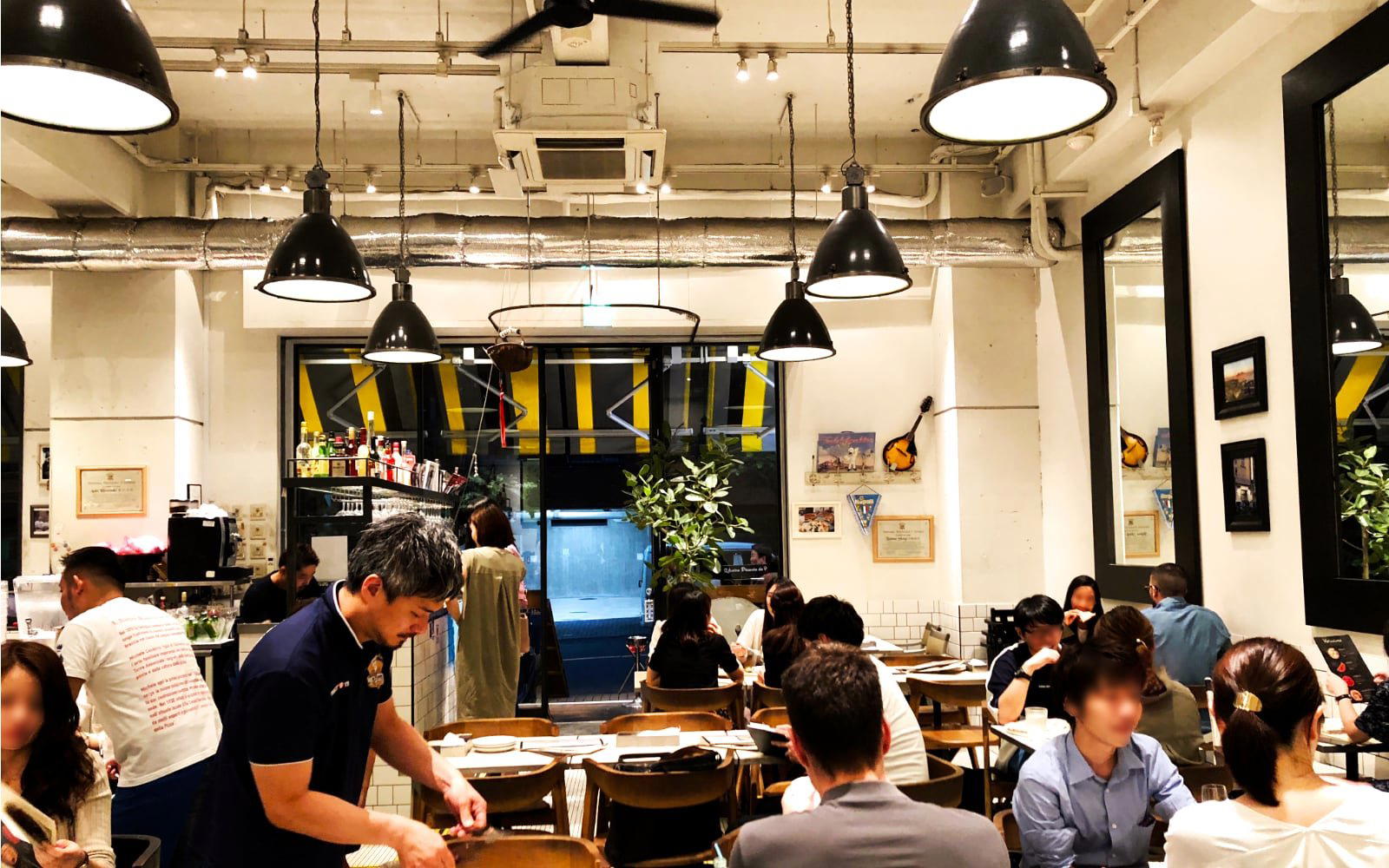
The physical setting in the Dairoku Ito Building on the ground floor is modest in the way that the leading pizza counters tend to be modest, hard surfaces, the smell of char and yeast reaching you before you reach the door, a room temperature shaped more by the oven than by any HVAC consideration. This is not the environment of Tokyo's high-end Western dining tier, where rooms at places like L'Effervescence or Sézanne signal ambition through design. The signal here is different: the oven is the room's centrepiece, and the ritual around it is the point.
What Neapolitan Doctrine Looks Like in Practice
The Vera Pizza Napoletana framework, developed and codified by the Associazione Verace Pizza Napoletana in Naples, specifies everything from flour type and water temperature to the 60-to-90-second cook time in a wood-fired oven running at 430–480°C. Da Michele's original on Via Cesare Sersale has been held up as a primary reference point for that tradition for over a century, which means Tokyo diners aren't encountering an interpretation of Neapolitan pizza. They're encountering the source text, or as close to it as geography permits.
That matters in a city where pizza fluency has grown considerably. Tokyo now has a genuinely sophisticated pizza conversation, with operators trained in Naples, imported flour specifications discussed in trade terms, and a consumer base that can distinguish between a cornicione that's properly leopard-spotted and one that merely looks the part. Against that backdrop, da Michele's two-item menu isn't a gimmick, it's a position statement about what the tradition actually prioritises.
Ebisu as a Setting for This Kind of Import
Ebisu sits between Shibuya's commercial weight to the northwest and Daikanyama's boutique density immediately below it. The neighbourhood draws a mixed crowd: media industry workers, international residents, and a dining public comfortable with both high-end Japanese and imported Western formats. It's a sensible address for a brand that needs to reach an audience with some frame of reference for what da Michele represents, without the tourist-density pressures of Shinjuku or the rarefied posturing of Ginza.
The contrast with Tokyo's premium Western dining tier is instructive. The ¥¥¥¥ counters, Harutaka for sushi, RyuGin for kaiseki, Crony for its brand of innovative French, operate on reservation infrastructure, extended lead times, and tasting formats that stretch across multiple hours. Da Michele's format is the structural inverse: walk-in or short-queue, fast cook time, paper-simple menu. Both represent different but legitimate answers to what a serious restaurant can be.
The Atmosphere Carries the Argument
There's a particular quality to a well-run pizza operation at pace, the way the oven's radiant heat sets the room's temperature, the dusted bench flour briefly visible in the air near the prep station, the sound of a peel scraping against stone. These are not decorative details; they're functional components of a process that has been refined over generations. In Naples, da Michele's original location became famous enough that Anthony Bourdain visited and wrote about it, and Julia Roberts ate there for a scene in Eat Pray Love, cultural references that have calcified into part of the brand's public record. The Tokyo address inherits that association without needing to manufacture its own.
For diners accustomed to the twelve-course formats of Tokyo's Western fine dining, the experience of eating at da Michele operates at a genuinely different frequency. There is no progression, no amuse-bouche, no wine pairing ritual. There is a pizza, a table or counter position, and the question of whether the execution meets the reputation. That directness is part of what makes the format legible across cultures, the criteria for assessment are narrow and clear.
Where This Fits in the Broader Japan Picture
Japan's serious dining map extends well beyond Tokyo. Osaka has HAJIME, Kyoto has Gion Sasaki, Nara has akordu, and Fukuoka has Goh, all operating in formats where Japanese craft and seasonal specificity are central to the proposition. Da Michele's Tokyo address occupies a different register entirely: it's not making a claim about Japanese ingredients or technique. It's making a claim about the integrity of a foreign tradition, and whether that tradition can be maintained at distance from its origin point.
That question sits at the centre of Tokyo's most interesting Western restaurant imports. The city has demonstrated repeatedly that it can sustain foreign dining traditions at high levels, French technique in particular has deep roots here. The Italian category, and Neapolitan pizza specifically, is a more recent area of serious attention, and da Michele's presence adds a reference point that other operators in the category have to position themselves against. See our full Tokyo restaurants guide for how this fits within the wider picture, and consider how it compares to high-precision operators in other categories globally, like Le Bernardin in New York or Atomix, all cases where a defined tradition is executed with unusual discipline.
Planning Your Visit
L'Antica Pizzeria da Michele is located at 4-chome-4-7, Ebisu, Shibuya, Tokyo, on the ground floor of the Dairoku Ito Building. Ebisu Station on the JR Yamanote Line and the Tokyo Metro Hibiya Line puts you within easy walking distance. Given the format, high-turnover, minimal menu, the practical calculus is simpler than at most Tokyo addresses of comparable reputation: arrive, queue if necessary, eat. Visitors travelling beyond Tokyo can use da Michele as a point of orientation for the city's pizza conversation before moving on to broader Japan itineraries that include destinations like Nanao, Sapporo, Takashima, Nishikawa Machi, Sakai, or Toyohashi.
Frequently asked questions
Where is L'Antica Pizzeria da Michele located?
L'Antica Pizzeria da Michele is located at Japan, 〒150-0013 Tokyo, Shibuya, Ebisu, 4 Chome−4−7 第6伊藤ビル 1階, Tokyo.
Is L'Antica Pizzeria da Michele Tokyo connected to the original Naples location?
Yes, L'Antica Pizzeria da Michele operates as an internationally expanded brand from the founding Naples pizzeria established in 1870, with locations now across multiple countries including Japan. The Ebisu address at 4-chome-4-7 in Shibuya, Tokyo, operates under the da Michele name and the Vera Pizza Napoletana production standards that define the parent brand. That lineage is the reason the Tokyo outpost draws a different kind of attention than a standalone Neapolitan-style operation would.
What do regulars order at L'Antica Pizzeria da Michele?
The da Michele name is synonymous with a deliberately short menu, in Naples, the original location has served essentially two pizzas for over 150 years: the Margherita and the Marinara. Tokyo guests follow the same logic, arriving with a specific pizza in mind rather than deliberating over options. The restraint is the point: the kitchen's focus stays narrow, and the product benefits.
How hard is it to get a table at L'Antica Pizzeria da Michele?
Ebisu's 4-chome strip draws consistent foot traffic from the Shibuya and Daikanyama crowd, and the da Michele name carries global recognition that pre-loads demand before a location even opens.
What makes L'Antica Pizzeria da Michele worth seeking out?
The original L'Antica Pizzeria da Michele in Naples dates to 1870, making it one of the oldest continuously operating pizzerias in the world, a credential the Tokyo address inherits by name and by operating standard. The Vera Pizza Napoletana framework governs the dough, flour, fermentation, and oven protocol, so what arrives in Ebisu is structurally the same product being made in Naples. In a city where ramen counters and sushi bars set a high bar for category precision, da Michele operates with comparable single-category discipline.
Can L'Antica Pizzeria da Michele adjust for dietary needs?
Vera Pizza Napoletana certification constrains what can be changed without compromising the product, the dough formula and cooking method are fixed by protocol. Marinara, the tomato-and-garlic pizza without cheese, is naturally dairy-free and has been on the menu since the beginning.
Where the Accolades Land
Comparable venues nearby, for context on price, style, and recognition.
| Venue | Cuisine | Price | Awards | Notes |
|---|---|---|---|---|
| L'Antica Pizzeria da MicheleThis venue (the venue you are viewing) | Authentic Neapolitan Pizza | $20–30 | Tabelog 100 #63 | Not listed |
| PIZZERIA IL TAMBURELLO | Authentic Neapolitan Pizza | $20–30 | Gambero Rosso 2 Spicchi · Tabelog 100 #16 | Chūō |
| PIZZA DA BABBO | Traditional Neapolitan pizza & Italian trattoria | $20–30 | Tabelog 100 #61 | Chūō |
| Pizzeria Parentesi | Organic-focused Neapolitan-style Pizzeria & Italian in Meguro | $30–50 | Tabelog 100 #34 | Meguro |
| MASSIMOTTAVIO | Neapolitan Pizza | Not listed | 50 Top Pizza Asia-Pacific #32 · Tabelog 100 #89 | Suginami |
| Pizzeria e Trattoria da ISA | Neapolitan Pizza | $20–30 | Not listed | Meguro |
Recognition history
Dated appearances from independent guides and award organizations, with the underlying list record or original source where available.
Opinionated About Dining Casual in Japan Ranked #65
Opinionated About Dining
Tabelog 100 #63 · No. 63
Tabelog · Tabelog 100 - Pizza - 2025