Our verdict
On Pharaon Street in Beirut, BARON occupies a position that regulars treat as a fixed point in the city's dining week. The address has built its following through consistency and a sense of place rather than seasonal reinvention, drawing the kind of clientele that books a table not to mark an occasion but because returning is simply part of how they eat in this city.

Pearl is the En Primeur Club membership app — saves, bookings, and concierge access live there. Same editors, same standards.
- Address
- Pharaon Street Building 125, Beirut, Lebanon
- Phone
- +96179179099
- Hours
- Daily 12–11:30 PM
- Website
- eatdrinkbaron.com
- Directions
- Get directions
- Booking
- Book on the venue's website
The menu
What to order
- Roasted cauliflower with tahini, pomegranate and walnuts
- Pork merguez
- Beef brisket in bao buns
- Brussels sprouts with miso butter
- Scallops in miso butter
Pharaon Street and the Architecture of Loyalty
Beirut has always rewarded its survivors. The restaurants that endure through the city's oscillating fortunes tend to share a common trait: regulars who treat them less as destinations than as extensions of domestic life. On Pharaon Street, Building 125, BARON sits in that category. The address doesn't announce itself with the programmatic intensity of the newer Gemmayzeh openings or the white-tablecloth formality of the established Ashrafieh institutions. What it offers instead is something Beirut's dining culture has always prized above novelty: a room that knows you back.
This is the lens through which BARON is leading understood. Its following isn't built on a single showpiece element — a celebrated chef, a tasting menu format, or a terrace view over the Mediterranean. It's built on the kind of friction-free familiarity that comes from a kitchen and a room working in steady, reliable alignment over time. In a city where that reliability has been genuinely hard-won, the gesture carries weight.
What Draws the Same Faces Back
Across Beirut's dining tiers, from the mezze institutions like Al Halabi and the expansive theatrical formats of Em Sherif to the neighbourhood gathering points like Al Falamanki Sodeco, the venues that cultivate genuine regulars tend to operate on a different logic than those chasing first-time visitors. The occasional diner wants discovery. The regular wants a table that feels pre-reserved in spirit even when it isn't.
BARON's position on Pharaon Street places it in one of Beirut's more layered neighbourhoods, where the built environment carries memory in a way that directly shapes the character of the dining rooms within it. The address itself, Building 125, is a locator that regulars know without needing further context. For first-time visitors, it asks for a little orientation, which is often how the better addresses in this city work. In Beirut's restaurant culture, the places that are slightly harder to locate without local knowledge tend to be the ones worth locating.
Venues that operate at this register in the Lebanese capital share certain characteristics. The menu typically reflects the kind of cooking that holds up across multiple visits rather than a format designed to impress on a single occasion. Compare this with the more self-consciously produced dining experiences elsewhere in the city — the Albergo rooftop formats like Albergo Rooftop, which places Lebanese cuisine within a hotel register designed for guests with limited visits, or the rawda-style casual houses like Al Rawda - Shatila, which operate on neighbourhood canteen logic. BARON occupies a middle tier that is neither occasion-formal nor canteen-casual, which is precisely where regulars tend to anchor.
Beirut's Dining Rhythm and Where BARON Sits
Lebanon's restaurant culture is one of the most socially embedded in the region. Eating out here is rarely a transactional act. The mezze format, with its slow deployment of small plates across an extended table, is structurally designed for conversation and return. Dishes arrive in waves rather than sequences, the table fills and empties and fills again, and the meal's duration is determined by the company rather than the kitchen's pacing. This is the tradition within which a venue like BARON operates, even where the specific format may vary.
Beyond Beirut, the broader Lebanese dining circuit extends to addresses like Onno Bistro in Bourj Hammoud, Al Halabi in the Matn District, and the wine-forward approach at BRUT by Youssef Akiki in Keserwan. Further afield, the coastal addresses, Feniqia in Byblos, Jammal in Batroun, offer a different register of Lebanese hospitality, one shaped by sea proximity and a more relaxed seasonal rhythm. The Bekaa Valley institutions like Shams in Aanjar and Lakkis Farm in Baalbek take the meal deeper into agricultural context. Against this dispersed geography, Beirut addresses like BARON serve as the city's own fixed points: the restaurants that function as social infrastructure rather than destinations.
The comparison is worth drawing internationally, too. The Beirut regular's relationship with a neighbourhood table has something in common with the loyalty dynamic at a sustained New York institution like Le Bernardin, where regulars navigate by the room's unwritten codes as much as the printed menu. The scale and formality differ entirely, but the underlying logic, a room that rewards return, is consistent across dining cultures. On the West Coast, the communal dinner format at Lazy Bear in San Francisco creates a different version of the same bond, this time through structured intimacy rather than open-ended mezze time.
Street Food Anchors and the Wider Network
No account of Beirut's dining culture is complete without its street-level nodes. Falafel Sahyoun operates at a register entirely removed from restaurant dining, but it anchors the same culture of return. The Lebanese tendency to have specific, non-negotiable addresses for specific dishes, one place for falafel, another for raw kibbeh, another for a long Friday lunch, is part of the same social architecture that supports a venue like BARON. The regulars who use BARON as a weekly anchor likely have an equally fixed address for the food that doesn't fit a restaurant table.
Further into the mountains, Kitchen Garage in Aley and Laiterie Massabki in Chtoura represent the domestic-scale hospitality that defines Lebanese eating outside the capital: small operations with strong local loyalty and a product depth that comes from proximity to the source. BARON's urban version of this logic is compressed into a city address, but the principle translates.
Finding BARON and Planning a Visit
BARON is located at Building 125, Pharaon Street, Beirut. The address is specific enough to locate with a map application, and the Pharaon Street reference provides enough neighbourhood context for anyone familiar with central Beirut to orient themselves quickly. In Beirut's dining culture, that mode of access is neither unusual nor a disadvantage, some of the city's most consistent addresses operate on exactly this basis.
First-time visitors to the address would do well to arrive without a rigid timetable. The meal format that defines this city's leading rooms is unhurried by design, and BARON's following suggests a room that operates on that same understanding. For a broader orientation to Beirut's restaurant scene before or after a visit, the EP Club Beirut restaurants guide maps the full range of the city's dining options by neighbourhood and register.
Frequently asked questions
Where do I go for BARON?
BARON is located at Pharaon Street Building 125, Beirut, Lebanon, Beirut.
What kind of dining experience does BARON offer compared to Beirut's larger format restaurants?
BARON on Pharaon Street operates at a different register from Beirut's more theatrical multi-room venues. Where places like Em Sherif are built around spectacle and scale, a Pharaon Street address typically anchors something more neighbourhood-facing, where the room earns its reputation through repeat custom rather than first-impression staging. Beirut's dining culture rewards this format well, given how socially embedded the city's eating-out habits are.
What do people recommend at BARON?
The crowd that comes back repeatedly tends to signal kitchen consistency over novelty. Asking staff on arrival for current preferences is the most reliable approach.
Do they take walk-ins at BARON?
No booking policy is publicly listed for BARON at Building 125, Pharaon Street, Beirut. Restaurants in this tier of the city's dining circuit often accommodate walk-ins during off-peak hours, though neighbourhood regulars can fill rooms quickly on weekends. Arriving early in the evening or on a weekday gives the best chance of a table without a reservation.
Cuisine and Credentials
| Venue | Cuisine | Price | Awards | Notes |
|---|---|---|---|---|
| BARONThis venue — the venue you are viewing | Mediterranean-Japanese Fusion | $30–50 | Not listed | Not listed |
| Albergo Rooftop | Mediterranean with Italian Accents | $50–100 | Relais Chateaux Award | Lebanese Cuisine |
| Em Sherif | Traditional Lebanese Fine Dining | $50–100 | World's 50 Best #13 | Not listed |
| Beihouse | Modern Levantine Mediterranean | $50–100 | World's 50 Best #5 · The Best Chef One Knife | Not listed |
| Buco | Modern Gastro Burgers | Not listed | World's 50 Best #39 | Not listed |
| Al Falamanki Sodeco | Traditional Lebanese | $20–30 | Not listed | Not listed |
Continue exploring
More in Beirut
Restaurants in Beirut
Browse all →
Bars in Beirut
Browse all →
Hotels in Beirut
Browse all →

Details
- Cozy
- Trendy
- Intimate
- Modern
- Date Night
- Group Dining
- Casual Hangout
- Special Occasion
- Open Kitchen
- Chefs Counter
- Garden
- Terrace
- Craft Cocktails
- Farm To Table
- Local Sourcing
- Organic
- Garden
- Small Plates
- Counter Dining
- Family Style
- Craft Cocktails
- Wine
- Vegetarian Friendly
- Pescatarian Friendly
- Gluten Free Options
Current opening hours
- Monday
- 12–11:30 PM
- Tuesday
- 12–11:30 PM
- Wednesday
- 12–11:30 PM
- Thursday
- 12–11:30 PM
- Friday
- 12–11:30 PM
- Saturday
- 12–11:30 PM
- Sunday
- 12–11:30 PM
Hours can change for holidays and private events. Last verified .
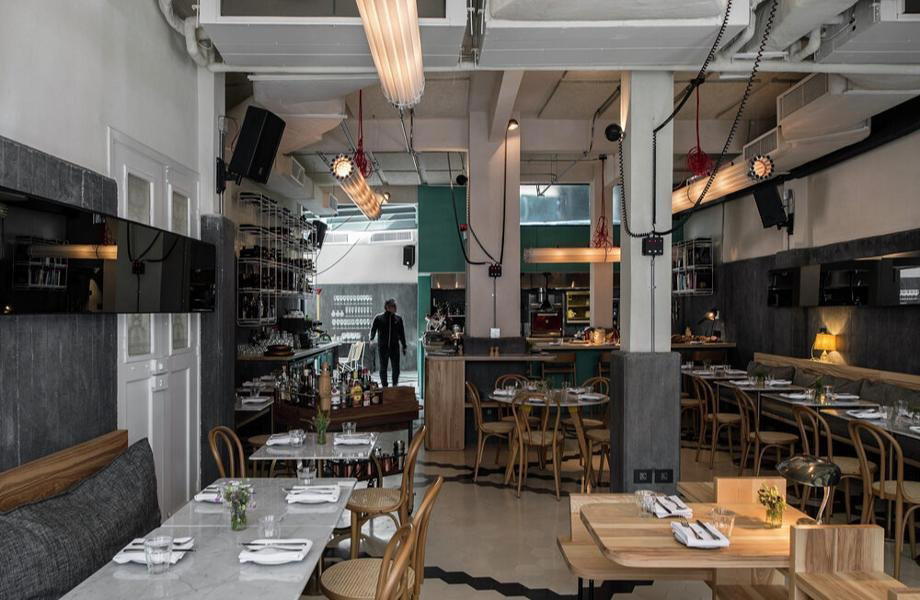
Intimate and cozy with blonde-wood seating and slate accents surrounding an open kitchen; warm, unfussy atmosphere in a fashionable artsy neighborhood with an intimate garden terrace.