A conceptual dining installation in Kanazawa's Ikedamachi district, インスタレーションテーブル エンソ ラシンメトリー ドゥ カルム sits at the intersection of art and table, where the city's deep ingredient culture meets structured technique. The name itself signals intent: asymmetry, calm, and circularity as organizing principles. For travelers already exploring Kanazawa's broader dining scene, this address represents the experimental edge of that conversation.
Pearl is the En Primeur Club membership app — saves, bookings, and concierge access live there. Same editors, same standards.
- Address
- 4 Bancho-33 Ikedamachi, Kanazawa, Ishikawa 920-0986, Japan
- Phone
- +81762084052
- Website
- enso-kanazawa.com
- Directions
- Get directions
 Saves & bookings on Pearl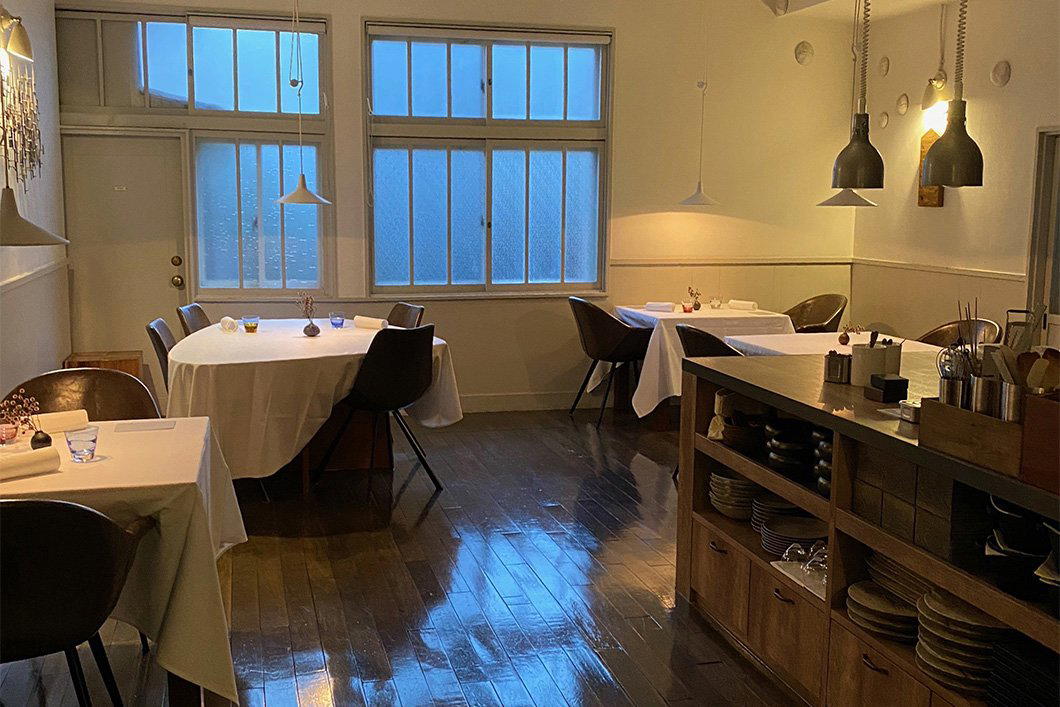
Where Installation Meets Table in Ikedamachi
Ikedamachi sits just south of Kanazawa's central districts, away from the more trafficked corridors near Higashi Chaya and Kenroku-en. The neighborhood carries a quieter register, its low-rise streetscape more workshop than showcase, which makes it a natural address for a dining concept that positions itself closer to art installation than conventional restaurant. The name インスタレーションテーブル エンソ ラシンメトリー ドゥ カルム parses as a deliberate provocation: "installation table," "ensō" (the Zen circle), "asymmetry," "calm." These are not accidental word choices, and they signal a format that is less interested in classical hospitality conventions than in the experience of the table as a composed spatial event.
Kanazawa has long maintained a dual identity in Japan's dining conversation. The city produces some of the country's most sought-after ingredients, Noto Peninsula seafood, Kaga vegetables, regional sake, and it houses a kaiseki tradition sophisticated enough to sit in genuine dialogue with Kyoto. At the same time, a younger generation of concepts has emerged that treat those same ingredients as raw material for something more explicitly cross-cultural. This venue's address in that second current connects it to a broader national movement, one visible in cities from Fukuoka to Osaka, where chefs trained in European or conceptual frameworks are building menus that use Japanese ingredients as primary vocabulary rather than supporting cast.
The Logic of Asymmetry: What the Name Signals About the Format
The title "ラシンメトリー" (asymmetry) and "カルム" (calm, from the French calme) point directly at the venue's operating aesthetic. Asymmetry in a dining context typically means a rejection of the paired, mirrored, or course-by-course logic that governs both kaiseki and classical French tasting menus. Instead, courses arrive in sequences governed by contrast and surprise rather than escalation. The French borrowing "calme" suggests a European technical framework applied to that asymmetric logic, not fusion in the 1990s sense, but a structural approach to pacing and composition borrowed from one tradition and used to organize another.
This intersection of imported method and local material has become one of the defining tensions in Japan's contemporary dining scene. Venues like HAJIME in Osaka and akordu in Nara have built their identities around exactly this kind of productive friction. The EA-GN-15 angle, local ingredients, global technique, describes not just a stylistic choice but a generational statement: that Japanese produce does not need to be expressed through Japanese form alone. In Kanazawa's specific case, where the ingredient culture is already strong enough to anchor a kaiseki counter, using those same products through a European or conceptual lens is a more charged decision than it would be elsewhere.
For comparison, the kaiseki tradition in Kanazawa, represented by venues including Zeniya and Kataori, operates within a deeply codified form where seasonal ingredients appear in prescribed sequence and presentation. The installation table format at this Ikedamachi address seems to propose something structurally different: the ingredients remain Kanazawa's, but the grammar organizing them is imported, deconstructed, or invented. The ensō symbol reinforces this, the Zen circle is simultaneously complete and open, a form that contains its own negation. Applied to a tasting format, it suggests a menu that circles back, that doesn't resolve in the conventional linear sense.
Kanazawa's Ingredient Culture as Foundation
Understanding what any serious Kanazawa dining concept has to work with requires a brief inventory. The Noto Peninsula, roughly an hour's drive north, supplies yellowtail, crab, and squid of a quality that has made it a reference point for Japanese seafood buyers. Kaga vegetables, a protected regional designation covering varieties like Kaga lotus root, Gorojima kintoki carrot, and Kaga negi, represent one of Japan's more complete regional produce traditions, distinct enough to appear on menus in Tokyo and Kyoto as provenance markers. The area's proximity to the Sea of Japan also means access to winter snow crab during the November-to-March season, when Kanazawa's restaurants of every format tend to build menus around it.
These are not generic Japanese ingredients. They carry specific regional identity and, in several cases, restricted designation. A concept that foregrounds technique over tradition must work with this material in ways that justify the departure from kaiseki convention, otherwise the asymmetry reads as mere novelty rather than considered argument. The venues doing this well in Japan's current scene, from Goh in Fukuoka to Gion Sasaki in Kyoto, treat ingredient provenance as the non-negotiable constant and technique as the variable. That hierarchy appears to be the operating logic here as well.
Kanazawa's Broader Dining Context
Kanazawa's restaurant scene is compact enough that a handful of addresses define each tier. At the traditional end, kaiseki counters and yakitori specialists like those at Hamagurizaka Maekawa hold the established ground. The city's gold-leaf culture, accessible through crafts destinations like Hakuichi, and its confectionery tradition, represented by establishments such as Amanatto Kawamura, establish a broader aesthetic register, detail-oriented, craft-conscious, slow. The more experimental tier is smaller but includes cross-cultural formats like Budoonomori Les Tonnelles, which applies French wine culture to a Kanazawa dining context. At a more democratic price point, Go! Go! Curry and Dokkan represent the city's casual registers.
The installation table concept sits in the experimental tier, in dialogue with venues working the same local-ingredients-plus-imported-technique seam in other Japanese cities, from Harutaka in Tokyo to regional counterparts like 三本松 石川制 in Nanao and 湖辺荘 in Takashima. The question those venues collectively raise, whether conceptual form can carry as much cultural weight as inherited tradition, is one that this Ikedamachi address seems designed to test. The comparison extends internationally: restaurants like Le Bernardin in New York City and Atomix in New York City demonstrate that technical rigor and cross-cultural ambition are not mutually exclusive at the highest level of dining.
Planning Your Visit
The venue is located at 4 Bancho-33 Ikedamachi, Kanazawa, Ishikawa, a residential-adjacent address that requires a deliberate journey rather than a casual walk-in. Ikedamachi is accessible by taxi or bus from Kanazawa Station in under fifteen minutes; the neighborhood itself rewards the approach on foot from the Katamachi district if conditions allow. Given the format implied by the name and concept, this is a booking-essential destination: installation-format dining in Japan typically operates on fixed-time seatings with limited capacity, and contacting the venue in advance is standard practice for any counter with this level of conceptual ambition.
Additional regional context is available through nearby destinations including 石山酒造乃 in Sapporo and 鳥羽屋 in Nishikawa Machi, which share the Sea of Japan ingredient culture that anchors this region's dining identity.
Awards and Standing
Comparable venues nearby, for context on price, style, and recognition.
| Venue | Cuisine | Price | Notes |
|---|---|---|---|
| インスタレーションテーブル エンソ ラシンメトリー ドゥ カルムThis venue — the venue you are viewing | Modern French with Hokuriku Influences | $$$$ | Not listed |
| レストランエンヌRestaurantN | French Bistro with Japanese Ingredients | $$$$ | near Kanazawa Station |
| レストラン エクティル | Contemporary French with Local Kanazawa Ingredients | $$$$ | Kanazawa |
| Restaurant N | Seasonal French Fine Dining | $$$$ | Hommachi |
| ビストロ高柳 | French Bistro | $$$ | Kanazawa |
| Kaiseki Tsuruko (つる幸) | Traditional Kaga Kaiseki | $$$$ | Takaoka-machi |
Continue exploring
More in Kanazawa
Restaurants in Kanazawa
Browse all →
Hotels in Kanazawa
Browse all →
Wineries in Kanazawa
Browse all →
At a Glance
- Elegant
- Modern
- Intimate
- Sophisticated
- Date Night
- Special Occasion
- Open Kitchen
- Historic Building
- Chefs Counter
- Sake Program
- Local Sourcing
Current opening hours
- Monday
- Closed
- Tuesday
- 11:30 AM–1:30 PM, 6–9 PM
- Wednesday
- 11:30 AM–1:30 PM, 6–9 PM
- Thursday
- 11:30 AM–1:30 PM, 6–9 PM
- Friday
- 11:30 AM–1:30 PM, 6–9 PM
- Saturday
- 11:30 AM–1:30 PM, 6–9 PM
- Sunday
- 11:30 AM–1:30 PM, 6–9 PM
Hours can change for holidays and private events. Last verified .
Stylish and modern interior preserving historic charm of the renovated building, with a quiet, calm atmosphere and open view of the chef's workspace.