Our verdict
Shibuya's dining scene has long played second fiddle to Ginza and Roppongi in Tokyo's fine-dining conversation, but 渋谷 鮨一山 represents the quieter, counter-focused tradition that persists in the neighbourhood's back streets. A sushi counter in Shibuya's KEFIA building, it positions itself in the mid-to-upper tier of Tokyo's omakase circuit without the Ginza address premium.

Pearl is the En Primeur Club membership app — saves, bookings, and concierge access live there. Same editors, same standards.
- Address
- Japan, 〒150-0002 Tokyo, Shibuya, 1 Chome−5−9 KEFIAビル N
- Phone
- +81 3-6413-6168
- Website
- sushiikki-japan.com
- Directions
- Get directions
Shibuya's Counter Tradition, Away from the Obvious Addresses
Tokyo's premium sushi conversation tends to anchor itself in Ginza, where three-star counters command international waiting lists and price points that rival comparable rooms in Paris or New York. But Shibuya has always run a parallel track: smaller, less publicised counters that serve a local professional clientele rather than an inbound luxury tourism circuit. 渋谷 鮨一山, operating from the KEFIA building in Shibuya's Chome 1-5-9 address, fits that pattern. The neighbourhood around it is commercial rather than ceremonial, which tends to keep reservation pressure lower and the room quieter than equivalent-quality counters in more destination-facing postcodes.
That geographic positioning matters more than it might appear. In Tokyo's omakase market, the same technical standard can translate to a very different dining experience depending on whether the surrounding neighbourhood draws expense-account tourism or regular local custom. Shibuya draws both, but tilts toward the latter at the counter level, which shapes the pace and character of a meal in ways that address alone cannot convey. For context on how that dynamic plays out across Tokyo's broader dining map, the EP Club Tokyo restaurants guide covers the city's key neighbourhoods and their respective dining registers.
The Team Dynamic at a Counter of This Type
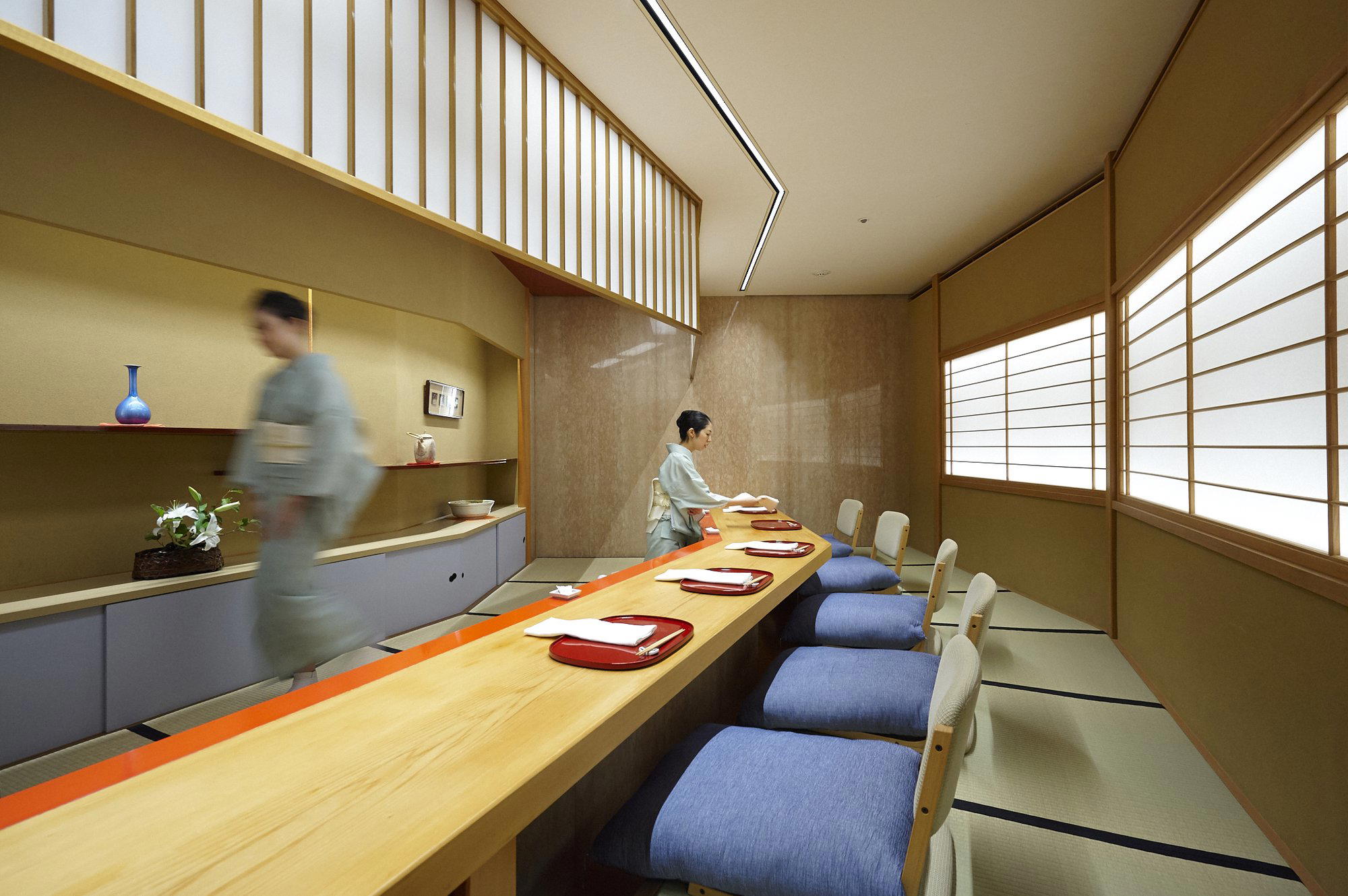
The collaborative structure of a serious sushi counter is worth understanding before the meal begins. Unlike tasting-menu restaurants, where kitchen, floor, and wine program operate as distinct departments, an omakase counter compresses those functions into a tight unit. The itamae reads the room from behind the hinoki; front-of-house pacing, drink pairing, and guest communication often happen through a single point of contact or through a small team with overlapping roles. At counters of this type, the quality of that collaboration is what separates a technically competent meal from one that feels coordinated.
This is where Tokyo's leading counters distinguish themselves from the merely proficient. Harutaka, for instance, has built its reputation partly on the fluency between its counter team and the understated front-of-house rhythm that keeps pacing tight without feeling managed. The same principle applies across format: RyuGin's kaiseki service is notable for the way floor staff translate the kitchen's seasonal logic to guests without narrating every component. At 渋谷 鮨一山, the Shibuya address and the building context suggest a counter that operates closer to the neighbourhood specialist model than to destination theatre.
Where Shibuya Sits in Tokyo's Omakase Tier
Tokyo's omakase market has stratified sharply over the past decade. At the leading, starred counters in Ginza and Azabu price at ¥50,000 and above per person, with booking windows measured in months. A layer below that, counters in Shibuya, Ebisu, and Nakameguro offer comparable fish sourcing and technical precision at a price point that reflects the neighbourhood rather than the postcode premium. It is a distinction that experienced Tokyo diners understand well and that first-time visitors often miss.
Comparison venues at the ¥¥¥¥ tier, such as Harutaka and the French-influenced L'Effervescence, occupy the upper bracket of that market. Innovative tasting-menu formats like Crony and Sézanne represent the French-trained end of Tokyo's premium dining spectrum. A Shibuya sushi counter at this address sits in a different competitive register, one defined more by neighbourhood loyalty and counter craft than by international recognition or starred visibility.
Japan's Counter Culture Beyond Tokyo
The sushi counter format that 渋谷 鮨一山 represents is part of a broader Japanese dining discipline that extends well beyond the capital. In Osaka, HAJIME operates at the intersection of Japanese precision and French structural influence. In Kyoto, Gion Sasaki works within a kaiseki tradition that shares the same seasonal and sourcing logic as premium sushi, even if the format diverges. Further afield, akordu in Nara and Goh in Fukuoka illustrate how Japan's regional dining circuits have developed their own counter-focused precision outside the major cities.
That regional density matters when planning a Japan itinerary. A traveller eating seriously across the country might also consider Abon in Ashiya, affetto akita in Akita, Aji Arai in Oita, Ajidocoro in Yubari District, Akakichi in Imabari, and aki nagao in Sapporo, each of which represents a distinct regional expression of Japanese counter dining.
For readers whose interest in precision counter formats extends internationally, Le Bernardin in New York City and Lazy Bear in San Francisco represent the Western tasting-menu tradition that has absorbed some of the same collaborative service logic, even if the format and cultural framing differ substantially.
Know Before You Go
Address: KEFIA Building, 1-5-9 Shibuya, Shibuya-ku, Tokyo 150-0002
Neighbourhood: Shibuya, Tokyo
Price tier:; comparable Shibuya omakase counters typically range ¥15,000–¥40,000 per person
Awards: No awards confirmed in available data
Website / Phone:
Frequently asked questions
Can I bring kids to 渋谷 鮨一山?
Serious omakase counters in Tokyo are structured around a single, multi-course sequence served at pace — there is no à la carte option and no flexibility to shorten or substitute. Children who cannot sit quietly through an extended counter meal, typically 90 minutes to two hours, are generally not suited to this format. Most counters at this level in Shibuya and across Tokyo discourage young children, though the venue has not published a formal age policy.
What's 渋谷 鮨一喜's location?
渋谷 鮨一喜 is located at Japan, 〒150-0002 Tokyo, Shibuya, 1 Chome−5−9 KEFIAビル N, Tokyo.
How hard is it to get a table at 渋谷 鮨一喜?
Reservations are recommended for 渋谷 鮨一喜 in Tokyo. Confirm current policy via the venue's official channels.
What has 渋谷 鮨一喜 built its reputation on?
渋谷 鮨一喜 is best approached by focusing on the core concept and signature offerings.
The Minimal Set
| Venue | Cuisine | Price | Awards | Notes |
|---|---|---|---|---|
| æ¸è°· 鮨ä¸åThis venue — the venue you are viewing | Traditional Edomae Sushi Omakase | $150–200 | Not listed | Not listed |
| Harutaka | Edo-Style Omakase Sushi | $200–300 | 3 Michelin Stars · World's 50 Best #76 | Sushi |
| L'Effervescence | Modern French with Japanese Influences | $200–300 | 3 Michelin Stars · World's 50 Best #69 | French |
| RyuGin | Modern Kaiseki | $500+ | 3 Michelin Stars · World's 50 Best #41 | Kaiseki, Japanese |
| Crony | Modern French with Japanese Influences | $150–200 | 2 Michelin Stars · World's 50 Best #34 | Innovative, French |
| Den | Modern Japanese Kaiseki | $150–200 | 2 Michelin Stars · World's 50 Best #51 | Innovative, Japanese |