

Tabelog Silver #156
Our verdict
A ten-seat kaiseki counter in Nishiazabu that has held Tabelog Silver every year since 2020 and earned a score of 4.46 in 2026. Chef Koji Yamazaki runs two seatings nightly, Tuesday through Saturday, with a programme centred on exceptional fish and a drinks list that takes sake and wine with equal seriousness. Dinner runs JPY 60,000–79,999.

Pearl is the En Primeur Club membership app, where members save venues, book tables and use the concierge.
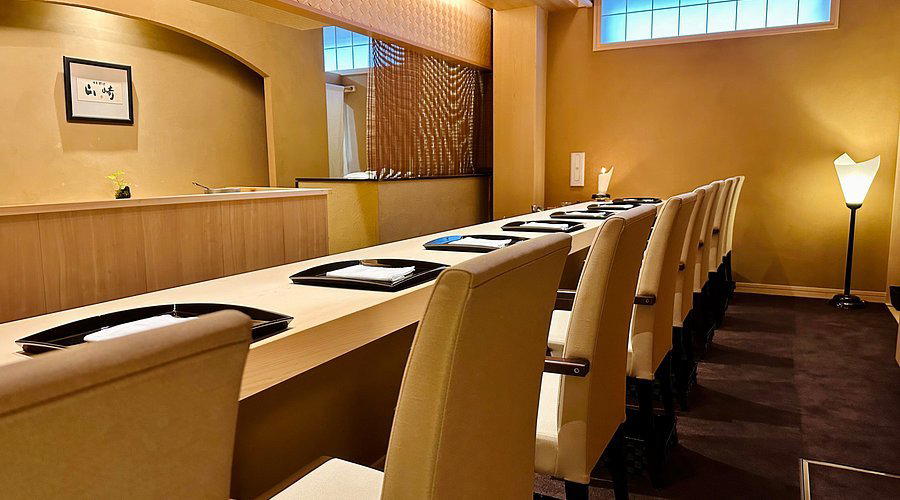
Ten counter seats. Two seatings per night. Five evenings a week. The arithmetic at Yamazaki is deliberately constrained, and that constraint is the point. At the upper end of Tokyo kaiseki, capacity is not a limitation to apologise for, it is the mechanism that makes the format work. A ten-seat counter in Nishiazabu's UOU Building cannot be anonymous. The chef is visible, the pacing is calibrated to the room, and the distance between kitchen decision and guest experience collapses to almost nothing.
Nishiazabu and the Quiet End of the Kaiseki Spectrum
Kaiseki in Tokyo has a clear geography. The most publicised addresses tend to cluster in Ginza, Roppongi, or the grander reaches of Minato Ward, where international hotel dining and Michelin-circuit tourism converge. Nishiazabu occupies a different register: residential enough to feel deliberate, close enough to Nogizaka Station (a nine-minute walk) and Roppongi Station (twelve minutes) to be accessible, but without the foot traffic that drives visibility. Restaurants that operate here do so because the neighbourhood suits a format built around regulars and reservation-only entry, not passing trade. Yamazaki fits that pattern precisely. Its Tabelog listing categorises the location as a hideout, which is less a marketing description than an accurate spatial note.
The kaiseki houses that have earned sustained peer recognition in this part of Tokyo, including Hirosaku, Akasaka Ogino, and Aoyama Jin, share a preference for intimacy over scale. The format rewards guests who arrive with some knowledge of the tradition, and it rewards chefs who can sustain quality across a small room rather than managing volume.
What Seven Consecutive Silver Awards Indicate
Tabelog Silver is not a one-cycle achievement. Yamazaki has held it every year from 2020 through 2026, seven consecutive awards, alongside three separate selections for the Tabelog Japanese Cuisine TOKYO Top 100 (2021, 2023, and 2025). The 2026 score of 4.46 places it at rank 156 among all Japanese restaurants on the platform nationally, and independently, the Opinionated About Dining guide ranked it 93rd among Japan's leading restaurants in 2025, up from 203rd in 2024 and a Highly Recommended citation in 2023. That upward trajectory across a demanding reference set is meaningful: OAD rankings are crowd-sourced from professional diners and serious independents, not general public reviews.
For comparative context, peer kaiseki counters in Tokyo operating at the same price tier, such as Kikunoi Tokyo, carry similar award profiles and price floors, but operate with larger seat counts and more formalised service structures. Ajihiro occupies adjacent territory in the Japanese cuisine category.
Fish as the Organising Principle
The editorial angle that makes Yamazaki worth examining closely is what the Tabelog record describes as being "particular about fish." In kaiseki, this is not a trivial detail. Traditional kaiseki structure progresses through a sequence of courses, sakizuke, hassun, yakimono, shokuji, and fish features prominently across multiple stages: as sashimi, as a grilled course, as the basis of clear broth. A kitchen that signals a specific commitment to fish sourcing is making a structural claim about where its competitive edge sits.
This connects directly to the broader pattern across Japan's most-discussed contemporary kaiseki. The genre has increasingly split between houses that lean into their classical Kyoto inheritance (hierarchical seasonal structure, prescribed course order, restrained seasoning) and those that treat the format as a framework for ingredient-led expression. The latter group, which includes Yamazaki based on its documented sourcing emphasis, tends to let the quality of the primary ingredient do more of the work, with technique applied in service of clarity rather than transformation. Gion Sasaki in Kyoto and Ifuki in Kyoto represent different points on that same axis. Ankyu in Kyoto sits at the more classical end.
The intersection of indigenous product and exacting technique is where Yamazaki's profile becomes most legible. Tokyo's access to the Tsukiji and Toyosu wholesale markets gives chefs here a different kind of sourcing latitude than their Kyoto counterparts, broader species range, faster supply chains from coastal fisheries, and direct relationships with market intermediaries who handle the country's highest-volume premium fish trade. A counter with ten seats and a documented emphasis on fish quality is positioned to take maximum advantage of that access, purchasing smaller quantities at higher grades and adjusting the menu to what arrived that morning rather than what the season dictates on paper.
The Drinks Programme as a Parallel Commitment
Yamazaki's Tabelog record notes that the drinks programme is "particular about sake" and "particular about wine," with a sommelier available and both nihonshu and wine offered. At the JPY 60,000–79,999 price point, this is not incidental. Kaiseki pairing in Japan has historically defaulted to sake, and correctly so, the umami register of nihonshu aligns structurally with dashi-based courses in a way that wine cannot always match. But the dual-track approach at Yamazaki reflects a broader shift in how high-end Japanese cuisine positions itself for an international and domestic audience that has grown up with both traditions. The presence of a sommelier at a ten-seat counter is a deliberate staffing commitment, not a default.
Format and Access
The restaurant operates Tuesday through Saturday only, with two seatings: the first at 17:30 and the second at 20:30. Sunday and Monday are closed, though the venue notes that Chef Yamazaki operates a separate address, Ayumi, on those days. Reservations are required; the venue shares availability through its Instagram account, which is the primary channel for tracking open slots. This is a meaningful logistical detail: it shifts the reservation process away from conventional booking platforms and toward a social-media-mediated waitlist dynamic that rewards attentive followers and penalises casual last-minute attempts.
The cancellation policy is strict. Changes or cancellations made seven or more days in advance incur a 50% course fee charge; those made within four days or fewer are charged at 100%. This is consistent with how Tokyo's small-counter fine dining operates across formats, kaiseki, omakase sushi, and tasting-menu French alike, where no-shows represent a disproportionate financial exposure for a kitchen running ten covers per seating. Guests should treat the booking as a fixed commitment from the moment it is confirmed.
For those building a broader Tokyo itinerary, the full context sits across our guides: Tokyo restaurants, Tokyo hotels, Tokyo bars, Tokyo wineries, and Tokyo experiences. For kaiseki outside Tokyo, HAJIME in Osaka, akordu in Nara, Goh in Fukuoka, 1000 in Yokohama, and 6 in Okinawa each offer distinct regional perspectives on the same high-commitment format.
Know Before You Go
- Address: Nishiazabu UOU Building 1F, 1-15-3 Nishiazabu, Minato, Tokyo 106-0031
- Access: 9-minute walk from Nogizaka Station; 12-minute walk from Roppongi Station; 15-minute walk from Hiroo Station
- Hours: Tuesday–Saturday, seatings at 17:30 and 20:30; closed Sunday and Monday
- Price: JPY 60,000–79,999 per person at dinner
- Seats: 10 counter seats only; no private rooms, no private hire
- Reservations: Required; check Instagram for availability
- Cancellation: 50% fee for changes 7+ days prior; 100% fee within 4 days
- Payment: Credit cards accepted (VISA, Mastercard, JCB, AMEX, Diners); no electronic money or QR payments
- Smoking: Non-smoking throughout
- Phone: +81-3-6812-9848
Frequently asked questions
What should I order at Yamazaki?
Yamazaki operates a set kaiseki course format, so there is no à la carte menu from which to choose individual dishes. The kitchen's documented emphasis is on fish, the Tabelog record explicitly flags it as "particular about fish", which means the sashimi and fish-based courses within the progression carry the most editorial weight. Given Tokyo's access to Toyosu market supply and the counter's small scale, those courses are likely to reflect what was sourced that morning rather than a fixed seasonal blueprint. For the drinks component, the presence of a dedicated sake programme alongside wine makes the pairing option worth considering, particularly for guests less familiar with nihonshu matched to dashi-forward kaiseki courses.
Comparable Venues
Comparable venues nearby, for context on price, style, and recognition.
| Venue | Cuisine | Price | Awards | Notes |
|---|---|---|---|---|
| YamazakiThis venue (the venue you are viewing) | Seasonal Japanese Kaiseki Omakase | $300–500 | Tabelog Silver #156 | Not listed |
| Sutamina-en | Traditional Yakiniku Specializing in Horumon | $50–100 | Tabelog Silver #133 | Adachi |
| Chugokusai Kan | Modern Chinese with Cantonese Roasted Specialties | $30–50 | Michelin Plate | Meguro |
| Seirinkan | Neapolitan Pizza | $20–30 | Tabelog 100 #25 | Meguro |
| Centre Bakery | Japanese Shokupan Bakery Café | $10–20 | Not listed | Bunkyō |
| Menya Shichisai | Kitakata-Style Ramen | $10–20 | Tabelog 100 #38 | Chūō |
Recognition history
Dated appearances from independent guides and award organizations, with the underlying list record or original source where available.
Opinionated About Dining Top Restaurants in Japan Ranked #123
Opinionated About Dining
Tabelog Silver #156
Tabelog
Full recognition history (7 entries)
Opinionated About Dining Top Restaurants in Japan Ranked #93
Opinionated About Dining
Tabelog 100 #93 · No. 93
Tabelog · Tabelog 100 - Japanese cuisine - TOKYO - 2025
Tabelog Silver
Tabelog
Opinionated About Dining Top Restaurants in Japan Ranked #203
Opinionated About Dining
Opinionated About Dining Top Restaurants in Japan Highly Recommended
Opinionated About Dining
Continue exploring
More in Tokyo
Restaurants in Tokyo
All restaurants in Tokyo →

Bars in Tokyo
All bars in Tokyo →





Details
- Intimate
- Elegant
- Sophisticated
- Quiet
- Special Occasion
- Date Night
- Business Dinner
- Solo
- Chefs Counter
- Standalone
- Sake Program
- Local Sourcing
- Omakase
- Tasting Menu
- Counter Dining
- Set Menu
- Sake
- Wine
- Pescatarian Friendly
Current opening hours
- Monday
- 5:30–8:30 PM
- Tuesday
- 5:30–8:30 PM
- Wednesday
- 5:30–8:30 PM
- Thursday
- 5:30–8:30 PM
- Friday
- 5:30–8:30 PM
- Saturday
- 5:30–8:30 PM
- Sunday
- 5:30–8:30 PM
Hours can change for holidays and private events. Last verified .
An intimate, counter-focused setting with a quiet, refined atmosphere centered on close interaction with the kitchen.