


Michelin Plate · Tabelog Bronze #452
Our verdict
Tamawarai has held a Tabelog Bronze Award every year since 2017 and appears consistently in the Tabelog Soba 100 list, making it one of the most decorated soba counters in Tokyo's Jingumae neighbourhood. The 14-seat house restaurant operates four days a week, with dinner available by reservation only and a prix fixe format that extends well beyond the noodle itself. Lunch prices run JPY 2,000–2,999; dinner reaches JPY 10,000–14,999.

Pearl is the En Primeur Club membership app, where members save venues, book tables and use the concierge.
The menu
What to order
- Arabiki Seiro
- Atsumori Seiro
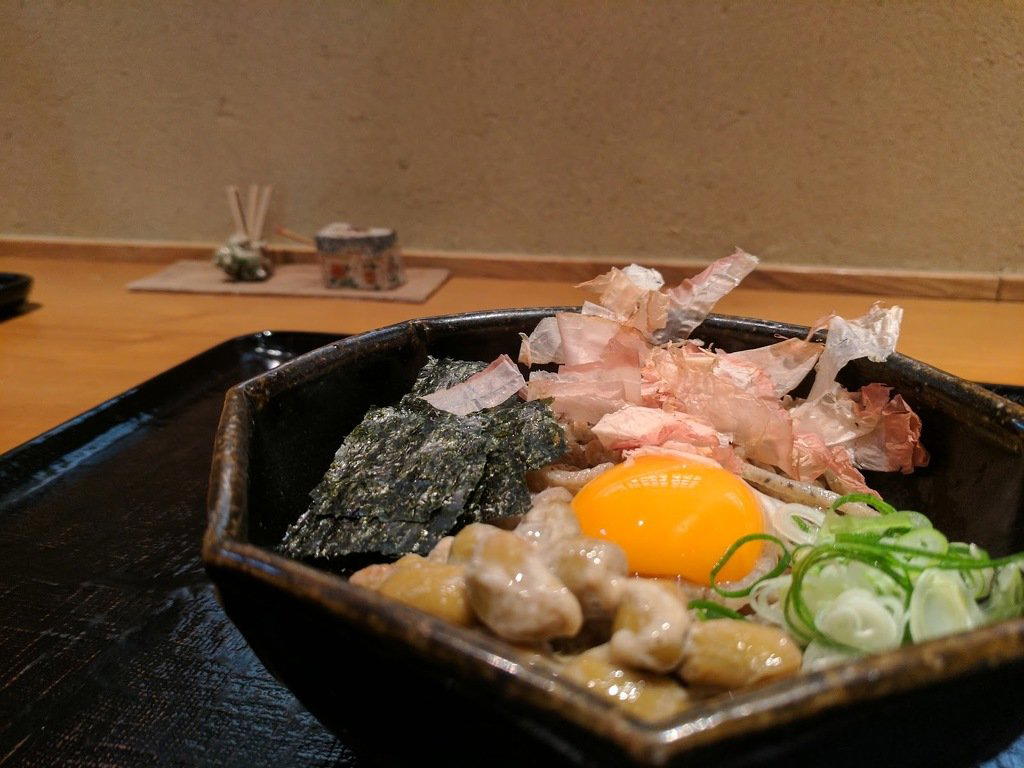
- Natto Soba
- Tofu Soba
Tokyo Soba at Its Most Considered: The Case of Tamawarai
Soba sits at an interesting fault line in Japan's dining culture. In Kyoto, buckwheat noodles tend to appear as one element inside a broader washoku framework, folded into kaiseki progressions or served with the quiet ceremony associated with that city's approach to traditional food. Tokyo operates differently. The capital has a distinct soba tradition rooted in the shitamachi districts of Edo, where stand-and-eat noodle shops and tatami-floored honten occupied opposite ends of a spectrum that was always more democratic than ceremonial. What has changed over the past two decades is the emergence of a third tier: small, serious soba establishments that apply the precision of fine dining to a form that once resisted that kind of attention. Tamawarai, established in September 2003 and operating from its current Jingumae address since July 2011, belongs to that tier.
The neighbourhood context matters here. Jingumae sits between Harajuku and Omotesando, an area better known internationally for fashion flagships and café culture than for traditional craft food. That positioning is not incidental. Tokyo's most compelling specialist restaurants frequently appear in unexpected residential pockets rather than in the city's historic dining districts, and Tamawarai's classification in Tabelog as a "house restaurant" and "hideout" reflects exactly that geography: a 14-seat counter operating four days a week, seven to nine minutes on foot from Meiji-Jingumae station on the Tokyo Metro.
The Award Record and What It Signals
Tabelog's Bronze Award is granted annually based on reviewer scores and volume, and it operates as one of the more reliable peer signals in Tokyo dining given the platform's scale and the difficulty of maintaining scores above 3.80 across several thousand reviews. Tamawarai has held that Bronze Award without interruption from 2017 through 2026, with a Tabelog score of 3.85. It has also been selected for the Tabelog Soba 100 list in 2017, 2018, 2019, 2021, 2022, 2024, and 2025. Across nine consecutive years of soba-specific recognition, that record places it among a small group of counters that have sustained consistent standing rather than peaking and receding.
The Opinionated About Dining (OAD) ranking adds a different data layer. OAD Casual Japan ranked Tamawarai 15th in 2025, up from 28th in 2024 and 45th in 2023, a trajectory that suggests growing critical consensus rather than stable obscurity. A Michelin Plate in both 2024 and 2025 completes the picture: not starred, but acknowledged within a guide that has historically under-represented soba in favour of kaiseki and sushi formats. For context, Tamawarai sits in the same award ecosystem as Tokyo soba addresses such as Akasaka Sunaba, Azabukawakamian, Edosoba Hosokawa, and Hamacho Kaneko, each of which approaches the category with its own sourcing and milling logic.
The Tokyo vs. Kyoto Divide in Soba
The distinction between Tokyo and Kyoto soba is worth spelling out because it shapes what a diner should expect at a place like Tamawarai. Kyoto's washoku tradition tends toward restraint in texture and flavour intensity, with soba appearing in lighter dashi-forward broths that complement the broader seasonal composition. Tokyo's Edo-period soba culture ran hotter, saltier, and faster: strong katsuobushi-based tsuyu, an expectation of speed, and a culture of eating standing at a street-level counter. The serious Tokyo soba counter of the 2000s and 2010s grafted a new set of values onto that tradition: single-origin buckwheat, stone-milling on premises or from trusted mills, attention to water temperature, and an evening format that slows the whole experience down considerably.
Tamawarai operates squarely within that Tokyo evolution. Under chef Urukawa Masahiro, the kitchen mills husked buckwheat from the chef's own garden alongside grain sourced from farmers in Ibaraki Prefecture, a sourcing approach that prioritises freshness of aroma over consistency of supply. The coarse-ground seiro, soba served on bamboo wicker, reflects the distinctly Tokyo preference for noodles with grip and flavour weight rather than the more delicate profiles associated with the Kyoto end of the spectrum. This is not refinement for its own sake; it is a direct argument about what buckwheat can express when the flour is treated as a primary ingredient rather than a commodity.
What Dish Is Tamawarai Famous For?
The seiro is the reference point, and the coarse-ground version in particular has drawn consistent attention in reviews for its intensity. But the menu at Tamawarai extends into territory that distinguishes it from the average soba counter. Tofu soba, reportedly developed from a staff meal, occupies an unusual position: a dish that originated outside the formal menu and found its way onto it through practical logic rather than concept-driven design. Hot seiro with hot tsuyu and beaten egg represents the kind of variation that only makes sense when the base noodle is strong enough to hold against a richer liquid. These are not garnishes to the soba; they are arguments for the noodle's versatility.
The evening prix fixe format extends that argument further. Dinner at Tamawarai is reservation-only, and the format includes courses beyond the soba itself: buckwheat preparations such as soba mash, rolled omelettes, and other dishes that treat the ingredient across multiple forms. This is more Tokyo than Kyoto in its ambition, closer to the capital's tendency to build a full evening around a single product than to Kyoto's habit of dissolving individual ingredients into a seasonal whole. The dinner price range of JPY 10,000–14,999 places it in the mid-to-upper tier of Tokyo soba but well below the ¥¥¥¥ benchmark of neighbouring restaurant categories: Hamadaya at kaiseki level, or sushi counters like Harutaka, operate at a structurally different price point.
For comparison across the broader Japanese soba scene, Ayamedo in Osaka and Chikuyuan Taro no Atsumori in Kyoto represent how the same category reads in western Japan, where the format and flavour logic differ from what Tamawarai is doing in Jingumae.
Operational Details Worth Knowing Before You Go
The 14-seat capacity and four-day operating week are not stylistic choices to be admired from a distance; they are genuine constraints that require advance planning. Dinner operates by reservation only, and the kitchen stops lunch service once the soba runs out, which means arriving early on weekday lunches is a practical necessity rather than a preference. Saturday lunch reservations are not accepted, and the restaurant closes on Sundays, Mondays, and Tuesdays.
Temporary closures occur in August, October, and November for buckwheat harvesting, a scheduling reality that reflects the sourcing commitment rather than seasonal whim. Anyone planning a visit around the autumn harvest period should confirm dates directly by phone. The restaurant accepts no credit cards, electronic money, or QR code payments; cash only. The drink list leans on sake and shochu, with the Tabelog listing noting a particular focus on sake selection.
Reservations for dinner require guests to order at least one dish in addition to the soba. Children below lower elementary school age are not accommodated. There is no parking and no private dining option at the 14-seat counter format.
- Address: 5 Chome-23-3 Jingumae, Shibuya, Tokyo 150-0001
- Transport: 7 minutes from Meiji-Jingumae station; 10 minutes from JR Harajuku and Shibuya stations
- Hours: Wed–Fri 11:30–15:00 (L.O. 14:30) and 18:30–21:30 (L.O. 20:30); Sat 11:30–15:00 and 18:00–20:00; Mon, Tue, Sun closed
- Dinner: Reservation only; prix fixe format; JPY 10,000–14,999
- Lunch: JPY 2,000–2,999; no Saturday reservations; service ends when soba runs out
- Payment: Cash only
- Phone: 03-5485-0025
Where Tamawarai Sits in the Broader Tokyo Picture
Tokyo's dining range is wide enough that a 14-seat soba counter in Jingumae sits in a different conversation from the kaiseki rooms of Roppongi or the sushi omakase counters of Ginza. For readers building a Tokyo itinerary across categories, the EP Club guides to Tokyo restaurants, Tokyo hotels, Tokyo bars, Tokyo wineries, and Tokyo experiences provide the broader map. For those extending beyond the capital, HAJIME in Osaka, Gion Sasaki in Kyoto, akordu in Nara, Goh in Fukuoka, 1000 in Yokohama, and 6 in Okinawa illustrate the range of serious dining across the country.
Tamawarai tokyo occupies a specific and well-evidenced position in that map: a soba counter that has been ranked, awarded, and returned to by serious diners for more than two decades, operating with the kind of material discipline and format consistency that the category's leading practitioners share, regardless of which city they work in.
Frequently asked questions
What dish is Tamawarai famous for?
Tamawarai is most associated with its coarse-ground seiro, buckwheat noodles served on bamboo wicker, made from flour milled in-house from grain sourced partly from the chef's own garden and partly from Ibaraki Prefecture farmers. The tofu soba, developed originally as a staff meal, and hot seiro served with hot tsuyu and beaten egg have also drawn consistent recognition in reviews. At dinner, these appear within a prix fixe format that extends across multiple buckwheat preparations, including soba mash and rolled omelettes.
Cuisine-First Comparison
Comparable venues nearby, for context on price, style, and recognition.
| Venue | Cuisine | Price | Awards | Notes |
|---|---|---|---|---|
| TamawaraiThis venue (the venue you are viewing) | Traditional Handmade Soba | $30–50 | Michelin Plate · Tabelog Bronze #452 | Not listed |
| RAMEN MATSUI | Modern Ramen | $20–30 | Michelin Bib Gourmand · Tabelog 100 #44 | Shinjuku |
| Torishige | Traditional Japanese Robatayaki | $30–50 | Michelin Bib Gourmand · Tabelog Bronze #474 | Minato |
| Osobano Kouga | Authentic Handmade Soba | $50–100 | Michelin Bib Gourmand · Tabelog 100 #87 | Minato |
| Sushi Mikata | Standing Sushi | $50–100 | Michelin Bib Gourmand | Minato |
| Ginza Katsukami | Tonkatsu Omakase | $50–100 | Michelin Bib Gourmand · Tabelog 100 #97 | Chūō |
Recognition history
Dated appearances from independent guides and award organizations, with the underlying list record or original source where available.
Michelin Plate
Michelin
Opinionated About Dining Casual in Japan Ranked #111
Opinionated About Dining
Tabelog Bronze #452
Tabelog
Full recognition history (10 entries)
Michelin Plate
Michelin
Opinionated About Dining Casual in Japan Ranked #15
Opinionated About Dining
Tabelog 100 #39 · No. 39
Tabelog · Tabelog 100 - Soba - EAST - 2025
Tabelog Bronze
Tabelog
Michelin Plate
Michelin
Opinionated About Dining Casual in Japan Ranked #28
Opinionated About Dining
Opinionated About Dining Casual in Japan Ranked #45
Opinionated About Dining
Continue exploring
More in Tokyo
Restaurants in Tokyo
All restaurants in Tokyo →



Bars in Tokyo
All bars in Tokyo →





Details
- Minimalist
- Cozy
- Quiet
- Intimate
- Classic
- Solo
- Special Occasion
- Sake Program
- Local Sourcing
- A La Carte
- Prix Fixe
- Sake
Current opening hours
- Monday
- Closed
- Tuesday
- Closed
- Wednesday
- 11:30 AM–2:30 PM, 6–9 PM
- Thursday
- 11:30 AM–2:30 PM, 6–9 PM
- Friday
- 11:30 AM–2:30 PM, 6–8 PM
- Saturday
- 11:30 AM–2:30 PM, 6–8 PM
- Sunday
- Closed
Hours can change for holidays and private events. Hours as of .
Dimly lit minimalist interior with traditional Japanese decor creating a quiet, relaxed, and austere atmosphere focused on the soba experience.