
Michelin Plate
Our verdict
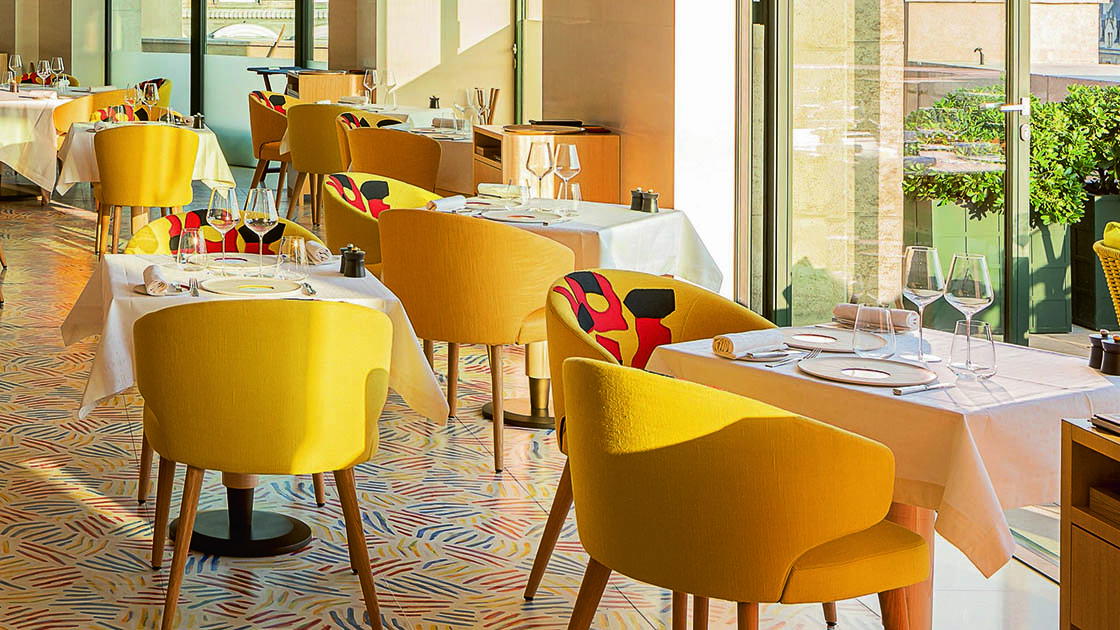
A Michelin Plate-recognized French atelier in Kyoto's Shimogyo Ward, L'aparté is run by a husband-and-wife team: a chef trained under Alain Ducasse and a graphic designer proprietress whose aesthetic sensibility shapes every detail. Seasonal menus spotlight Japanese ingredients within a French framework, while hand-embroidered napkins and hand-drawn maps of France and Japan signal the level of care applied to the room itself.

Pearl is the En Primeur Club membership app, where members save venues, book tables and use the concierge.
The menu
What to order
- Tender Octopus with Beans and Shiso Soup
- Roasted Omi Duck with Kyoto Leeks
- Zucchini Roll with Mussels
A Room Built by Hand, Down to the Last Stitch
The French restaurant that earns its place in Kyoto does not arrive there by importing Paris wholesale. It arrives by negotiating, carefully and visibly, between two culinary traditions, two aesthetic vocabularies, and two countries' worth of seasonal logic. L'aparté, a Michelin Plate-recognized address in Shimogyo Ward, makes that negotiation legible in the physical fabric of the dining room itself. The napkins are embroidered with the restaurant's logo. The menus and wine lists carry hand-drawn maps of both France and Japan. These are not decorative gestures applied at the end; they are structural decisions that define what kind of place this is before a dish arrives at the table.
Shimogyo occupies the southern half of Kyoto's central grid, a ward more associated with commuter infrastructure and craft workshops than with the high-density kaiseki corridors of Gion. That address creates a particular kind of quietness. The French cooking tradition in Kyoto has produced a small but serious cohort of restaurants, and L'aparté occupies a different register from the grander French houses in the city. Where some establishments signal ambition through scale and ceremony, this one signals it through the granular, through choices made at the level of textile and cartography.
French Technique, Japanese Seasons
Kyoto's position within Japanese fine dining rests substantially on seasonal discipline. The kaiseki tradition has codified that discipline over centuries, and the French restaurants that survive and earn recognition here absorb it rather than resist it. L'aparté structures its menus around Japanese ingredients interpreted through a French technical framework, a pairing that has become a distinct subgenre of serious cooking in Japan. For context, L'Effervescence in Tokyo operates in a related register at a higher price tier and awards level, while HAJIME in Osaka pursues a more conceptual variation on French-Japanese integration. L'aparté is more intimate in scale and more atelier in character than either.
The chef trained under Alain Ducasse, a credential that places the kitchen inside a specific tradition of classical French cooking: precise, product-led, not given to theatrical flourish. Ducasse-trained kitchens tend toward coherence over surprise, and the seasonal menu structure at L'aparté reflects that disposition. The cooking follows the Japanese agricultural calendar, which in Kyoto is particularly pronounced, the city sits in a basin with distinct thermal seasons and a culture of vegetable cultivation, specifically Kyo-yasai, the traditional Kyoto vegetables, that gives any ingredient-led kitchen plenty to work with across the year.
Comparable Kyoto restaurants in the ¥¥¥ tier include cenci, which applies Italian technique to Japanese produce at Michelin one-star level, and Kyo Seika, which does something similar from a Chinese framework. The French equivalent, at this price range and intimacy level, is a smaller group. Further afield, akordu in Nara offers another angle on European technique meeting Japanese regional produce, and is worth cross-referencing for readers planning a broader Kansai itinerary.
The Design Logic of the Space
The proprietress is a graphic designer, and that fact is not incidental. Restaurants where one partner controls the kitchen and the other controls the visual program are common at every level of the market; what is less common is a space where the graphic sensibility extends into the objects that mediate between kitchen and guest. The hand-embroidered napkins and hand-drawn cartographic menus at L'aparté are objects in themselves, not printed assets. They compress time, the time it takes to make something by hand, into the ritual of sitting down to eat.
The Michelin description frames the husband-and-wife collaboration as threads woven together like warp and woof, which is florid language for an essentially precise observation: the cooking and the design operate as a single system. The result is a room where refinement and warmth are present simultaneously, a combination that sounds direct but is genuinely difficult to calibrate. Many Kyoto restaurants in this category achieve one at the cost of the other. The kaiseki houses at the ¥¥¥¥ tier, such as Ifuki at two Michelin stars or Gion Sasaki at three, achieve extraordinary refinement through formality. L'aparté operates at a different temperature.
For readers with an interest in how French and European fine dining spaces translate into the Japanese context, the comparison set extends beyond Kyoto. Hotel de Ville Crissier in Switzerland represents the classical French house in its European habitat; seeing how a Ducasse-lineage chef interprets that tradition within a Kyoto framework offers a different kind of reading.
Where L'aparté Sits in the Kyoto French Scene
Kyoto's French restaurants cluster into a few distinct types. There are the long-established grand establishments that sit adjacent to luxury hotel infrastructure or historic garden settings. There are the newer single-chef rooms that signal through minimal design and tasting-menu rigidity. And there is a smaller group, of which L'aparté is a clear example, that operates as an atelier, a word the restaurant itself uses, and a word that carries specific implications about scale, craft, and the relationship between maker and guest.
Other Kyoto French addresses worth mapping against this one include Droit, la bûche, and La Biographie, each of which takes a different position on the formality and price spectrum. Hiramatsu Kodaiji represents the grand-hotel-adjacent French tradition in the city. anpeiji occupies a related but distinct category. Placed against these, L'aparté reads as the most explicitly hand-crafted in its physical presentation and the most domestic in scale, which is a specific kind of offer, not a default.
Readers planning a trip that takes in multiple Japanese cities can find related editorial context at Harutaka in Tokyo, Goh in Fukuoka, 1000 in Yokohama, and 6 in Okinawa.
Know Before You Go
Location: 247-3 Nishiwakamatsucho, Shimogyo Ward, Kyoto 600-8334, Japan
Cuisine: French, with seasonal Japanese ingredients
Price tier: ¥¥¥
Recognition: Michelin Plate (2025)
Booking: Contact details not publicly listed; check current reservation platforms for availability
Hours:; verify before visiting
Leading approached via: Shimogyo Ward; closest major transit hub is Kyoto Station
For broader Kyoto planning, see our full Kyoto restaurants guide, our Kyoto hotels guide, our Kyoto bars guide, our Kyoto wineries guide, and our Kyoto experiences guide.
Frequently asked questions
Is L'aparté formal or casual?
It sits between the two in a way that is specific to this type of small French atelier. Kyoto's ¥¥¥ French tier generally maintains composed service and some level of dress expectation, and the hand-embroidered napkins and Michelin Plate recognition at L'aparté indicate a room that takes presentation seriously. That said, the domestic scale and the craft-led design philosophy produce a warmer atmosphere than the ¥¥¥¥ kaiseki houses in the city. Think: cared-for rather than ceremonial.
Does L'aparté work for a family meal?
The atelier format and ¥¥¥ price tier make this a considered choice rather than a casual option for families. At this price point in Kyoto, the expectation is a seated tasting menu in an intimate room, which suits couples, small groups of adults, or a special-occasion meal with older children. It is not structured for a relaxed, drop-in family dinner. For broader Kyoto options across price tiers, the full Kyoto restaurants guide maps the field.
at L'aparté?
The kitchen operates on a seasonal menu format rather than an à la carte list, so the question of what to order resolves into when to visit. The chef's Ducasse training and the restaurant's documented commitment to Japanese seasonal ingredients mean the menu shifts with the agricultural calendar. A spring visit will follow a different logic than an autumn one. The Michelin Plate recognition signals consistent quality of execution across the menu rather than one standout dish, which is characteristic of this kind of atelier format: the coherence of the meal is the point.
Where the Accolades Land
A compact comparison to help you place this venue among nearby peers.
| Venue | Cuisine | Price | Awards | Notes |
|---|---|---|---|---|
| L'apartéThis venue (the venue you are viewing) | Modern French with Japanese Ingredients | $100–150 | Michelin Plate | Not listed |
| Gion Sasaki | Modern Kaiseki | $300–500 | 3 Michelin Stars · La Liste Top Restaurants | Kaiseki, Japanese |
| cenci | Innovative Italian-Japanese Fusion | $100–150 | 1 Michelin Star · World's 50 Best #76 | Italian |
| Ifuki | Sumibi Kappo Kaiseki | $200–300 | 2 Michelin Stars · La Liste Top Restaurants | Kaiseki |
| Kyokaiseki Kichisen | Kyoto Kaiseki | $200–300 | 2 Michelin Stars · La Liste Top Restaurants | Japanese |
| Kyo Seika | Modern Chinese Fine Dining | $150–200 | 1 Michelin Star · Tabelog Bronze #216 | Chinese |
Recognition history
Dated appearances from independent guides and award organizations, with the underlying list record or original source where available.
Michelin Plate
Michelin
Full recognition history (2 entries)
Michelin Plate
Michelin
Continue exploring
More in Kyoto
Restaurants in Kyoto
All restaurants in Kyoto →
Bars in Kyoto
All bars in Kyoto →
Hotels in Kyoto
All hotels in Kyoto →
Wineries in Kyoto
Browse all →
Details
- Intimate
- Elegant
- Sophisticated
- Cozy
- Modern
- Date Night
- Special Occasion
- Chefs Counter
- Open Kitchen
- Garden
- Sake Program
- Extensive Wine List
- Local Sourcing
- Garden
- Tasting Menu
- Wine
- Sake
- Vegetarian Friendly
- Allergy Accommodating
Current opening hours
- Monday
- Closed
- Tuesday
- 12–1 PM, 6–7 PM
- Wednesday
- 12–1 PM, 6–7 PM
- Thursday
- 12–1 PM, 6–7 PM
- Friday
- 12–1 PM, 6–7 PM
- Saturday
- 12–1 PM, 6–7 PM
- Sunday
- Closed
Hours can change for holidays and private events. Hours as of .
Sophisticated and relaxing with modern open kitchen, central fireplace lined with wine bottles, romantic counter seats overlooking a small back garden, and artistic touches.