
A Michelin-starred French table in Higashiyama, Hiramatsu Kodaiji pairs classic technique and Burgundy-weighted cellar depth with produce sourced from the Kyotanba township. The dining room sits within sight of Yasaka Pagoda, and the kitchen's emphasis on regional ingredients and house-garden herbs gives the menu a geographic anchor that most French restaurants in Kyoto cannot claim.
Pearl is the En Primeur Club membership app — saves, bookings, and concierge access live there. Same editors, same standards.
- Address
- 353 Masuyacho, Higashiyama Ward, Kyoto, 605-0826, Japan
- Phone
- +81 75-533-6063
- Website
- hiramatsurestaurant.jp
- Directions
- Get directions
 Saves & bookings on Pearl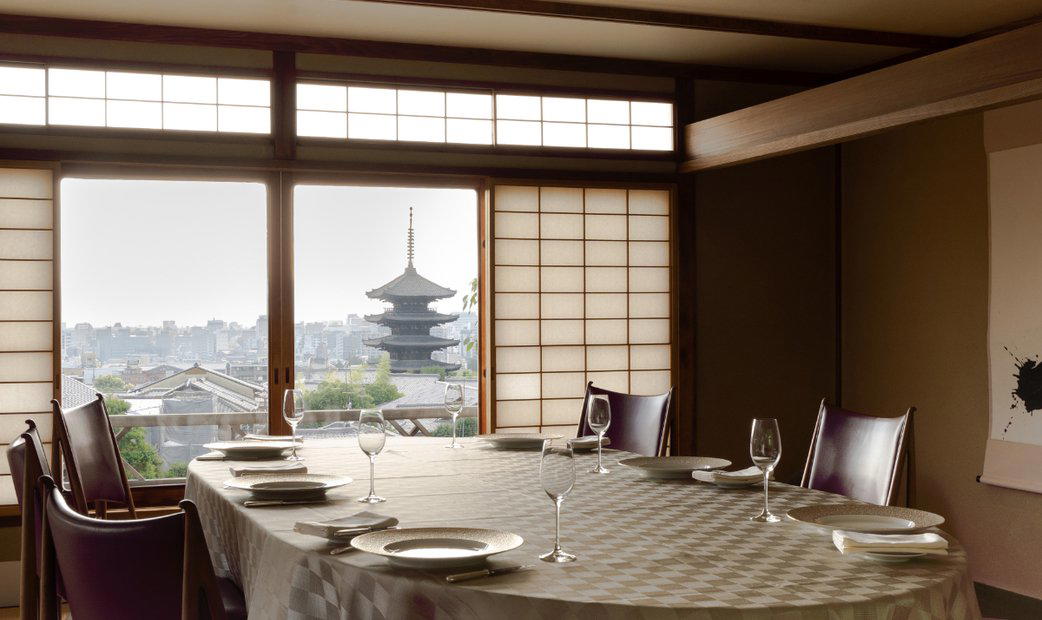
French Dining in Higashiyama: A Neighbourhood Context
Kyoto's French dining scene occupies an unusual position in Japan's broader high-end restaurant map. Where Tokyo concentrates its French addresses in Minami-Aoyama and Ginza, Kyoto spreads them across a city whose identity is defined by kaiseki, temple precincts, and hyperlocal ingredient culture. That context matters when assessing any Western kitchen here. The city's three- and four-symbol tier is dominated by Japanese formats, Gion Sasaki holds three Michelin stars for kaiseki, while Ifuki and Kyokaiseki Kichisen both operate at two stars within the same tradition. French restaurants at the ¥¥¥ level, by contrast, occupy a smaller and more specific niche, competing less against each other and more against the argument that Kyoto is fundamentally a washoku city. Hiramatsu Kodaiji, the sole Michelin-starred French address in Higashiyama Ward, is a one-Michelin-star restaurant in Kyoto serving contemporary French with Kyoto seasonal ingredients at about $150 per person. It makes its case from within that context.
The Hiramatsu group has operated high-end French restaurants in Japan for decades. The Kodaiji branch represents the group's Kyoto expression, and its location in Higashiyama, within direct sightline of Yasaka Pagoda, places it in a district where the visual and architectural grammar is entirely Japanese. That tension between French technique and a setting saturated with Japanese heritage is not incidental. It shapes how the kitchen thinks about sourcing, presentation, and register.
The Kitchen's Sourcing Logic
One editorially significant aspect of how this kitchen operates is its emphasis on Kyotanba. That township, in the hilly northwest of Kyoto Prefecture, has developed a strong reputation among serious kitchens in the region for the quality of its vegetables, beef, and herbs. Choosing to anchor a French menu around Kyotanba produce is a considered position: it signals that the kitchen is not simply importing French ingredient logic wholesale but is instead asking what classical French technique can do with a specific Japanese geography. Herbs from the property's own garden add further granularity, narrowing the sourcing radius to the immediate site. French ingredients, caviar, and truffles appear in the mix, but as refinements layered onto a locally rooted base rather than as the primary identity of the menu.
This sourcing architecture places Hiramatsu Kodaiji within a broader Japanese-French synthesis that has become one of the more interesting developments in the country's restaurant scene over the past two decades. Kitchens like L'Effervescence in Tokyo have pursued similar territory from a different angle, and akordu in Nara applies European technique to Yamato ingredients in adjacent fashion. The question in each case is whether the sourcing logic produces genuine flavour specificity. At the one-star level with a strong Michelin citation, the former appears to be the answer here.
On the Wine Side: Cellar Orientation at Hiramatsu Kodaiji
The editorial angle for this venue is the wine program, and it deserves proper treatment in the context of what serious French dining in Japan typically produces. The Hiramatsu group's restaurants have historically maintained wine lists weighted toward classic French regions, particularly Burgundy and Bordeaux, with depth in producer-level selections that go beyond the approachable négociant tier. That cellar orientation is consistent across the group's portfolio and reflects a house sensibility rather than an improvised approach at each address.
For a French table at the ¥¥¥ price point in a city like Kyoto, the wine list carries disproportionate weight in the overall experience calculus. Kyoto's drinking culture skews toward sake and whisky; visitors choosing a French restaurant with serious intentions are often there partly because of what the cellar offers. A list with genuine Burgundy depth, producer-specific, vintage-ranged, with village and premier cru options below the grand cru threshold, functions as a signal that the kitchen and the floor are working in concert. The combination of classic French sauce work, truffles, and caviar as flavour anchors maps directly onto the structural logic of aged Burgundy or white Rhône, and a sommelier-guided pairing in that register is one of the more coherent pairings available at this price level in Kyoto.
Comparable French addresses at similar price points in Kyoto include anpeiji, Droit, La Biographie, and la bûche. Each approaches the French-in-Kyoto proposition differently, and the wine programs vary accordingly. Hiramatsu Kodaiji's group backing gives it potential cellar advantages in terms of procurement and allocation access that smaller independent addresses cannot easily replicate.
Presentation and Dining Register
The Michelin citation notes that plating at the restaurant has the quality of oil paintings. In French haute cuisine terms, that signals a kitchen operating in a visual register where presentation is treated as a compositional discipline, not merely a finishing step. Classic French sauce work, reductions, emulsions, butter-mounted jus, requires that each element on the plate be positioned to support the saucing logic. When that is done at a high level, the result is dishes where colour, texture, and form are interdependent. The garden herb accents add a botanical register to the visual grammar, and the contrast between French luxury ingredients and locally specific produce creates the kind of visual counterpoint that the leading kitchens in this tradition have always understood as part of the dish's argument.
The physical setting amplifies this register. Dining within view of Yasaka Pagoda is a circumstance that few French restaurants anywhere can claim, and the juxtaposition of classical French formality with one of Kyoto's most recognisable structures gives the experience a geographic specificity that transcends what the food alone could achieve. This is not incidental atmosphere; it is a frame that any serious diner will read and respond to.
The comparable set in Broader Japanese Context
At the one-star level, the restaurant sits in a peer bracket that includes MOKO in Kyoto's contemporary dining tier and, further afield, Goh in Fukuoka and 1000 in Yokohama. For the highest formal French benchmark in Japan, the point of comparison shifts upward to HAJIME in Osaka, which operates at three stars. Outside Japan, Hotel de Ville Crissier in Crissier represents the European tradition that restaurant's classical technique most directly references. Placing this Kyoto address within that constellation helps calibrate expectations: it is a kitchen working in an established classical French idiom with strong local sourcing, not a conceptual avant-garde operation.
Also worth considering for those building a Japanese itinerary around French dining and serious wine programs: Harutaka in Tokyo and 6 in Okinawa offer contrasting approaches to the question of how Japanese geography shapes fine dining ambition.
Planning Your Visit
The restaurant is located at 353 Masuyacho in Higashiyama Ward, Kyoto, within walking distance of the Yasaka Pagoda and the Ninenzaka preservation district. The address is ¥¥¥, placing it in the upper-mid tier for Kyoto dining, above the neighbourhood-level bistro bracket but below the ¥¥¥¥ kaiseki houses like Gion Sasaki. It holds, with Michelin one-star recognition confirmed in the 2024 guide. The restaurant's position within a heritage district means accessibility is primarily on foot from nearby transport connections; the area around Yasaka Pagoda is dense with other dinner options, making it practical to build an evening around the neighbourhood.
What Should I Eat at Hiramatsu Kodaiji?
The kitchen's declared emphasis falls on ingredients from the Kyotanba township, classic French sauces and technique, and the use of garden herbs as flavour accents. Truffles and caviar appear as refinements within the menu structure rather than as headline centrepieces. Given this framing, the approach is to follow the tasting format rather than selecting à la carte, allowing the kitchen to demonstrate its sourcing logic in sequence. Pairing with the wine list, which reflects the Hiramatsu group's orientation toward classic French regions, is one coherent way to experience the full register of the kitchen's intentions. The one-star Michelin recognition in 2024 provides external validation of the kitchen's consistency at this level.
Cost Snapshot
Comparable venues nearby, for context on price, style, and recognition.
| Venue | Cuisine | Price | Awards | Notes |
|---|---|---|---|---|
| Hiramatsu KodaijiThis venue — the venue you are viewing | French | $$$$ | Michelin 1 Star | Not listed |
| anpeiji | Not listed | $$$$ | Michelin 1 Star | Fushimi, Light French with Japanese Ingredients |
| Droit | Sakyō, Classic French Fine Dining | $$$$ | Michelin 1 Star | Not listed |
| MUNI ALAIN DUCASSE | Not listed | $$$$ | Michelin 1 Star | Nakagyō, Modern French with Japanese Influences |
| Reine des prés | Not listed | $$$$ | Michelin 1 Star | Kamigyō, Modern French with Japanese Sensibility |
| Jean-Georges at The Shinmonzen | Not listed | $$$$ | Michelin 1 Star | Higashiyama, Contemporary French-Asian Fusion |
Recognition history
Dated appearances from independent guides and award organizations, with the underlying list record or original source where available.
Michelin 1 Star
Michelin
Michelin 1 Star
Michelin
Continue exploring
More in Kyoto
Restaurants in Kyoto
Browse all →
Bars in Kyoto
Browse all →
Hotels in Kyoto
Browse all →
Wineries in Kyoto
Browse all →
At a Glance
- Elegant
- Romantic
- Scenic
- Sophisticated
- Intimate
- Date Night
- Celebration
- Special Occasion
- Business Dinner
- Panoramic View
- Private Dining
- Historic Building
- Design Destination
- Standalone
- Extensive Wine List
- Sommelier Led
- Local Sourcing
- Skyline
- Street Scene
Current opening hours
- Monday
- Closed
- Tuesday
- 11:30 AM–3 PM, 5:30–10 PM
- Wednesday
- 11:30 AM–3 PM, 5:30–10 PM
- Thursday
- 11:30 AM–3 PM, 5:30–10 PM
- Friday
- 11:30 AM–3 PM, 5:30–10 PM
- Saturday
- 11:30 AM–3 PM, 5:30–10 PM
- Sunday
- 11:30 AM–3 PM, 5:30–10 PM
Hours can change for holidays and private events. Last verified .
Dim, sophisticated lighting with bioethanol fireplace ambiance; four-story building adorned with Miro paintings and beautiful furnishings resembling an art museum; serene and refined atmosphere.