
A Michelin Plate omakase counter in Ginza's most theatre-adjacent block, Kabukizaura Masashi earns its name from the alley behind the Kabukiza. The menu draws on both Japanese tradition and the chef's background in Chinese cooking, producing a set format that moves between nigiri, tempura, and baked gyoza within a single sitting.
Pearl is the En Primeur Club membership app — saves, bookings, and concierge access live there. Same editors, same standards.
- Address
- 4 Chome-11-9 Ginza, Chuo City, Tokyo 104-0061, Japan
- Phone
- +81 80-2071-0902
- Website
- facebook.com
- Directions
- Get directions
 Saves & bookings on Pearl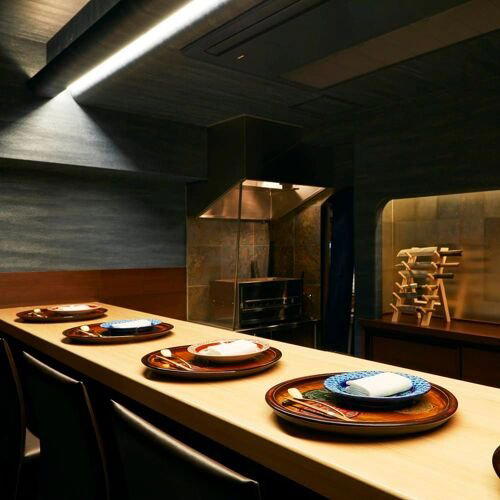
The Alley Behind the Stage
Kabukizaura Masashi is a Seasonal Japanese Omakase restaurant in Tokyo, priced at about US$136 per person. At the leading sit counters like Harutaka and kaiseki rooms in the tier of RyuGin, where omakase begins at ¥40,000 and formal service is the operative language. Below that summit, a smaller cohort of Michelin-recognised addresses occupies a more accessible register: still serious, still structured around a set menu, but without the ceremony that prices out a midweek dinner. Kabukizaura Masashi sits in this cohort. The address, 4 Chome-11-9 Ginza, puts it in the block directly behind the Kabukiza theatre, which is where the name comes from: kabukiza-ura means behind the kabuki theatre. The location is not incidental. It shapes who comes, when they come, and the tone the room is expected to hold.
What the Room Is Doing
The first thing that registers on arrival is the wall. Where many Ginza dining rooms suppress decoration in favour of material restraint, pale wood, stone, negative space, this one deploys colour deliberately. The artwork draws faces in kumadori, the high-contrast shaded makeup worn by kabuki performers, and the theme connecting the images is the relationship between people and food across time. It reads less like décor chosen to match the neighbourhood and more like a stated position: this room has a point of view, and the point of view is playful without being insubstantial.
The format is omakase, which in Ginza has come to mean different things depending on which door you open. At three-Michelin-star counters, omakase implies a long sequence, a single tightly controlled register, and a kitchen with no visible crossover from other culinary traditions. At Kabukizaura Masashi, the set meal uses that same structural frame but populates it differently. Two pieces of nigiri anchor the Japanese end of the menu. Two preparations, tempura and a deep-fried item, work textural contrast against each other. And then there is the baked gyoza, which arrives not as a novelty but as a disclosure: the kitchen has Chinese cooking in its background, and it is not hiding it.
Lunch and Dinner: Different Propositions
Location behind the Kabukiza creates a natural split in the evening clientele. Theatre-adjacent dining in Tokyo tends to attract pre- and post-performance guests who arrive with time constraints and specific appetite, and Ginza's kabuki calendar runs afternoon and evening programmes. The lunch hour in this block draws a different crowd: nearby office workers, Ginza daytime shoppers, and travellers who have built the afternoon around the Chuo district. Where dinner in this context can take on something of an occasion character, people dressed for the theatre, couples marking an event, lunch tends toward the transactional and the local.
The mood of the room shifts between services. Lunch at a Ginza omakase counter with Michelin recognition but without the three-star price ceiling is one of the more direct ways to access serious Japanese cooking in the neighbourhood without the multi-month reservation lead time that venues like Myojaku or Azabu Kadowaki require. Dinner, by contrast, is likely to carry more of the ceremonial neighbourhood energy. Both services operate around the same omakase structure, but the social temperature around the meal differs.
Comparable omakase addresses at the ¥¥¥ tier, Den in Jingumae, for instance, holds two Michelin stars at a similar price register while operating a more internationally visible profile, tend to be booked further in advance precisely because of that recognition. Kabukizaura Masashi's Michelin Plate classification (2024) places it below the star tier but within the guide's acknowledged range of quality, which often translates to more flexible access.
The Drink Question
At a counter where the kitchen crosses between Japanese and Chinese technique within a single omakase sequence, pairing drinks to the meal requires a level of judgment that standard wine-list navigation does not easily provide. The proprietress handles this, and the Michelin notes for the restaurant specifically flag her as the person to defer to on beverage selection. In a Ginza room at this price point, that kind of floor-side expertise is neither given nor guaranteed, at many counters in the neighbourhood, drink pairings are either fixed alongside the menu or left to the guest with minimal guidance. The active recommendation here is to hand the decision over. The combination of nigiri, tempura, deep-fried preparations, and gyoza in a single set creates enough range that a single pairing logic rarely holds across all of it.
Ginza in Context
The broader Ginza dining scene rewards those who look past its concentration of starred addresses. The neighbourhood holds a secondary tier of recognised but less discussed rooms that deliver a different kind of value: smaller, more personal, less codified in their approach to what a serious Japanese meal should look like. The restaurant is one of those rooms. Across the city, other addresses that operate in similarly thoughtful but comparatively quieter registers include Kagurazaka Ishikawa and Ginza Fukuju, both of which approach Japanese cuisine with strong technical foundations and personal editorial voices. Jingumae Higuchi operates in a similar register in a different neighbourhood entirely.
For travellers moving between cities, the interplay between Ginza-style formality and regional Japanese cooking is worth tracking. The kaiseki tradition in Kyoto, represented by rooms like Isshisoden Nakamura and Gion Sasaki, operates on different seasonal and ceremonial logic. Osaka's version of serious Japanese cooking, found at places like Kashiwaya Osaka Senriyama or the French-Japanese ambition of HAJIME, tends toward a different kind of expressiveness. The restaurant belongs specifically to the Ginza iteration: restrained in format, specific in location, and quietly cross-cultural in a way the neighbourhood doesn't always broadcast.
See our full Tokyo restaurants guide for the broader picture across the city's neighbourhoods, alongside our Tokyo hotels guide, Tokyo bars guide, Tokyo experiences guide, and Tokyo wineries guide for complete planning coverage. Further afield, akordu in Nara, Goh in Fukuoka, 1000 in Yokohama, and 6 in Okinawa complete a broader Japan itinerary for serious diners.
Planning Your Visit
Address: 4 Chome-11-9 Ginza, Chuo City, Tokyo 104-0061. Price tier: US$136 per person. Reservations: Recommended. Dress: Smart casual. Hours: Tue-Sat 5-10 PM; Sun 3-10 PM; Mon closed.
What dish is Kabukizaura Masashi famous for?
The baked gyoza is especially discussed preparation in the omakase sequence, and it is also the clearest signal of the kitchen's cross-cultural range. It arrives within a set meal that otherwise moves through nigiri, tempura, and deep-fried preparations.
A Minimal comparable set
Comparable venues nearby, for context on price, style, and recognition.
| Venue | Cuisine | Price | Notes |
|---|---|---|---|
| Kabukizaura MasashiThis venue — the venue you are viewing | Chūō, Seasonal Japanese Omakase | $$$$ | Not listed |
| Nikuya Tanaka | Chūō, Wagyu Kappo | $$$$ | Not listed |
| Hatsunezushi | Ōta, Edomae Sushi Omakase | $$$$ | Not listed |
| Arakicho Tatsuya | Shinjuku, Seasonal Kaiseki | $$$$ | Not listed |
| Kappo Ryu | Minato, Seasonal Kappo Omakase | $$$$ | Not listed |
| Tasogare | Not listed | $$$$ | Minato, Modern Japanese Bistro with European Influences |
Recognition history
Dated appearances from independent guides and award organizations, with the underlying list record or original source where available.
Michelin Plate
Michelin
Michelin Plate
Michelin
Michelin Plate
Michelin











At a Glance
- Cozy
- Intimate
- Elegant
- Classic
- Special Occasion
- Date Night
- Chefs Counter
- Sake Program
Current opening hours
- Monday
- Closed
- Tuesday
- 5–10 PM
- Wednesday
- 5–10 PM
- Thursday
- 5–10 PM
- Friday
- 5–10 PM
- Saturday
- 5–10 PM
- Sunday
- 3–10 PM
Hours can change for holidays and private events. Last verified .
Cozy and colorful interior with playful kabuki makeup-themed wall art, traditional relaxing atmosphere, and open kitchen view of the chef.