
Michelin Bib Gourmand
Our verdict
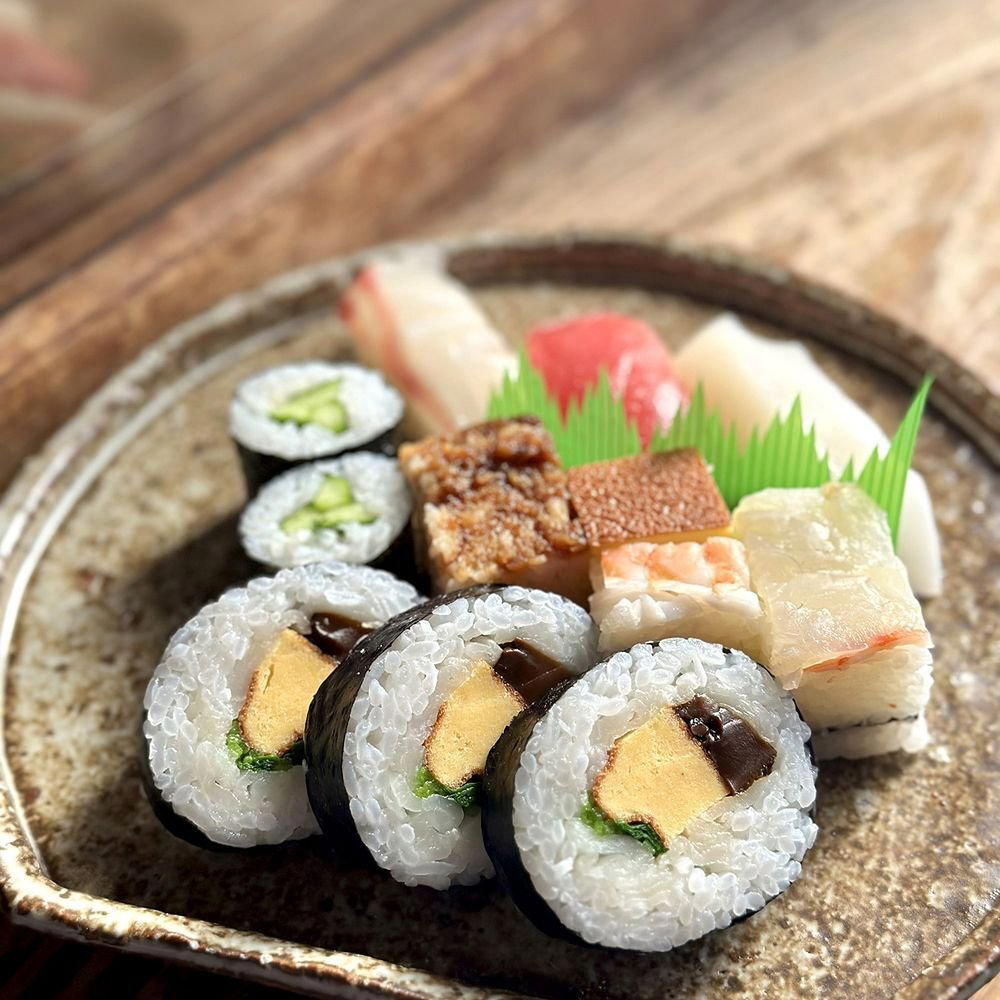
Izugen is a third-generation sushi-ya in Kyoto's Shimogyo Ward, holding the Michelin Bib Gourmand for 2024 and 2025. The kitchen practices Kyoto-style sushi, meaning no hand-formed nigiri and no counter, instead, pressed and rolled forms built on rice cooked with kombu and bonito. The Kyoto sushi mixed platter, covering bo sushi, hako sushi, and maki sushi, anchors the menu at an accessible price point.

Pearl is the En Primeur Club membership app, where members save venues, book tables and use the concierge.
The menu
What to order
- Kyoto sushi mixed platter
- Bo sushi
- Hakozushi
Kyoto Sushi, Off the Counter
Walk into almost any sushi restaurant in Tokyo or Osaka and the counter is the room. The itamae works in front of you, forming each piece by hand, and the theatre of that exchange is half the point. Kyoto operates on different logic. Here, sushi has historically meant pressed forms, vinegared rice layered with fish or vegetables into wooden moulds, then sliced and served at a table, no counter, no performance, no tasting-menu pricing. Izugen, in the Shimogyo district south of Shijo, is among the clearest expressions of that tradition still operating in the city.
The room announces this approach immediately. There is no long hinoki counter to slide into, no chef's tray waiting with a card listing the day's fish. Instead, the space reads as a neighbourhood dining room in the older Kyoto sense: modest, settled, arranged for repeat visitors rather than first-timers building a story to tell. A picture of a maiko hangs on the wall, the current third-generation chef has kept it there because, by his account, he believes she invites guests to step inside, an old pun on the word maikomu. It is a detail that tells you something about the register of the place: traditional, somewhat quietly literary, unbothered by trends.
The Structure of Kyoto Sushi
Understanding what Izugen serves requires a brief taxonomy of the form. Kyoto sushi diverges from Edo-mae sushi on almost every axis. Where Edo-mae is fast, hand-formed, and built around raw fish sourced from Tokyo Bay, Kyoto-style sushi uses preserved or marinated fish, relies on the mould rather than the palm, and reflects a landlocked city's historical relationship with ingredients transported from the coasts. Mackerel, salted and cured, is the emblematic fish, it travels well and ages into a complexity that fresh tuna cannot replicate in this context.
Bo sushi is the pressed mackerel form: a log of vinegared rice topped with a fillet that has been cured, wrapped in kombu or leaf, then pressed into a long cylinder and sliced. Hako sushi uses a wooden box mould, pressing rice and toppings into a block before cutting into portions. Maki sushi here refers to the rolled form, though constructed with the same attention to rice and balance as the pressed variants. These are not simplified versions of a more complex original. They are complete expressions of a different culinary grammar.
At Izugen, the rice underneath all three forms is cooked with kombu and bonito, a dashi-inflected base that deepens the flavour without sweetness. This matters because Kyoto-style sushi is often dismissed by those expecting the clean acidity of Tokyo rice or the richness of Osaka's oshi-zushi. The kombu-and-bonito approach produces something between the two: savoury, restrained, suited to the preserved fish that sits on top of it.
A Bib Gourmand Standard at an Accessible Price
Michelin's Bib Gourmand designation is awarded to restaurants that deliver quality cooking at a price the guide considers reasonable for the market. Izugen has held the designation for both 2024 and 2025, which places it in a tier of Kyoto dining that is seriously considered without being formally starred. In a city where kaiseki restaurants at the ¥¥¥¥ level, think Gion Sasaki at three stars or Ifuki at two, set the upper ceiling of what Kyoto cooking can cost, a single-¥ restaurant holding sustained Michelin recognition represents a different kind of argument: that the older, plainer, neighbourhood-rooted forms of Kyoto food are worth seeking out on their own terms.
For comparison, Izuu operates in the Gion district and is also associated with Kyoto-style pressed sushi, while Kikunoi Sushi Ao approaches sushi from a kaiseki-influenced frame at a higher price point. Sushi Rakumi and KASHIWAI represent the city's more contemporary sushi expressions, and Kiu adds further variety to the Kyoto dining spectrum. Izugen sits at a remove from all of them, older in form, simpler in setting, cheaper in price, and no less specific about what it is doing.
The Kyoto sushi mixed platter, which covers all three styles, is the natural starting point for visitors unfamiliar with the format. It lets the differences between bo, hako, and maki read clearly side by side, and it does so at a price that positions Izugen as a place you can visit repeatedly rather than save for a single occasion. That framing, casual, frequent, known to locals over generations, is the restaurant's actual identity, and the Bib Gourmand formalises what Shimogyo residents have presumably understood for decades.
Third Generation in Shimogyo
The Kyoto restaurant world contains a number of multi-generational establishments where continuity is both a selling point and a discipline. Holding a form across three generations means the current cook has inherited both the technique and the obligation to keep it coherent. The details at Izugen that read as quirky, the maiko painting, the insistence on table service rather than counter, the narrow menu built around three sushi styles, are better understood as the accumulated decisions of a kitchen that has stayed committed to a specific version of itself. Each generation has chosen not to modernise in the directions that might have broadened appeal or raised prices.
That compression of history into a small dining room in Shimogyo is part of what makes Izugen worth understanding within the broader Kyoto dining picture. The city's food culture tends to attract attention at its expensive end, the three-Michelin-star kaiseki rooms that require months of planning and budgets to match. But those restaurants exist within a city that also has neighbourhood sushi-ya that have been pressing mackerel into wooden moulds for three generations, holding a Michelin Bib Gourmand, and charging ¥ for the privilege. Both ends of that range are Kyoto.
For those planning a wider trip through Japan's culinary regions, the contrast with approaches elsewhere is instructive. Harutaka in Tokyo represents the Edo-mae counter tradition that Izugen explicitly steps away from. HAJIME in Osaka shows how a different Japanese city approaches fine dining. akordu in Nara, Goh in Fukuoka, 1000 in Yokohama, and 6 in Okinawa each map a distinct regional dining register. Further afield, Sushi Shikon in Hong Kong and Shoukouwa in Singapore show how Japanese sushi traditions translate into other Asian cities at the premium end of the market, a very different frame than Izugen, but part of the same extended conversation about what sushi can mean.
For a fuller picture of where to eat and drink across the city, see our full Kyoto restaurants guide, our full Kyoto bars guide, our full Kyoto hotels guide, our full Kyoto wineries guide, and our full Kyoto experiences guide.
Know Before You Go
- Address: Takeyacho 391, Shimogyo Ward, Kyoto 600-8093
- Price range: ¥ (accessible, single-tier pricing)
- Awards: Michelin Bib Gourmand 2024, Michelin Bib Gourmand 2025
- What to order: The Kyoto sushi mixed platter covering bo sushi (mackerel), hako sushi, and maki sushi
- Format: Table service, no counter, consistent with traditional Kyoto sushi style
- Note: Phone and booking; walk-in is the typical approach for this category of Kyoto neighbourhood restaurant, but confirming locally before visiting is advisable
What Dish Is Izugen Famous For?
Izugen is associated with the Kyoto sushi mixed platter, which presents three distinct pressed and rolled sushi forms: bo sushi with cured mackerel, hako sushi, and maki sushi. The kitchen's approach to rice, cooked with kombu and bonito rather than seasoned with sugar-forward vinegar, is the structural foundation of all three. The restaurant has held the Michelin Bib Gourmand in both 2024 and 2025, recognition that reflects the kitchen's consistency within a third-generation tradition of Kyoto-style sushi that avoids hand-formed nigiri entirely.
Frequently asked questions
Where do I go for Izugen?
Izugen is located at Japan, 〒600-8093 Kyoto, Shimogyo Ward, Takeyacho, 391, Kyoto.
What does dinner at Izugen typically cost?
Pricing at Izugen is listed as ¥.
What kind of recognition has Izugen received?
Izugen has received recognition including: A Kyoto eatery to drop in often and casually. Izugen is a much-loved tradition from the old days, jealously guarded by its third-generation chef. Rice, the essential base of sushi, is cooked with kombu and bonito. Order the Kyoto sushi mixe….
What dish is Izugen famous for?
Izugen is associated with the Kyoto sushi mixed platter, which presents three distinct forms: bo sushi with cured mackerel, hako sushi, and maki sushi. None of these are hand-formed at a counter, that distinction is central to Kyoto sushi tradition and separates Izugen from Edo-mae style restaurants. The rice base is cooked with kombu and bonito, giving it a character specific to this kitchen. Michelin has recognised the kitchen with back-to-back Bib Gourmand awards in 2024 and 2025.
Price and Positioning
A quick snapshot of similar venues for side-by-side context.
| Venue | Cuisine | Price | Awards | Notes |
|---|---|---|---|---|
| IzugenThis venue (the venue you are viewing) | Traditional Kyoto Sushi | $20–30 | Michelin Bib Gourmand | Not listed |
| Gion Sasaki | Modern Kaiseki | $300–500 | 3 Michelin Stars · La Liste Top Restaurants | Kaiseki, Japanese |
| cenci | Innovative Italian-Japanese Fusion | $100–150 | 1 Michelin Star · World's 50 Best #76 | Italian |
| Ifuki | Sumibi Kappo Kaiseki | $200–300 | 2 Michelin Stars · La Liste Top Restaurants | Kaiseki |
| Kyokaiseki Kichisen | Kyoto Kaiseki | $200–300 | 2 Michelin Stars · La Liste Top Restaurants | Japanese |
| Kyo Seika | Modern Chinese Fine Dining | $150–200 | 1 Michelin Star · Tabelog Bronze #216 | Chinese |
Recognition history
Dated appearances from independent guides and award organizations, with the underlying list record or original source where available.
Michelin Bib Gourmand
Michelin
Full recognition history (3 entries)
Michelin Bib Gourmand
Michelin
Michelin Bib Gourmand
Michelin
Continue exploring
More in Kyoto
Restaurants in Kyoto
All restaurants in Kyoto →
Bars in Kyoto
All bars in Kyoto →
Hotels in Kyoto
All hotels in Kyoto →
Wineries in Kyoto
Browse all →
Details
- Classic
- Cozy
- Intimate
- Quiet
- Solo
- Casual Hangout
- Historic Building
- Sake Program
- Local Sourcing
- A La Carte
- Small Plates
- Sake
Current opening hours
- Monday
- 11 AM–2:30 PM, 3:30–7 PM
- Tuesday
- 11 AM–2:30 PM, 3:30–7 PM
- Wednesday
- 11 AM–2:30 PM, 3:30–7 PM
- Thursday
- Closed
- Friday
- 11 AM–2:30 PM, 3:30–7 PM
- Saturday
- 11 AM–2:30 PM, 3:30–7 PM
- Sunday
- 11 AM–2:30 PM, 3:30–7 PM
Hours can change for holidays and private events. Hours as of .
Warm wooden townhouse with tatami rooms, low ceilings, unpretentious lighting, quiet conversation, and clean scents of rice and sea.