


Michelin Plate · Tabelog Bronze #485
Our verdict
Kyoto kaiseki often rewards restraint, but Higashiyama Tsukasa works in a more free-form register: counter seating, a seasonal Japanese base, and ideas that move beyond strict classical boundaries. Recognition from Tabelog Bronze and Opinionated About Dining places it in the city’s serious Japanese dining tier, with a format better suited to diners who want precision without predictability.

Pearl is the En Primeur Club membership app, where members save venues, book tables and use the concierge.
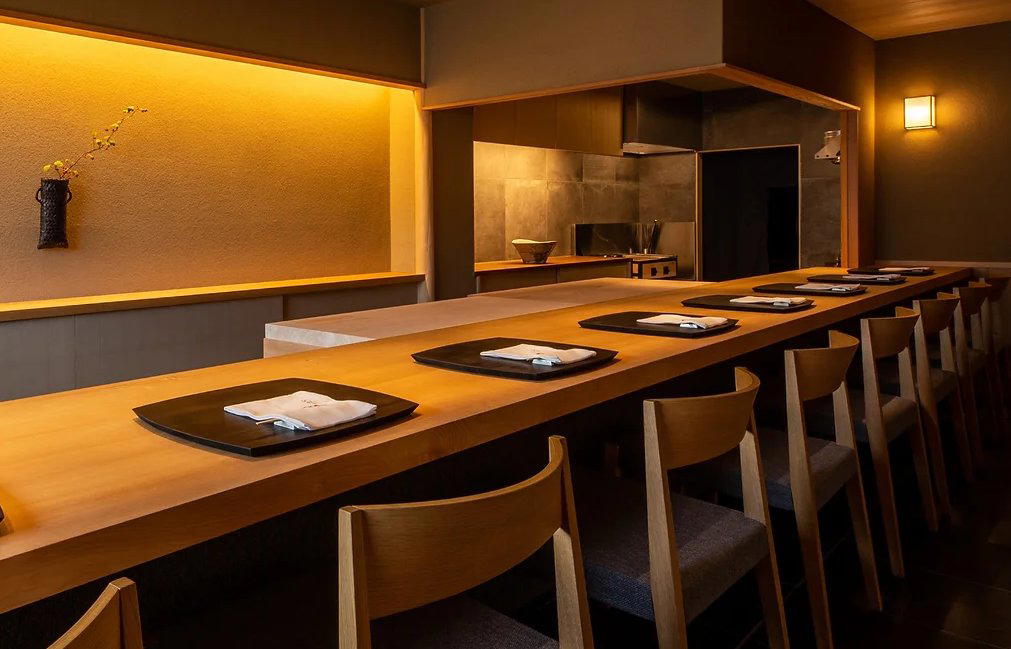
Kyoto moves at a cadence that can make dining feel exacting without becoming theatrical: low evening traffic, a city poised between inherited ritual and daily life, and rooms that ask pointed questions about how far tradition can bend before the meal stops reading as itself. Higashiyama Tsukasa sits inside that debate, not as a fixed museum-piece experience, but as a focused Kyoto restaurant whose appeal is best understood through the city’s broader conversation about restraint, change and serious dining.
Kyoto dining is often discussed through timing, temperature, vessel, season and restraint, shaped by the city’s long relationship with hospitality and craft. The stricter end prizes quietness and sequence; newer dining rooms may keep the architecture of tradition while loosening the vocabulary. The useful comparison is not old versus new, but restaurants treating tradition as preservation versus those treating it as living syntax.
A compact Kyoto restaurant where the meal becomes less doctrinaire
The scale of attention matters. It turns the meal from banquet formality into a close reading of decisions: pacing, transitions, and how a restaurant moves through ideas without losing its centre. Kyoto has many intimate dining rooms, from the more formal world of Gion Kida to the bracket represented by Mizuno, Kappo Umetsu, Gion Mamma and Gion Kajisho. Here, the distinction is not luxury signalling, but how tightly the experience holds together while the restaurant steps outside expected boundaries.
The strongest clue is the restaurant’s willingness to resist a single rigid template. Rather than presenting tradition as something sealed off from the present, the experience reads as one using Kyoto’s dining logic while questioning the assumption that every reference point must be predictable. Familiar local anchors can still matter, but they are treated as working tools rather than museum pieces.
This is where Kyoto’s current dining scene becomes interesting. Some restaurants translate seasonality through inherited forms; others use the same sense of place to test appetite, memory and surprise. Higashiyama Tsukasa can be read in that second conversation. The meal depends on coherence and discipline, but its pleasure lies in watching a serious restaurant absorb broader ideas without collapsing into novelty shorthand.
Recognition confirms a serious Kyoto restaurant, not a novelty act
A free-form restaurant in Kyoto needs more than charm. The trust signal provided here is concrete: Higashiyama Tsukasa appears in the Opinionated About Dining restaurant source for 2026. That does not settle the argument alone, but it places the restaurant within a wider conversation among diners who track serious restaurants beyond the obvious canonical names.
The format matters because this kind of meal depends on a guiding point of view, but biography is not the story. The story is a broader Kyoto shift: diners who understand classical dining increasingly allow a restaurant to move with more flexibility if internal discipline remains intact. That audience is narrower than first-time visitors seeking a canonical Kyoto meal. It suits repeat visitors, solo diners, and travellers who have already eaten the city’s more formal dining.
For that first classical reference point, the EP Club Kyoto map gives contrast. Other Kyoto dining rooms frame the wider city conversation around dining culture and closely observed hospitality. For broader planning, use Our full Kyoto restaurants guide alongside Our full Kyoto hotels guide, Our full Kyoto bars guide, Our full Kyoto wineries guide and Our full Kyoto experiences guide.
Who should choose this style of Kyoto meal
The right diner is not seeking a scripted introduction to Kyoto refinement, but what happens after that script has been learned. A focused restaurant encourages attention to the compression of the room, the rhythm of the meal, and the kitchen’s ability to make a sequence coherent while moving across references. For diners who care more about decision-making than ceremony, that can be more rewarding than a grander room.
It also reminds us that Kyoto is often narrowed into gentle images: seasonal ingredients, lacquer, restraint, silence. In the city itself, better contemporary dining rooms are rarely so passive. They work with rules because rules create tension. A surprising moment lands only if the preceding meal has established discipline; a broader reference makes sense only if the experience still speaks clearly in context. The risk is part of the point.
For travellers building a Japan dining itinerary, the restaurant pairs conceptually with other serious addresses, not only classical rooms. EP Club’s wider archive includes other dining in Japan and beyond that shows how elastic a restaurant language can be when technique, format and context are treated seriously. Read together, they suggest that category labels matter less than whether a restaurant has the control to make its own language convincing.
The editorial case for Higashiyama Tsukasa is clear: choose it when Kyoto’s classical vocabulary is already familiar and the appeal is seeing it stretched. Opinionated About Dining recognition confirms its place in a serious conversation; the setting keeps the experience intimate; the restaurant’s openness to broader references makes it sharper than a conventional seasonal meal. It is not the safest Kyoto dinner. That is precisely why it matters.
Frequently asked questions
Is Higashiyama Tsukasa okay with children?
Higashiyama Tsukasa is best considered as a focused dining room in Kyoto, so the practical fit is strongest for calm, well-managed parties who are comfortable with a serious meal. Confirm suitability directly when booking.
What is the atmosphere like at Higashiyama Tsukasa?
Expect an intimate, focused restaurant in Kyoto rather than a broad dining room. Its inclusion in the Opinionated About Dining restaurant source for 2026 points to a serious dining room rather than a casual stop.
What kind of cuisine does Higashiyama Tsukasa serve?
Higashiyama Tsukasa is a Kyoto restaurant whose appeal lies in a disciplined meal with room for broader references.
How much does it cost to eat at Higashiyama Tsukasa?
Confirm current pricing directly with Higashiyama Tsukasa when booking.
Fast Comparison
Comparable venues by cuisine and price in the same metro.
| Venue | Cuisine | Price | Awards | Notes |
|---|---|---|---|---|
| Higashiyama TsukasaThis venue (the venue you are viewing) | Modern Kaiseki Omakase | $200–300 | Michelin Plate · Tabelog Bronze #485 | Not listed |
| Kamanza Nagashima | Traditional Japanese Kappo | Not listed | 1 Michelin Star | Yamashina |
| SEN | Kaiseki | $150–200 | 1 Michelin Star · Tabelog Bronze #395 | Shimogyō |
| Muromachi Wakuden | Modern Kyoto Kaiseki Omakase | $100–150 | 1 Michelin Star · Tabelog Bronze #298 | Nakagyō |
| Nakamitsu | Modern Japanese Omakase | $150–200 | 1 Michelin Star | Nakagyō |
| Godan Miyazawa | Michelin-Starred Tea Kaiseki | $150–200 | 1 Michelin Star | Shimogyō |
Recognition history
Dated appearances from independent guides and award organizations, with the underlying list record or original source where available.
Michelin Plate
Michelin
Opinionated About Dining Top Restaurants in Japan Recommended
Opinionated About Dining
Tabelog Bronze #485
Tabelog
Full recognition history (8 entries)
Michelin Plate
Michelin
Opinionated About Dining Top Restaurants in Japan Ranked #294
Opinionated About Dining
Tabelog Bronze
Tabelog
Tabelog 100 #26 · No. 26
Tabelog · Tabelog 100 - Japanese cuisine - WEST - 2025
Michelin Plate
Michelin
Continue exploring
More in Kyoto
Restaurants in Kyoto
All restaurants in Kyoto →
Bars in Kyoto
All bars in Kyoto →
Hotels in Kyoto
All hotels in Kyoto →
Wineries in Kyoto
Browse all →
Details
- Intimate
- Elegant
- Sophisticated
- Cozy
- Modern
- Date Night
- Special Occasion
- Chefs Counter
- Open Kitchen
- Sake Program
- Omakase
- Counter Dining
- Sake Program
Current opening hours
- Monday
- Closed
- Tuesday
- 6–9 PM
- Wednesday
- 6–9 PM
- Thursday
- 6–9 PM
- Friday
- 6–9 PM
- Saturday
- 6–9 PM
- Sunday
- Closed
Hours can change for holidays and private events. Hours as of .
Sophisticated open counter with 8-9 seats offering a calm, personal atmosphere that fosters conversation in a minimalist, serene setting.