



A former 1930s elementary school converted into a 48-room boutique hotel in Kyoto's Higashiyama district, The Hotel Seiryu Kyoto Kiyomizu holds a Michelin Key (2024) and La Liste Top Hotels recognition (94 points, 2026). The Yasaka Pagoda frames the guest lounge windows, Benoit Kyoto from the Ducasse Paris group anchors the dining program, and three private baths offer a quieter counterpoint to one of the city's most visited temple corridors.
Pearl is the En Primeur Club membership app — saves, bookings, and concierge access live there. Same editors, same standards.
- Address
- 2-chōme-204-2 Kiyomizu, Higashiyama Ward, Kyoto, 605-0862
- Phone
- +81 75-532-1111
- Website
- princehotels.com
- Directions
- Get directions
 Saves & bookings on Pearl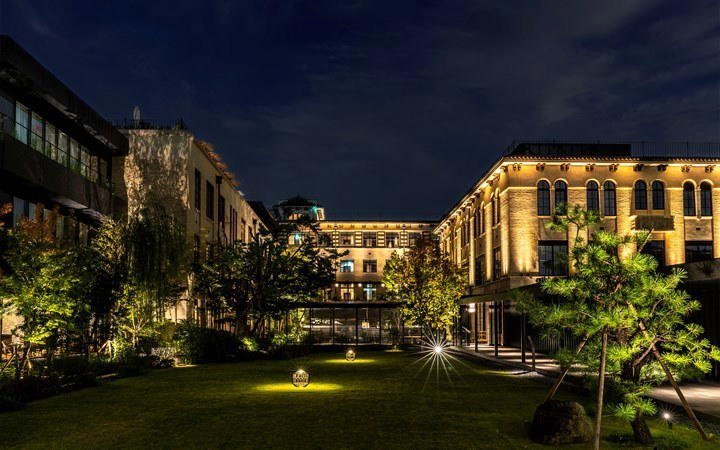
A School Becomes a Sanctuary in Higashiyama
The approach to The Hotel Seiryu Kyoto Kiyomizu follows the same stone-paved lane that leads pilgrims toward Kiyomizu-dera, one of Kyoto's oldest and most visited UNESCO World Heritage Sites. At some point on that walk, the temple-bound crowds thin just enough that the building's 1930s brick facade registers as something out of step with the surrounding machiya townhouses and souvenir stalls. That contrast is the point. In a city where adaptive reuse has become a serious architectural discipline, the conversion of a century-old elementary school into a 48-room hotel represents one of Higashiyama's more considered reinventions.
The decision to preserve the school's exterior, its arched windows, its load-bearing brick courses, its general civic solidity, rather than clad it in something more conventionally ryokan-like says something about where Kyoto's premium hotel tier has been heading. Properties such as The Shinmonzen and SOWAKA have staked similar ground: heritage structure, contemporary interior, specific neighbourhood identity. Hotel Seiryu sits in that cohort, drawing its name from the word for azure dragon and wearing the building's provenance as a credential rather than a quirk.
The Case for Higashiyama as a Rest Base
Location in Kyoto's luxury hotel segment cuts two ways. The large international flagships, including the Four Seasons Hotel Kyoto and Park Hyatt Kyoto, offer the infrastructure of major hotel groups: full-service spas, multiple restaurants, considerable room counts. Hotel Seiryu trades that scale for proximity. The Kiyomizu-dera Temple, dating to the eighth century, sits eight to ten minutes on foot. Yasaka Pagoda is visible from inside the building. Fushimi Inari Shrine and Kenninji temple are reachable without committing to a taxi or subway line.
For visitors organizing their time around Kyoto's major temple and shrine circuit, that positioning is material. The difference between a hotel within walking distance of the Higashiyama historic district and one that requires a vehicle for every excursion compounds across a multi-day stay. The practical calculation, at a room rate reported at approximately $1,145 per night as a member property of The Leading Hotels of the World, is whether that location premium justifies itself. For itineraries anchored to Higashiyama's shrines and pagodas, it typically does.
Where the Building Gives Way to the View
The floors that preserve the school's original outward appearance, the first through fourth, have been fully modernized inside, the institutional past dissolved into bespoke finishes without nostalgia. The guest lounge takes this architectural conversation to its most direct expression: floor-to-ceiling glass providing nearly 360-degree views of the surrounding site, with the Yasaka Pagoda framing one of the more architecturally specific sightlines available in a Kyoto hotel public space.
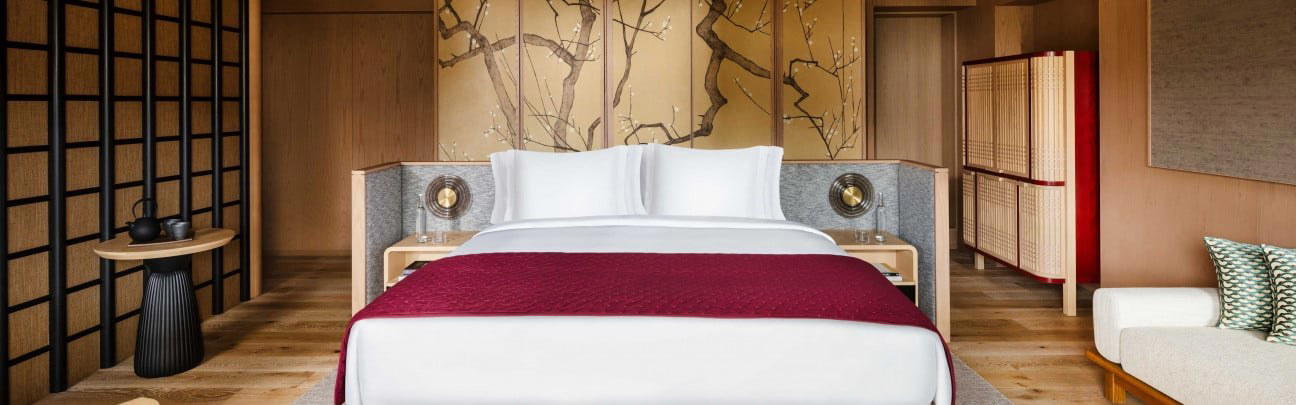
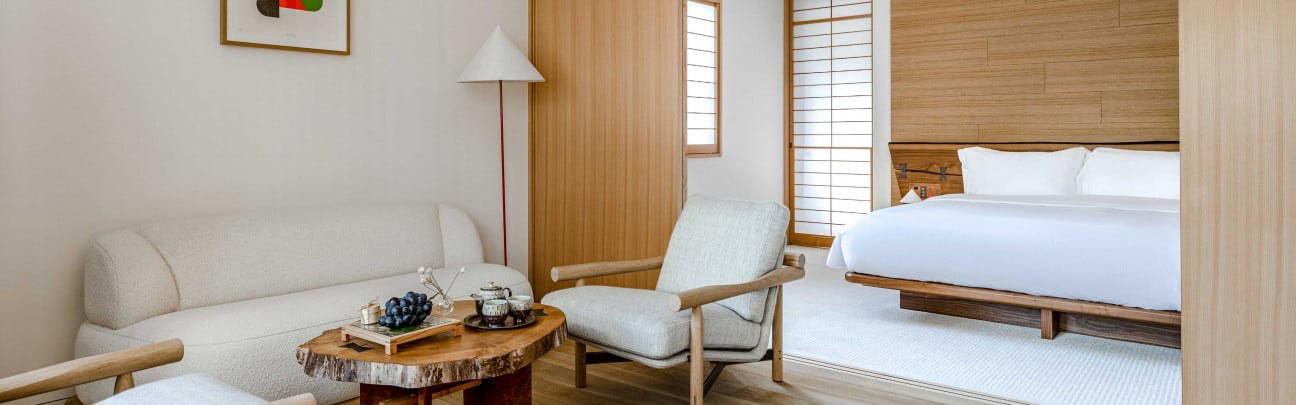
The 48 guest rooms are distributed across 15 different configurations plus one suite, each finished in golden woods, off-whites, and earth tones. Tray ceilings with recessed lighting replace any impulse toward dramatic overhead fixtures, producing a glow that reads as deliberate rather than incidental. The extra-large windows in each room are the real design decision: the view from this part of Higashiyama is the amenity, and the rooms are calibrated to make that clear without overclaiming it through excess decoration.
Recovery as Programming: The Three Private Baths
Kyoto's Higashiyama walking routes are among the more concentrated temple circuits in Japan. A single day that takes in Kiyomizu-dera, Sannenzaka, Ninenzaka, Maruyama Park, and Yasaka Shrine covers meaningful ground, and the physical toll of that kind of shrine-and-staircase itinerary is real. The hotel's response to that reality is practical: three private baths available to guests, scaled to be both spacious and functional without the ceremonial weight of a full onsen facility.
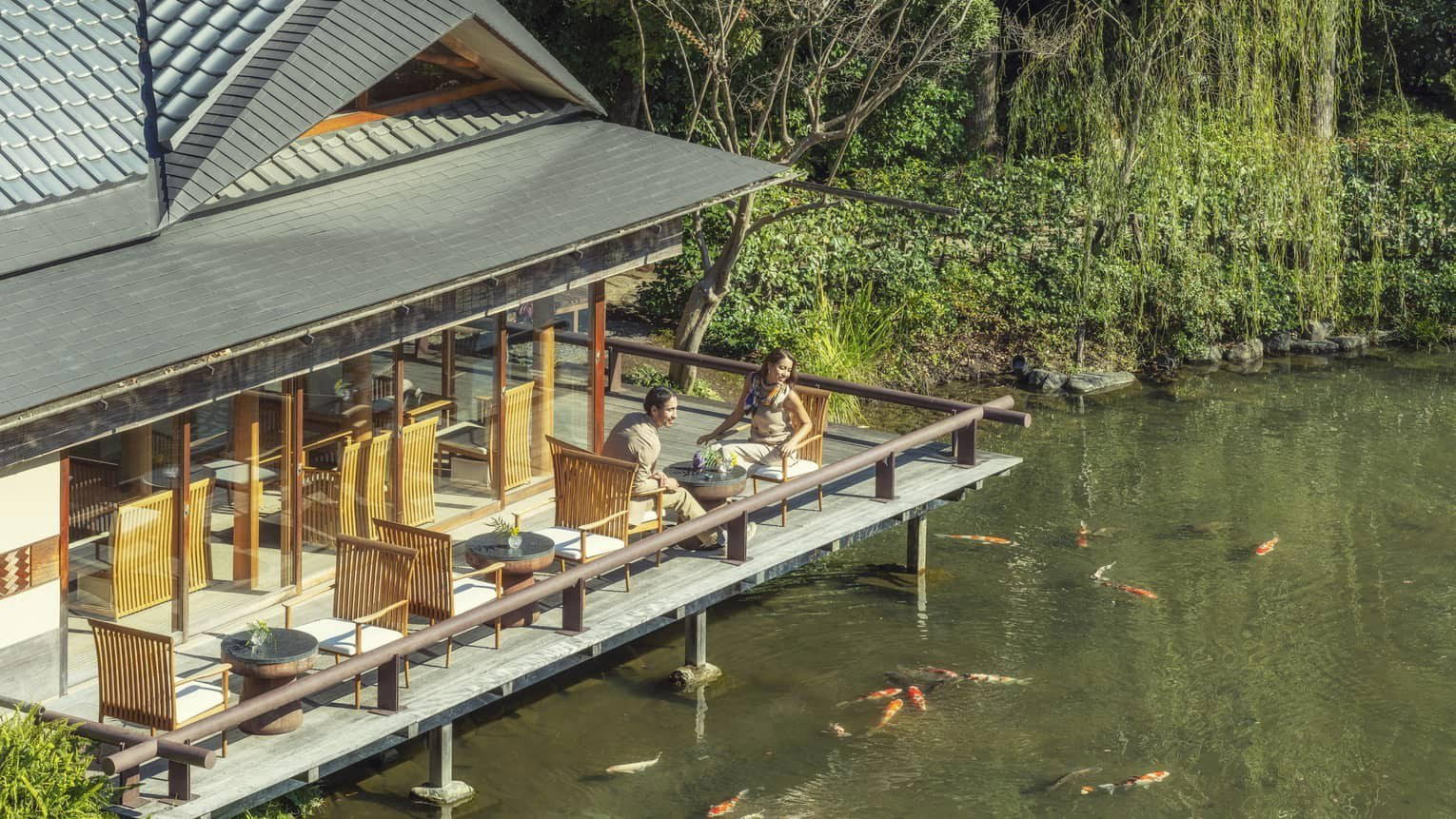
In the broader category of Japanese wellness hospitality, private baths of this kind occupy an interesting middle register. Purpose-built onsen ryokan, properties like Gora Kadan in Hakone or Asaba in Izu, build their entire proposition around thermal bathing culture, with communal baths, kaiseki dining, and structured ryokan ritual. Hotel Seiryu doesn't attempt to compete in that register. It offers private bath access as one layer of a wider urban hotel program, positioned closer to the boutique-hotel-with-thoughtful-amenities model than to the dedicated retreat format.
Benoit Kyoto and the Rooftop as Evening Ritual
The dining program at Hotel Seiryu is anchored by Benoit Kyoto, an outpost of the Parisian bistro founded in 1912 and now operated under the Ducasse Paris group. In a city where dining options range from hyper-local kaiseki at small, reservation-only establishments to internationally oriented hotel restaurants, Benoit's presence is a specific editorial choice. It signals a guest profile that values the familiarity and culinary credibility of a named Parisian brand alongside access to Kyoto's wider dining scene.
The rooftop bar resolves the question of where to spend the hour before or after dinner more definitively than most hotel rooftop spaces in this price bracket manage. At the elevation it occupies above Higashiyama, as lanterns come on across the district and the pagoda settles into dusk, the bar functions as a decompression chamber between the day's temple circuit and the evening ahead. The view over Kyoto from this position is the product of the building's height and location, not of any particular design intervention, which is, in this case, precisely the right approach.
Recognition and Peer Placement
Hotel Seiryu holds a Michelin Key awarded in 2024 and appears in La Liste's Leading Hotels ranking for 2026 with a score of 94 points. Within Kyoto specifically, the hotel sits in a competitive set that includes design-led boutique properties such as Ace Hotel Kyoto and HOTEL THE MITSUI KYOTO, as well as the larger international flagships and more intimate properties like Aman Kyoto and Dusit Thani Kyoto. At 48 rooms, it operates at a scale that allows for more personal service without the full programming infrastructure of a resort-sized property.
Planning Your Stay
Comparable Venues
Comparable venues nearby, for context on price, style, and recognition.
| Venue | Cuisine | Price | Awards | Notes |
|---|---|---|---|---|
| The Hotel Seiryu Kyoto KiyomizuThis venue — the venue you are viewing | Renovated historic school building blending Japanese heritage with contemporary luxury | $$$$ | Michelin 1 Key | Not listed |
| Hoshinoya Kyoto | luxury hybrid ryokan blending traditional Japanese architecture with modern comforts | $$$$ | Michelin 1 Key | Nishikyō |
| Suiran, a Luxury Collection Hotel, Kyoto | Traditional Japanese luxury ryokan blended with modern amenities | $$$$ | Michelin 1 Key | Ukyō |
| Four Seasons Hotel Kyoto | Contemporary luxury resort anchored by historic Japanese heritage, featuring modern amenities integrated with traditional design elements and cultural programming. | $$$$ | Michelin 1 Key | Higashiyama |
| Hiiragiya | Traditional Japanese ryokan blending Edo-Meiji heritage with modern comforts | $$$$ | Michelin 1 Key | Nakagyō |
| Genji Kyoto | Contemporary Japanese sanctuary inspired by the Tale of Genji | $$$$ | Michelin 1 Key | Shimogyō |
Recognition history
Dated appearances from independent guides and award organizations, with the underlying list record or original source where available.
Forbes 4-Star
Forbes
La Liste Top Hotels
La Liste
Forbes 4-Star
Forbes
Leading Hotels of World Member
Leading Hotels of World
Michelin 1 Key
Michelin
Michelin 1 Key
Michelin
Continue exploring
More in Kyoto
Hotels in Kyoto
Browse all →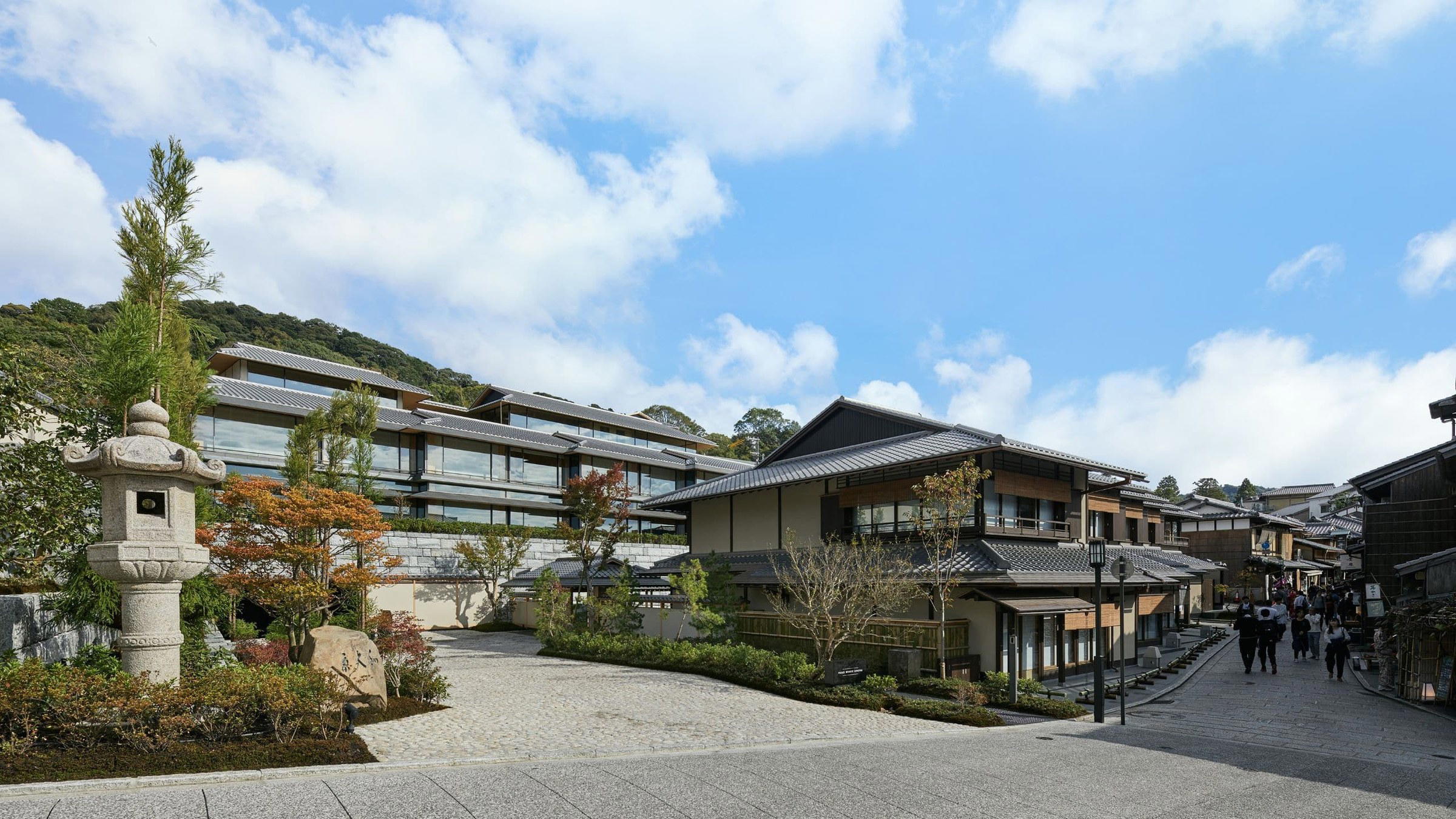
Bars in Kyoto
Browse all →
Restaurants in Kyoto
Browse all →
Wineries in Kyoto
Browse all →
At a Glance
- Elegant
- Quiet
- Sophisticated
- Scenic
- Modern
- Romantic Getaway
- Anniversary
- Weekend Escape
- Historic Building
- Panoramic View
- Terrace
- Wi Fi
- Fitness Center
- Spa
- Room Service
- Concierge
- Restaurant
- Bar
- Mountain
- Street Scene
- Wi Fi
- Fitness Center
- Spa
- Room Service
- Concierge
- Restaurant
- Bar
Calm and tranquil oasis with light-filled spaces, soundproof rooms, and a peaceful atmosphere amidst the city bustle, featuring golden woods and soothing earth tones.