
Tabelog 100 #83
Our verdict
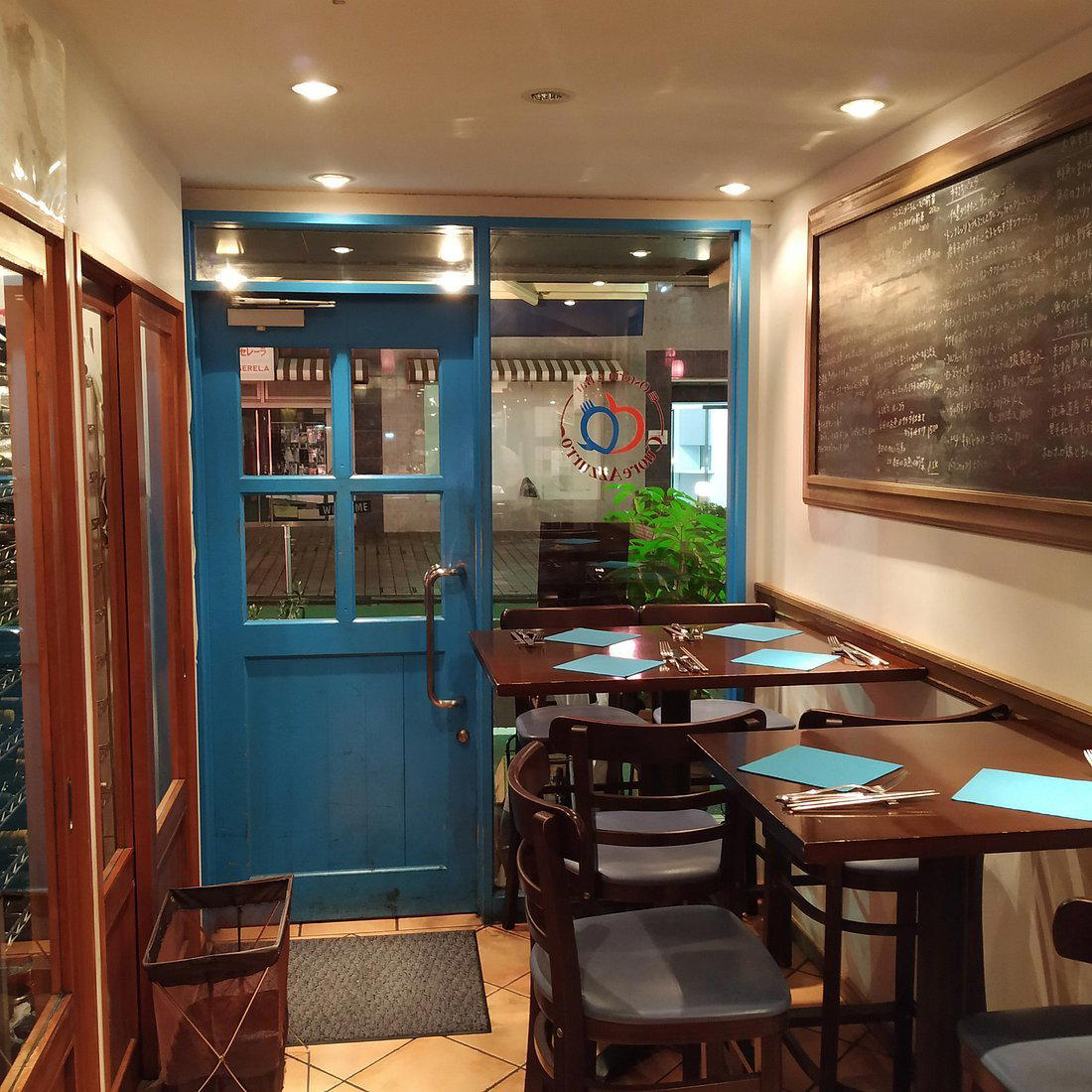
A compact Italian address in Kamimeguro, Cuore Azzurro sits within Tokyo's quietly expanding cohort of European kitchens that stake their identity on sourced ingredients rather than spectacle. The Meguro River neighbourhood frames a dining culture that rewards specificity over scale, and this room operates within that register, ingredient-forward, unhurried, and worth planning ahead for.

Pearl is the En Primeur Club membership app, where members save venues, book tables and use the concierge.
The menu
What to order
- Pasta al Pomodoro
- Risotto ai Funghi
- Roasted onions stuffed with chicken livers
- Tagliolini with cuttlefish ink and sea urchins
Kamimeguro and the Italian Question in Tokyo
Meguro's dining strip along the river has developed a particular personality over the past decade: independently run rooms, European in orientation, that draw loyal followings without the machinery of a hotel group or a Michelin campaign behind them. The neighbourhood sits a short walk from Nakameguro station, and its restaurant character leans toward the considered and the repeat-visit rather than the occasion splurge. Cuore Azzurro, on a ground-floor address in Kamimeguro 2-chome, belongs to that cohort.
Italian cooking in Tokyo has long occupied two distinct registers. One is the high-formality, multi-course Italian that references French technique and competes in the same tier as kaiseki, addresses like those surrounding the Ginza and Minami-Aoyama corridors, where tasting menus price into the same range as L'Effervescence or Sézanne. The other is the neighbourhood-scaled Italian, where the sourcing story and the cooking confidence do the persuading rather than the ceremony. Cuore Azzurro operates in that second register, which in Tokyo's most attentive dining pockets can be the more demanding of the two to pull off consistently.
What Ingredient Sourcing Means in This Context
Tokyo's serious Italian kitchens have largely moved past the question of whether to use Japanese produce. The more interesting debate now is how specifically, and how honestly, that sourcing is communicated. The Japanese domestic supply network for high-specification ingredients, Kyushu vegetables, Tohoku dairy, Hokkaido seafood, is deep enough that a committed kitchen in Meguro can build a credible seasonal programme without touching imported pantry staples except where they genuinely matter (olive oil, cured meats, specific aged cheeses).
This sourcing tension plays out differently across Japan's restaurant geography. In Osaka, HAJIME resolves it through a highly conceptual lens. In Kyoto, Gion Sasaki anchors it firmly in kaiseki tradition. In Nara, akordu frames it through Spanish-influenced technique applied to local produce. For a neighbourhood Italian in Meguro, the answer is quieter: produce that reads as seasonal in both the Italian and Japanese senses, and a menu that changes in response to what the supply chain actually delivers rather than what looks good printed in advance.
That approach puts real pressure on the kitchen's relationships with suppliers, and on its willingness to adjust the plate when those relationships surface something worth showcasing. Italy's own regional cooking tradition, from the Ligurian coast to the Veneto, is built on exactly this kind of market-driven adaptability. The leading Japanese-Italian rooms are those that understand that the sourcing discipline is native to the form, not an imposed localism.
The Meguro River Room: What to Expect
The address in Kamimeguro places Cuore Azzurro within a sub-neighbourhood where ground-floor restaurants tend toward the intimate. Across this stretch, you are more likely to encounter eight to twenty covers than the open dining halls of Shibuya or Shinjuku. The physical format matters because it shapes the service rhythm: rooms of this scale can sustain a pace of cooking that responds to the table rather than to a central kitchen's throughput requirements.
Tokyo's neighbourhood Italian scene at this scale invites comparison with what Crony does in its French-inflected mode, a focused room where the counter or close-set tables create an unscripted quality to the meal. The contrast with more structured kaiseki addresses like RyuGin is useful: the formality there is vertical, moving through a precise ceremonial sequence, whereas a neighbourhood Italian of this type tends to work horizontally, broader engagement with the diner, less ritual distance.
For those mapping Tokyo's Japanese-meets-European dining, addresses like affetto akita in Akita and Abon in Ashiya show how this format extends beyond the capital, European cooking shaped by local produce, operating at neighbourhood scale, in cities where the restaurant culture rewards specificity over category recognition.
What can be said is that the Kamimeguro location and format signal a positioning distinct from the ¥¥¥¥ tier occupied by Harutaka in its omakase bracket. The neighbourhood restaurants of this type in Meguro typically sit in a mid-range to upper-mid range bracket relative to Tokyo's wider dining spread, accessible enough for repeat visits, considered enough to merit planning ahead.
| Venue | Cuisine | Price Tier | Format |
|---|---|---|---|
| Cuore Azzurro | Italian (Kamimeguro) | Unconfirmed | Neighbourhood room |
| Crony | Innovative French | ¥¥¥¥ | Counter-led, intimate |
| L'Effervescence | French | ¥¥¥¥ | Multi-course, formal |
| RyuGin | Kaiseki | ¥¥¥¥ | Ceremonial sequence |
Planning Your Visit
Kamimeguro is most easily accessed from Nakameguro station on the Tokyu Toyoko and Tokyo Metro Hibiya lines, a short walk from the river. The ground-floor location in a low-rise building is characteristic of the neighbourhood's quieter side streets rather than the main river promenade. Booking ahead is advisable for any independently operated room at this scale in Tokyo, smaller seat counts mean less flexibility for walk-in dining, particularly on weekends. See our full Tokyo restaurants guide for broader context on the city's dining districts.
Across Japan, the pattern of ingredient-forward European cooking at neighbourhood scale appears in formats as varied as Goh in Fukuoka, Aji Arai in Oita, and Ajidocoro in Yubari District. Globally, the closest analogue in philosophy, a sourcing-first European kitchen operating below the spectacle tier, might be found in addresses like Lazy Bear in San Francisco or, at the more formal end, Le Bernardin in New York City, both of which anchor their identity in what arrives from the supply chain rather than in theatrical presentation. Similarly, aki nagao in Sapporo and Akakichi in Imabari show how produce provenance becomes the structural spine of menus when chefs are willing to let it.
Frequently asked questions
How do I find Cuore Azzurro?
Cuore Azzurro is located at Japan, 〒153-0051 Tokyo, Meguro City, Kamimeguro, 2 Chome−42-12 渋谷ビル 1F, Tokyo.
How far ahead should I plan for Cuore Azzurro?
Ground-floor independent rooms along the Kamimeguro strip in Tokyo routinely fill midweek tables within a week or two, and weekend sittings faster still. Contacting the venue directly to confirm availability and any reservation policy is the practical first step.
What is Cuore Azzurro known for?
Cuore Azzurro is a neighbourhood Italian address at 2-42-12 Kamimeguro, Meguro City, Tokyo, operating within the quietly developing tier of European rooms along the Meguro River strip. The area has built a reputation over the past decade for independently run kitchens that prioritise European culinary orientation without the formality of central Tokyo's dining rooms. Cuore Azzurro sits within that cohort.
At-a-Glance Comparison
| Venue | Cuisine | Price | Awards | Notes |
|---|---|---|---|---|
| Cuore AzzurroThis venue (the venue you are viewing) | Authentic Regional Italian | $50–100 | Tabelog 100 #83 | Not listed |
| Harutaka | Edo-Style Omakase Sushi | $200–300 | 3 Michelin Stars · World's 50 Best #76 | Sushi |
| L'Effervescence | Modern French with Japanese Influences | $200–300 | 3 Michelin Stars · World's 50 Best #69 | French |
| RyuGin | Modern Kaiseki | $500+ | 3 Michelin Stars · World's 50 Best #41 | Kaiseki, Japanese |
| Crony | Modern French with Japanese Influences | $150–200 | 2 Michelin Stars · World's 50 Best #34 | Innovative, French |
| Den | Modern Japanese Kaiseki | $150–200 | 2 Michelin Stars · World's 50 Best #51 | Innovative, Japanese |
Recognition history
Dated appearances from independent guides and award organizations, with the underlying list record or original source where available.
Tabelog 100 #83 · No. 83
Tabelog · Tabelog 100 - Italian - TOKYO - 2025
Continue exploring
More in Tokyo
Restaurants in Tokyo
All restaurants in Tokyo →


Bars in Tokyo
All bars in Tokyo →




Details
- Cozy
- Intimate
- Elegant
- Date Night
- Special Occasion
- Open Kitchen
- Extensive Wine List
- A La Carte
- Counter Dining
- Wine
Current opening hours
- Monday
- 6–11 PM
- Tuesday
- Closed
- Wednesday
- 6–11 PM
- Thursday
- 6–11 PM
- Friday
- 6–11 PM
- Saturday
- 6–11 PM
- Sunday
- 6–11 PM
Hours can change for holidays and private events. Hours as of .
Trendy yet cozy atmosphere with warm, inviting lighting well-suited for intimate dining.