
Michelin Selected
MOXY Tokyo Kinshicho holds a 2025 MICHELIN Selected distinction and sits in Sumida-ku, east of the Sumida River, within straightforward metro reach of Asakusa and central Tokyo. The property follows the MOXY format: compact, design-forward rooms with a social lobby emphasis. It suits travellers who want an editorially credible Tokyo base in a less-trafficked neighbourhood without the price of the Otemachi or Marunouchi luxury tier.

Pearl is the En Primeur Club membership app — saves, bookings, and concierge access live there. Same editors, same standards.
- Address
- 3 Chome-4-2 Kotobashi, Sumida City, Tokyo 130-0022, Japan
- Phone
- +81 3-5624-8801
- Website
- marriott.com
- Directions
- Get directions
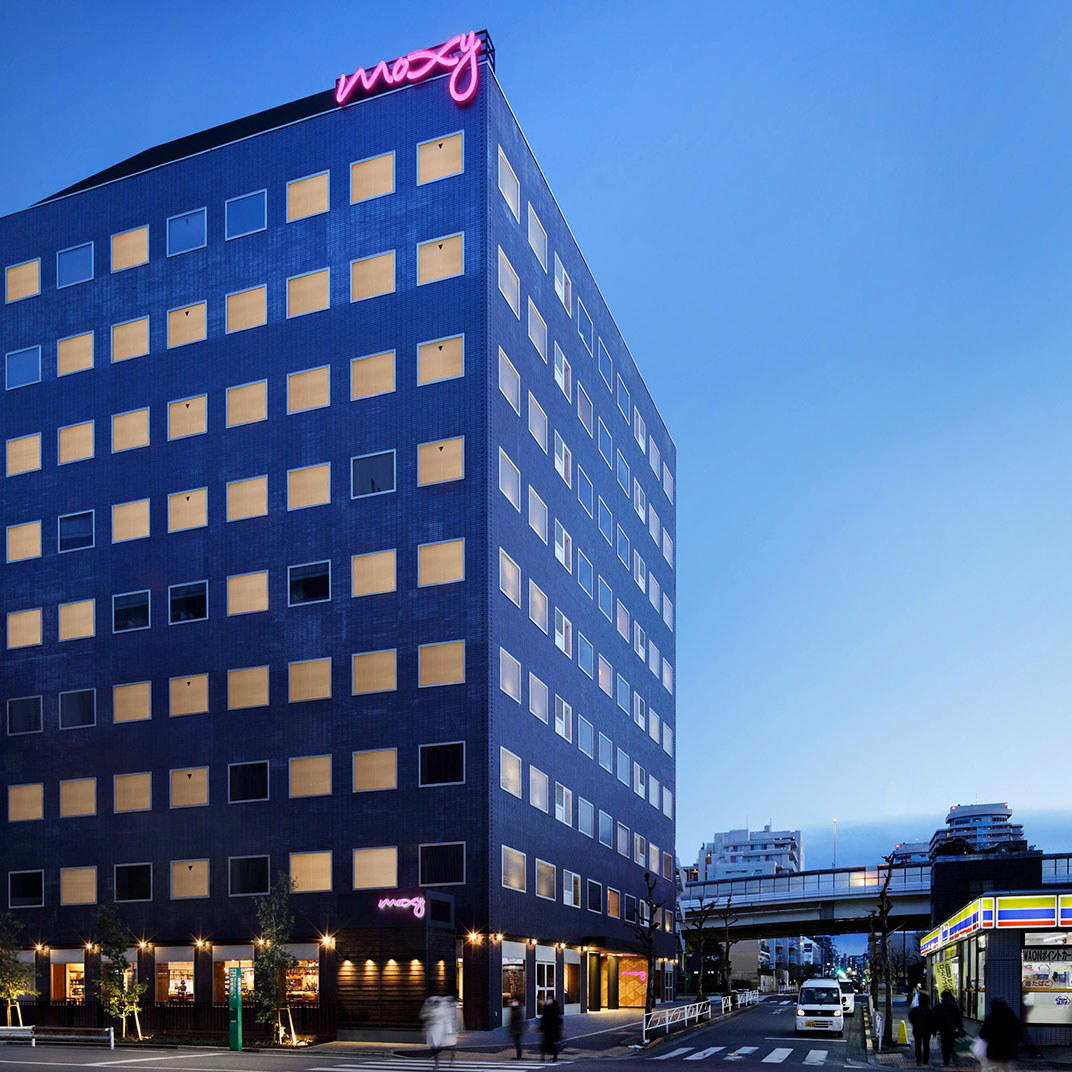
Sumida's Budget-Smart Counter Against Tokyo's Hotel Spectrum
Tokyo's hotel market sorts itself into tiers with unusual clarity. At one end, properties like Bvlgari Hotel Tokyo, Aman Tokyo, and Four Seasons Hotel Tokyo at Otemachi compete on ceremony, surface area, and the weight of a famous address. At the other, a wave of design-forward limited-service properties has quietly redefined what a competent, characterful Tokyo base looks like — particularly east of the Sumida River, where land costs and tourist density both run lower than in Shinjuku or Ginza. MOXY Tokyo Kinshicho sits in that second category, at 3-4-2 Kotobashi in Sumida-ku, and its 2025 MICHELIN Selected distinction positions it as a property the guide's editors consider worth the attention of travellers who know how to read between the stars.
What MICHELIN Selected Actually Signals
The MICHELIN Selected designation for hotels does not carry the culinary star hierarchy familiar from the restaurant guide, but it functions as a meaningful editorial filter. Properties receive it when the guide's inspectors assess them as delivering a reliable, considered experience within their category — not as a consolation tier, but as a statement of category confidence. In Tokyo's 2025 edition, the list spans a wide range of price points and formats. For a traveller comparing properties across the eastern wards, that signal matters more than a star rating on a booking aggregator.
Kinshicho and the Logic of the Sumida-ku Base
Kinshicho itself rewards a closer look than it typically gets from visitors anchored to the western hotel corridors. The neighbourhood sits on the eastern bank of the Sumida River, within direct transit reach of Asakusa, Ryogoku, and the broader shitamachi belt, Tokyo's older merchant districts, where the food culture runs toward tempura specialists, unagi houses, and the kind of ramen shops that have been at the same address for forty years. Sumida-ku is also less than twenty minutes by metro from the main Yamanote Line loop, which means access to Shinjuku, Shibuya, and the central business wards is not meaningfully slower than from a hotel in Nihonbashi.
The practical implication for a hotel guest is that a Kinshicho base offers access to a part of Tokyo that sees far fewer international visitors than the obvious neighbourhoods, while remaining connected. Travellers who have spent time at properties like Palace Hotel Tokyo or The Capitol Hotel Tokyu will recognise that central location comes at a price premium that not every trip justifies.
The MOXY Format and What It Prioritises
The MOXY brand, operating under Marriott's portfolio, has developed a consistent design language across its global properties: compact rooms with considered storage, social spaces weighted toward the lobby and bar rather than the guest floor corridor, and a visual vocabulary that reads younger and more graphic than the brand's mid-scale peers. The format was built around the premise that the room is where you sleep, and the common areas are where the stay actually happens. In Tokyo, where the density of things worth doing outside the hotel is higher than in almost any other city, that trade-off reads as sensible rather than compromised.
What that means practically: guests at MOXY Tokyo Kinshicho are buying a well-located, design-aware base with MICHELIN editorial credibility at a price point that sits well below the Otemachi or Marunouchi corridor. The property is not competing with Andaz Tokyo or JANU Tokyo for suite square footage or concierge depth. It is competing for the traveller who wants a considered room in a less-trafficked part of the city and does not need the full-service infrastructure of a luxury tower.
Placing It Against Japan's Broader Hotel Spectrum
The choice of where to base a Japan trip extends well beyond Tokyo's own hotel tier. Travellers with more time in the country often split their itinerary between the city and a ryokan stay, the traditional inn format that produces properties like Gora Kadan in Hakone, Asaba in Izu, or Nishimuraya Honkan in Kinosaki-cho. These are categorically different experiences: the ryokan is structured around kaiseki meals, communal bathing, and a pace designed to slow the traveller down. A MOXY property is the operational opposite, it is built for people moving through a dense urban itinerary at speed.
For Kyoto extension, HOTEL THE MITSUI KYOTO represents the premium option in a city where the hotel tier has risen sharply in recent years. Further afield, design-led properties like Zaborin in Kutchan and Benesse House in Naoshima attract travellers for whom the property itself is the destination. Halekulani Okinawa and Jusandi in Ishigaki serve the southern island market, while Amanemu in Mie positions itself as the country's most considered onsen resort. Fufu Nikko, Fufu Kawaguchiko, Kamenoi Besso in Yufu, and Sekitei in Hatsukaichi-shi each represent the ryokan tier in their respective regions. MOXY Tokyo Kinshicho is the entry point for the urban leg of a trip that might include several of these.
Globally, the contrast is even sharper. Properties like Badrutt's Palace Hotel in St. Moritz and Hôtel de Paris Monte-Carlo represent the European grand hotel tradition at its most formal, while The Fifth Avenue Hotel in New York City and Bellustar Tokyo occupy the upper-mid and luxury tier in their respective cities. MOXY operates in a different register entirely, and the 2025 MICHELIN Selected recognition suggests it is executing that register with enough consistency to earn editorial notice.
Planning a Stay
MOXY Tokyo Kinshicho is in Sumida-ku, accessible via Kinshicho Station on both the JR Sobu and Tokyo Metro Hanzomon lines. The station sits at the intersection of lines that run east-west across the city, making connections to central Tokyo and the airport express routes at Shinjuku direct. Given the MOXY format's emphasis on social common spaces, arriving in the evening and spending time in the lobby area before heading out to eat in the surrounding Sumida neighbourhood follows the property's own logic. For a deeper read on Tokyo's dining and hotel scene, the EP Club Tokyo guide covers the city across all tiers and neighbourhoods.
| Venue | Cuisine | Price | Awards |
|---|---|---|---|
| MOXY Tokyo KinshichoThis venue — the venue you are viewing | This venue | Not listed | Michelin Selected |
| Bvlgari Hotel Tokyo | Michelin 3 Key, World's 50 Best | Not listed | 3 Michelin Keys · World's 50 Best #24 |
| Aman Tokyo | Michelin 2 Key, World's 50 Best | Not listed | 2 Michelin Keys · World's 50 Best #11 |
| Palace Hotel Tokyo | Michelin 3 Key | Not listed | 3 Michelin Keys · World's 50 Best #73 |
| Four Seasons Hotel Tokyo at Otemachi | Michelin 3 Key | Not listed | 3 Michelin Keys · La Liste Top Hotels |
| Andaz Tokyo | Michelin 1 Key | $300–500 | 1 Michelin Key |
Recognition history
Dated appearances from independent guides and award organizations, with the underlying list record or original source where available.
Michelin Selected
Michelin
Continue exploring
More in Tokyo
Hotels in Tokyo
Browse all →

Bars in Tokyo
Browse all →

Restaurants in Tokyo
Browse all →


Details
- Modern
- Trendy
- Lively
- Energetic
- Business Trip
- Weekend Escape
- Design Destination
- Wi Fi
- Fitness Center
- Restaurant
- Elevator
- Wheelchair Accessible
Lively lobby and lounge with pops of neon-pink, energetic party atmosphere, and lively social spaces.