



Occupying the upper floors of Nihonbashi Mitsui Tower from the 30th floor upward, Mandarin Oriental Tokyo earned a Michelin 1 Key in 2024 and a La Liste Top Hotels score of 94.5 points in 2026. The property holds 179 rooms and suites, a sky-level spa across floors 36 and above, and a dining floor that spans Cantonese, molecular, and Japanese counter formats. Direct subway access via Mitsukoshi-mae Station places the whole city within reach.
Pearl is the En Primeur Club membership app — saves, bookings, and concierge access live there. Same editors, same standards.
- Address
- 2-chōme-1-1 Nihonbashimuromachi, Chuo City, Tokyo 103-8328
- Phone
- +81 3-3270-8800
- Website
- mandarinoriental.com
- Directions
- Get directions
 Saves & bookings on Pearl
Nihonbashi at Altitude: The Vertical Geography of Tokyo Luxury
Tokyo's premium hotel tier has long been defined by elevation. Several of the city's most-discussed properties use height not as a novelty but as an organizing principle, placing the arrival experience, the spa, and the dining floor above the street-level noise of one of the world's densest cities. At Mandarin Oriental Tokyo, that logic is taken further than most: the building's lobby begins at the 38th floor, meaning guests never engage with the street at all. The private elevator delivers you directly into a two-story sky lobby ringed with glass, and the panorama of central Tokyo arrives before you have located your room key. That compression of the arrival sequence — elevator, glass, city — sets the register for what follows.
The address in Nihonbashi is worth understanding on its own terms. This district is not the Tokyo of tourist shorthand. It is the city's financial and mercantile core, a neighbourhood where Edo-period trading houses gave way to Meiji-era banks and eventually to the kind of quiet institutional weight that repels mass tourism. Mitsukoshi department store has stood nearby since 1673 in various forms. The district's character is composed and purposeful rather than frenetic, which makes it a particular fit for a property where restraint runs through the design language. For comparison, Aman Tokyo occupies Otemachi to the north, Four Seasons Hotel Tokyo at Otemachi shares that financial-district posture, and Bvlgari Hotel Tokyo has anchored itself in Yaesu. Each property makes a different argument about which part of central Tokyo carries the right address. Nihonbashi is the oldest claim.
The Dining Floor as Cultural Argument
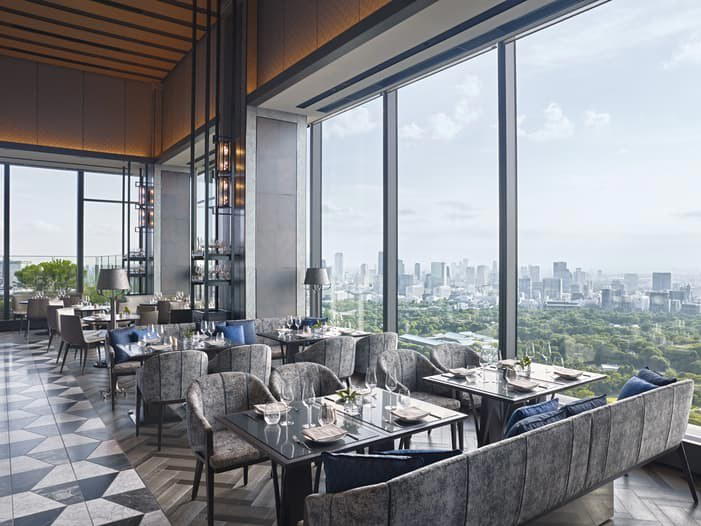
Japanese hotel dining has historically occupied an uncomfortable middle ground: elaborate enough to satisfy international guests, rarely distinctive enough to draw the city's own residents away from specialist restaurants. The better luxury properties in Tokyo have responded by building dining programs with genuine genre depth rather than breadth for its own sake. Mandarin Oriental Tokyo's approach splits its offer across three clear registers, and the split itself reflects something real about the city's food culture.
Sense, the Cantonese restaurant, represents a long-standing cross-cultural current in Tokyo's premium dining scene. Traditional Cantonese technique has found a receptive audience in Japan for decades, partly because both traditions prize precision and restraint in technique, and partly because the product sourcing overlap (seafood, seasonal vegetables) creates natural alignment. Sense operates in that tradition rather than trying to reframe it.
The molecular counter, six seats, housed in the corner of the Oriental Lounge on the 37th floor, belongs to a different lineage. The format descends from the early-2000s wave of avant-garde tasting menus that reframed dining as a kind of applied chemistry. At six seats, it is sized for concentration rather than volume, which is the correct format for this style. The number matters: a counter of that scale places the kitchen's technique under direct observation, and the pacing is necessarily slower and more deliberate than a full dining room would allow.
The hotel's willingness to host Noma's Tokyo pop-up, documented in public record and referenced across hospitality press at the time, signals something about the property's appetite for programming risk. Noma's approach to fermentation and foraged ingredients sits at a significant remove from Japanese kaiseki tradition, yet the pop-up drew sustained interest precisely because both disciplines share an obsessive relationship with seasonality and product sourcing. That convergence is worth noting because it describes a genuine intellectual overlap rather than a marketing convenience.
For context on Tokyo's broader dining scene, our full Tokyo restaurants guide maps the city's current counter culture, from omakase to standing ramen.
Rooms and the Logic of the View
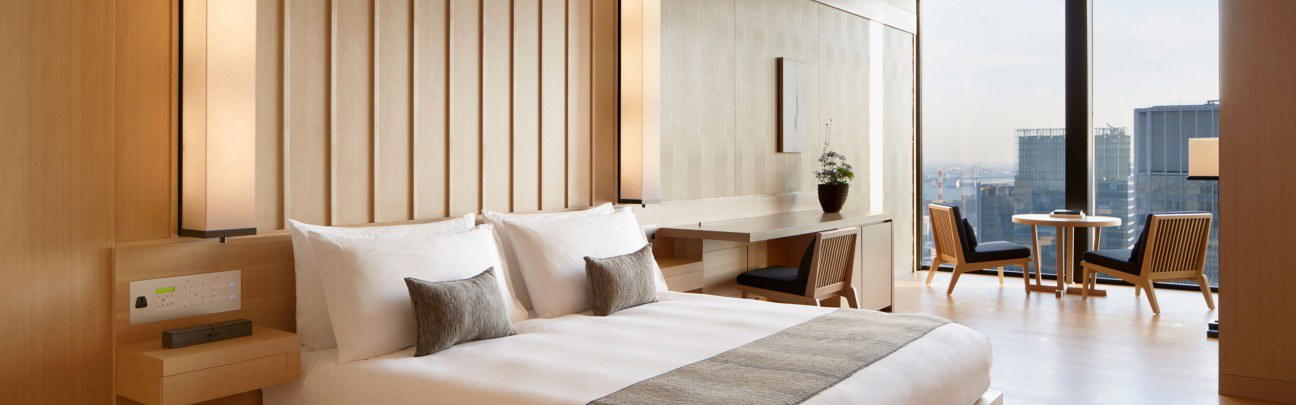
The 179 guest rooms occupy floors 30 through 36, and the view logic is explicit: every room faces the city, with floor-to-ceiling glass as the primary design element. Rooms to the east look toward the Sumida River and Tokyo Skytree; rooms to the west take in Ginza, Tokyo Station, and, on clear days, Mount Fuji. The hotel provides binoculars in each room, which is a more considered gesture than it might appear. It acknowledges that the view is not background scenery but an active part of the guest experience.
The interior language is calibrated to step back from the windows rather than compete with them. The Japanese design vocabulary, isegata (traditional kimono-dyeing sheets) framed in each room, handcrafted washi paper lanterns, bamboo flooring in the suites, wisteria embroidery on headboards, provides texture without visual noise. The gray granite bathrooms include both a standalone sunken tub and a rain-shower fixture alongside a standard fitting, which is a practical density of amenity that matches the price tier. At approximately $1,281 per night, the property sits at the upper end of Tokyo's luxury segment, broadly aligned with Palace Hotel Tokyo, JANU Tokyo, and Andaz Tokyo in pricing architecture, though each property makes different trade-offs between room scale, dining depth, and spa investment.
The Spa at Altitude
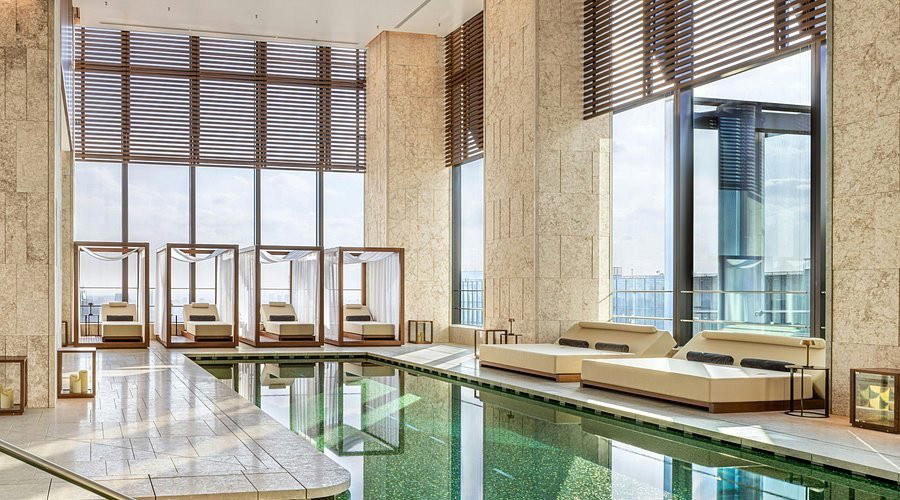
Sky spas have become a standard feature in Tokyo's top-tier properties, but the format varies considerably in execution. The spa at Mandarin Oriental Tokyo sits on floor 36, with four treatment rooms and five private spa suites, each oriented to the city below. The distinction between treatment rooms and suites is functional: the suites include features such as the Tranquility Suite's infinity bath positioned against two glass walls, which creates a specific geometry of immersion and view. The heat and water sequence includes a vitality pool, a crystal steam room, and an ice fountain. That progression follows conventional hydrotherapy logic, moving through heat, steam, and cold exposure in a sequence designed for parasympathetic recovery rather than novelty.
The broader design of the spa draws from both Asian and Western therapeutic traditions, which is not unusual for an international luxury brand operating in Japan. What is specific here is the altitude context: the 36th-floor placement puts the spa above most of the city's visible skyline noise, and the silence of the corridors leading to treatment rooms is described consistently in guest accounts as a contrast to the urban density outside.
Planning a Stay: Access, Timing, and Context
Mitsukoshi-mae Station on the Ginza and Hanzomon lines provides direct subway access from the hotel, connecting to Shibuya, Shinjuku, and the broader network without requiring a taxi. The Ginza shopping district is within walking distance to the south. The Nihonbashi location means the property is better positioned for guests whose priorities are central Tokyo business, the financial district's quieter dining scene, and cultural programming than for those anchoring in Shinjuku or Shibuya nightlife.
The hotel's curated activity program includes samurai instruction, sushi-making sessions referencing Tsukiji Market, and kaiseki dinners paired with geisha performance. These formats exist in the broader Tokyo luxury hotel market and are not unique to this property, but the combination suggests a deliberate orientation toward cultural access alongside the in-house dining and spa offer.
The La Liste score places it in a competitive bracket alongside properties with similar city-view and dining-depth profiles across Asia.
Guests extending beyond Tokyo have strong options across Japan. HOTEL THE MITSUI KYOTO anchors the Kansai alternative, while ryokan-format properties including Gora Kadan in Hakone, Asaba in Izu, and Nishimuraya Honkan in Kinosaki-cho offer a counterpoint in hospitality format and pace. Further afield, Amanemu in Mie, Benesse House in Naoshima, ENOWA Yufu in Yufu, Zaborin in Hokkaido, Fufu Kawaguchiko, Fufu Nikko, Halekulani Okinawa, Jusandi in Ishigaki, and Sekitei in Hatsukaichi-shi represent Japan's geographic spread of design-led and traditional hospitality. For international context on the Mandarin Oriental group's positioning, The Fifth Avenue Hotel in New York City, Aman New York, and Aman Venice offer useful reference points for how altitude, design restraint, and dining investment translate across different city contexts. Closer to home, Bellustar Tokyo, A Pan Pacific Hotel and The Capitol Hotel Tokyu complete the Tokyo luxury tier for those building a shortlist.
Recognition history
Dated appearances from independent guides and award organizations, with the underlying list record or original source where available.
Forbes 5-Star
Forbes
La Liste Top Hotels
La Liste
Robb Report Selected for 2026 Robb Report Best Luxury Hotels in Tokyo
Robb Report
Virtuoso Luxury Hotel Partner
Virtuoso
Forbes 5-Star
Forbes
Michelin 1 Key
Michelin
Michelin 1 Key
Michelin
Continue exploring
More in Tokyo
Hotels in Tokyo
Browse all →

Bars in Tokyo
Browse all →

Restaurants in Tokyo
Browse all →



At a Glance
- Elegant
- Sophisticated
- Modern
- Scenic
- Romantic Getaway
- Business Trip
- Wellness Retreat
- Anniversary
- Celebration
- Panoramic View
- Destination Spa
- Rooftop Pool
- Design Destination
- Private Dining
- Spa
- Fitness Center
- Room Service
- Concierge
- Restaurant
- Bar
- Wi Fi
- Business Center
- Valet Parking
- Sauna
- Hot Tub
- Laundry Service
- Skyline
- Mountain
- Spa
- Fitness Center
- Room Service
- Concierge
- Restaurant
- Bar
- Wi Fi
- Business Center
- Valet Parking
- Sauna
- Hot Tub
- Laundry Service
Sophisticated and serene with expansive panoramic city views framed by futuristic design; bright, airy spaces with natural light; calm wellness-focused atmosphere enhanced by onsen-style spa facilities.
Know Before You Go
- Getting there
- 2-chōme-1-1 Nihonbashimuromachi, Chuo City, Tokyo 103-8328