Urban Greek Restaurant on Murray Street brings the structured rhythms of Greek dining culture to central Hobart, where communal sharing, unhurried pacing, and the Mediterranean tradition of the long table translate readily to Tasmania's relaxed hospitality character. The address places it within easy reach of the waterfront dining strip, offering an alternative register to the region's dominant Australian and European fine dining scene.
Pearl is the En Primeur Club membership app — saves, bookings, and concierge access live there. Same editors, same standards.
- Address
- 103 Murray St, Hobart TAS 7000, Australia
- Phone
- +61 3 6169 1129
- Website
- urbangreek.com.au
- Directions
- Get directions
 Saves & bookings on Pearl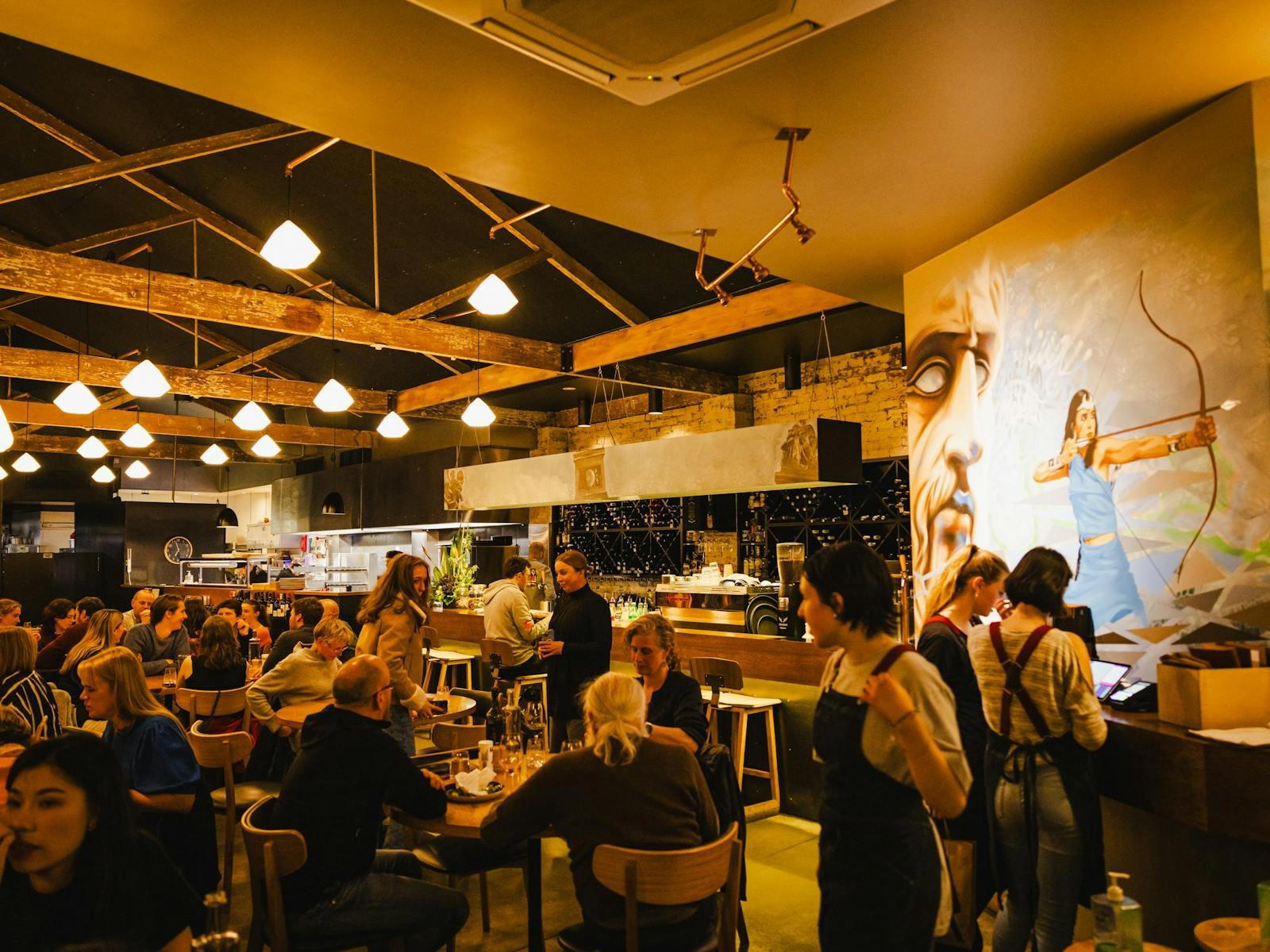
Greek Dining Ritual in a Southern Latitude
Urban Greek Restaurant is a casual Greek restaurant in Hobart, Tasmania, serving Authentic Cretan Greek cuisine at a price point of about USD 35 per person. Murray Street in central Hobart is a functional artery: government buildings, heritage sandstone, the kind of address that accumulates restaurants because foot traffic is reliable and the civic surroundings lend a certain gravity. In that context, a Greek restaurant occupies an interesting position. Greek dining is not a cuisine that thrives on haste or minimalism. It is built around a different tempo altogether: the extended mezze spread, the table that refills rather than resets, the idea that the meal is the event rather than the preamble to one. That rhythm translates with surprising ease to Hobart, a city whose dining culture has always rewarded lingering.
Urban Greek Restaurant at 103 Murray St sits within that tradition. The name signals intent directly, without the studied ambiguity that defines much of the city's newer dining vocabulary. Where venues like Aloft and the Japanese-wine bar format of Scholé operate in registers of deliberate conceptual restraint, Urban Greek occupies a more legible cultural position, one rooted in the Mediterranean logic of abundance, generosity, and the communal table.
The Architecture of a Greek Meal
Understanding what to expect from a serious Greek restaurant requires understanding how the meal is structured, because the pacing is as important as the food. Greek dining, at its most considered, does not follow the European three-course sequence. It unfolds laterally: multiple small dishes arriving without strict hierarchy, shared across the table, with bread and dips as the foundation rather than an opener. The distinction matters because it changes how a diner should approach the menu. Ordering selectively from a Greek menu is almost a category error. The format rewards breadth over depth, and the quality of a meal often reveals itself in the cumulative effect of five or six dishes rather than in any single plate.
In the broader Australian dining context, Greek cooking has sometimes been flattened into a comfort-food register, the same way Italian cooking spent decades reduced to pizza and pasta before venues like Cugini Restaurant and Don Camillo Restaurant in Hobart demonstrated what happens when European culinary traditions are taken seriously on their own terms. The more rigorous end of Greek dining in Australia has been pushing back against that flattening, leaning into the regional complexity of Greek cuisine, the distinctions between Cretan, Aegean, and mainland cooking, the central role of olive oil as a structural ingredient rather than a condiment.
Where This Sits in Hobart's European Dining Tier
Hobart's dining scene has developed a genuine identity over the past decade, anchored initially by producers and foragers and built outward from there. The Agrarian Kitchen represents one pole of that development: produce-driven, hyperlocal, the farm-to-table commitment taken to its logical conclusion. That model has become the dominant aspirational register for Tasmanian fine dining, and it has produced some of the more interesting cooking in the country.
Greek cooking operates on a different axis. It is not primarily a cuisine of local specificity; it is a cuisine of technique, tradition, and cultural memory. The ingredients are largely Mediterranean, the methods centuries old, and the flavor profile defined by lemon, olive oil, herbs, and charcoal heat. In a city where the surrounding landscape exerts such strong influence on what ends up on the plate, a restaurant committed to a geographically distant culinary tradition makes a specific editorial choice. That choice positions Urban Greek within the European dining strand in Hobart rather than the Tasmanian provenance strand, placing it in conversation with the Italian and French-influenced rooms that have operated in the city for years.
For readers planning a broader Australian itinerary that takes in serious dining, Hobart now sits alongside destinations like the wine-country kitchens of Hentley Farm in Seppeltsfield and Provenance in Beechworth, or the headline rooms of Attica in Melbourne and Rockpool in Sydney. The city rewards a multi-day visit built around eating, and Urban Greek fills a gap in that map: a European tradition delivered without the fine-dining scaffolding that surrounds most of the city's most-discussed rooms.
Planning a Visit
103 Murray Street is a central address, walkable from the waterfront and from the majority of Hobart's central accommodation. The location makes it a practical choice for diners spending time in the CBD, and the European dining format, unhurried and built for sharing, suits an evening with time on either side. Reservations are recommended, especially for weekend dinners and larger groups.
Pipit in Pottsville, Brae in Birregurra, and Laura at Pt Leo Estate in Merricks represent the regionalist strand of Australian fine dining at its most resolved. The Greek model is older than both and no less considered.
Where It Fits
Comparable venues nearby, for context on price, style, and recognition.
| Venue | Cuisine | Price | Notes |
|---|---|---|---|
| Urban Greek RestaurantThis venue — the venue you are viewing | Authentic Cretan Greek | $$ | Not listed |
| The Tasmanian Juice Press | Healthy Cold-Pressed Juices & Light Eats | $$ | Hobart |
| Callington Mill Distillery at MACq 01 Hobart | Modern Australian Whisky Dining | $$$ | Hobart Waterfront |
| Sapa Rose | Modern Traditional Vietnamese | $$ | Hobart CBD |
| Queen Sheba Injera | Authentic Ethiopian | $$ | North Hobart |
| Templo | Italian-inspired Seasonal Tasting Menu | $$$ | West Hobart |
Continue exploring
More in Hobart
Restaurants in Hobart
Browse all →
Bars in Hobart
Browse all →
Hotels in Hobart
Browse all →

At a Glance
- Lively
- Cozy
- Trendy
- Group Dining
- Family
- Celebration
- Date Night
- Open Kitchen
- Extensive Wine List
- Local Sourcing
Current opening hours
- Monday
- 5–9 PM
- Tuesday
- Closed
- Wednesday
- 5–9 PM
- Thursday
- 5–9 PM
- Friday
- 5–9:30 PM
- Saturday
- 5–9:30 PM
- Sunday
- 5–9 PM
Hours can change for holidays and private events. Last verified .
Warm, welcoming, and busy atmosphere with bold Greek mythology murals and a social, energetic vibe.