Teppanyaki makibi san-an sits in Kanazawa's Honmachi district, where the city's appetite for precise, counter-focused cooking finds a natural home in the teppanyaki format. The iron griddle here is both stage and instrument, and the service dynamic between cook and guest defines the rhythm of the meal. Book ahead: Kanazawa's serious dining rooms fill on shorter notice than most visitors expect.
Pearl is the En Primeur Club membership app — saves, bookings, and concierge access live there. Same editors, same standards.
- Address
- 1 Chome-3-27 Honmachi, Kanazawa, Ishikawa 920-0853, Japan
- Phone
- +81762560760
- Website
- san-an.jp
- Directions
- Get directions
 Saves & bookings on Pearl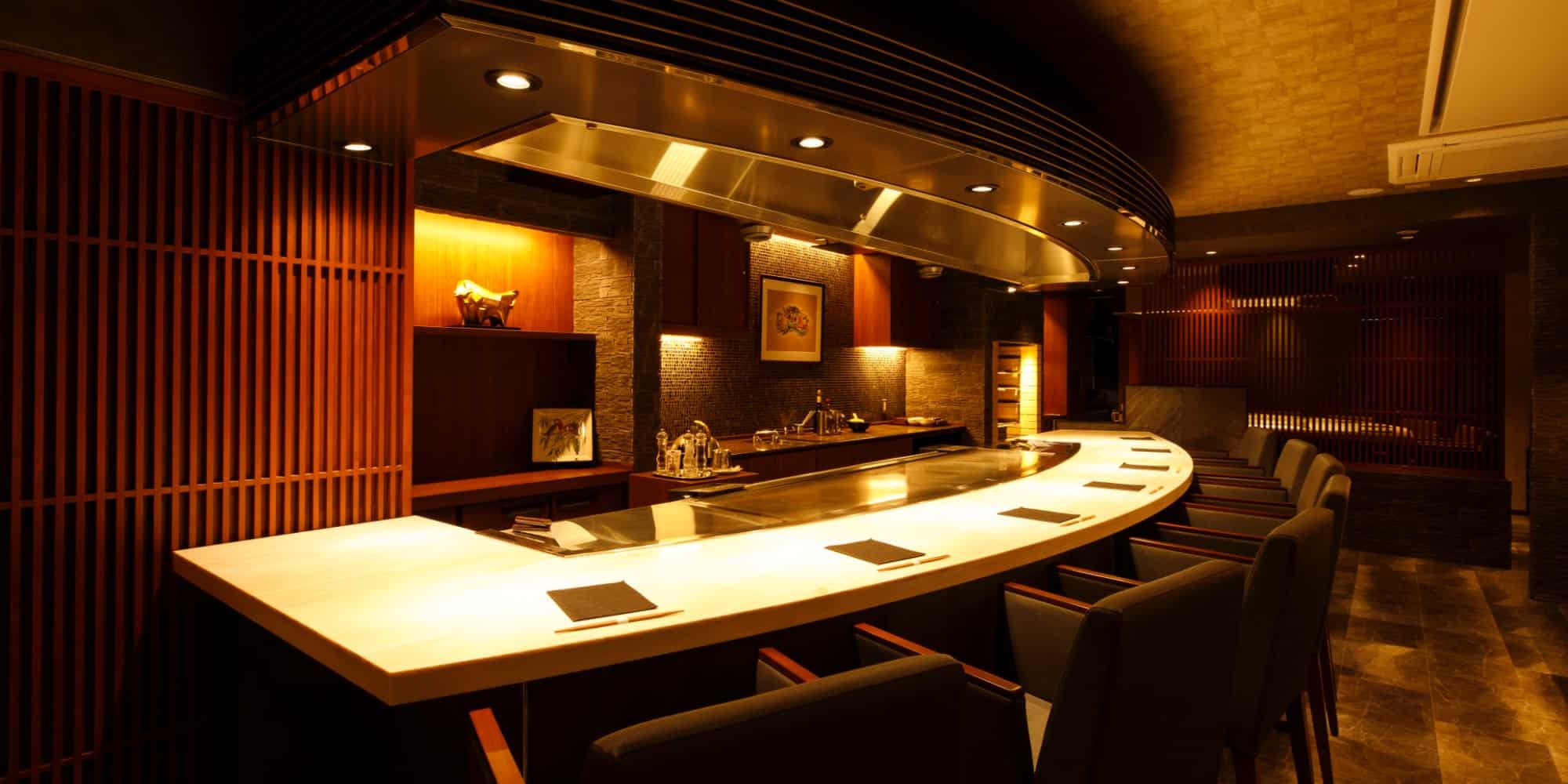
The Iron Counter as Theater
In Kanazawa, the gap between a meal and a performance has always been narrow. The city's kaiseki tradition, upheld by rooms like Dokkan and Hakuichi, trained local diners to read a meal as a sequence of considered gestures rather than a series of dishes. Teppanyaki makibi san-an, addressed from 1 Chome-3-27 Honmachi in the commercial heart of Kanazawa, operates from within that same cultural inheritance. The iron griddle, flat and radiant, is not decoration here. It is the focal point around which guest, cook, and the supporting cast of front-of-house position themselves, and the meal unfolds at whatever pace that triangle allows.
Honmachi is not the city's most photogenic quarter. That distinction belongs to Higashi Chaya or the lanes behind Kenroku-en. But Honmachi is where Kanazawa does business, and a teppanyaki address here signals a room aimed at the city's own residents as much as its visitors. That is, broadly speaking, a quality signal in Japan: restaurants that survive on local repeat trade rather than tourist footfall tend to stay disciplined in a way that tourist-facing rooms do not.
What Teppanyaki Demands of Its Team
The teppanyaki format is unusual among Japanese cooking traditions in how completely it exposes the gap between a well-synchronized team and a merely adequate one. Sushi omakase counters like Harutaka in Tokyo concentrate attention on a single chef whose knife work and rice technique carry the evening. Kaiseki rooms, even structured ones like Gion Sasaki in Kyoto, can absorb minor front-of-house lapses because the kitchen and the dining room are separated. Teppanyaki collapses that separation entirely. The cook works two or three feet from the guest. Every decision about heat, rest, and seasoning happens in plain sight. The person managing the dining room must read the table's pace and signal the cook without breaking the mood. At its finest, this produces an experience of remarkable coherence; at anything less than its leading, the seams show immediately.
At makibi san-an, the name itself encodes a collaborative logic. In Japanese restaurant naming conventions, compound references often point to a founding team or a house philosophy rather than a single presiding figure. That framing fits the teppanyaki format: the griddle cook handles the protein and the timing, but the broader meal requires someone managing beverage pacing, reading the table for when to press forward and when to slow down, and coordinating the flow of accompaniments that frame the main event. Rooms that get this right develop a recognizable rhythm that regulars return for as much as any specific ingredient.
Kanazawa's Position in Japan's Regional Dining Map
Understanding where makibi san-an sits requires understanding what Kanazawa has become as a dining city. The Hokuriku Shinkansen connection to Tokyo, which opened in 2015 and extended to Tsuruga in 2024, repositioned the city from a well-regarded regional destination to a genuinely accessible one for day-trippers and weekend travelers from the capital. That infrastructure change brought both more competitive pressure on Kanazawa's restaurants and more diners willing to seek out addresses beyond the obvious kaiseki circuit.
The city's dining range now covers ground from Amanatto Kawamura at the sweet, artisanal end to Budoonomori Les Tonnelles at the French-influenced end, with Go! Go! Curry holding down the city's claim to a distinct regional curry tradition. Teppanyaki occupies a particular position in this range: it is formal enough to carry occasion weight, interactive enough to work for groups celebrating something, and ingredient-forward enough to showcase Ishikawa Prefecture's considerable larder of seafood, wagyu, and seasonal produce.
Japan's Hokuriku coast produces some of the country's most respected seafood, and Kanazawa's Omicho market is the distribution point for much of it. A teppanyaki room in this city has access to ingredients that rooms in Tokyo or Osaka frequently import from the same source but at greater remove. That geographic proximity to supply matters in a format where protein quality is so directly audible, visible, and ultimately apparent on the plate. Comparable regional dynamics play out at places like Goh in Fukuoka, where proximity to Kyushu's seafood supply informs what the kitchen can credibly serve.
Booking and Planning in Context
Kanazawa's serious dining rooms have tightened their availability considerably since the Shinkansen extension. Visitors who once booked a week out now find that the city's better-regarded counters and teppanyaki rooms fill two to four weeks ahead, particularly on Friday and Saturday evenings and during the spring cherry blossom and autumn foliage windows. The address at 1 Chome-3-27 Honmachi puts makibi san-an within walking distance of the central Kanazawa Station area, which simplifies logistics for travelers staying in the station hotel cluster. Arriving by Shinkansen from Tokyo takes roughly two and a half hours from Tokyo Station, and from Kyoto the Thunderbird limited express to Kanazawa runs the journey in approximately two hours and fifteen minutes. Our full Kanazawa restaurants guide covers the wider planning picture for the city.
For those building a longer Hokuriku circuit, the region holds additional dining interest in Nanao at 三本の旗竿制 and across the Sea of Japan coast. The Takashima area produces 湖麺庵, and the broader Tohoku and Chubu circuits reward diners willing to move between cities rather than concentrating in a single stop.
The Teppanyaki Counter Within Japan's Broader Premium Dining Conversation
Japan's most-discussed premium dining rooms currently sit in a small cluster of Tokyo, Osaka, and Kyoto addresses. HAJIME in Osaka and akordu in Nara represent the internationally recognized tier, while internationally followed New York rooms like Atomix and Le Bernardin set the reference frame for what a high-functioning front-of-house team looks like at the highest level. Makibi san-an does not claim that company. It operates in a regional city, in a format defined by immediacy and craft rather than conceptual ambition, and it answers to a local audience with a developed palate and a preference for precision over novelty.
That positioning is not a limitation. It is, arguably, what makes a room like this worth seeking out. The teppanyaki format at its most disciplined is a study in what happens when a small team of specialists focuses on a narrow set of techniques and executes them correctly, night after night, for guests who know what correctly looks like. Rooms in this category across Japan, from 廣羽屋 in Nishikawa Machi to Birdland in Sakai, share that orientation. The griddle is the constant. The team around it is the variable that determines whether the evening coheres.
How Teppanyaki makibi san-an Kanazawa compares with similar nearby venues.
| Venue | Cuisine | Price |
|---|---|---|
| Ajiraku Yumemi | Not listed | JPY 6,000 - JPY 7,999 |
| Komatsu Yasuke | Sushi | Not listed |
| BIRD | Not listed | JPY 10,000 - JPY 14,999 View spending breakdown |
Continue exploring
More in Kanazawa
Restaurants in Kanazawa
Browse all →
Bars in Kanazawa
Browse all →
Hotels in Kanazawa
Browse all →
Wineries in Kanazawa
Browse all →
At a Glance
- Elegant
- Sophisticated
- Special Occasion
- Business Dinner
- Chefs Counter
- Open Kitchen
- Sake Program
- Corkage Allowed
- Local Sourcing
Current opening hours
- Monday
- 5–9 PM
- Tuesday
- 5–9 PM
- Wednesday
- Closed
- Thursday
- 5–9 PM
- Friday
- 11:30 AM–2 PM, 5–9 PM
- Saturday
- 11:30 AM–2 PM, 5–9 PM
- Sunday
- 11:30 AM–2 PM, 5–9 PM
Hours can change for holidays and private events. Last verified .
Sophisticated atmosphere focused on live teppanyaki grilling, providing a luxurious dining experience away from daily hustle.
Know Before You Go
- Getting there
- 1 Chome-3-27 Honmachi, Kanazawa, Ishikawa 920-0853, Japan