Michelin Bib Gourmand
Our verdict
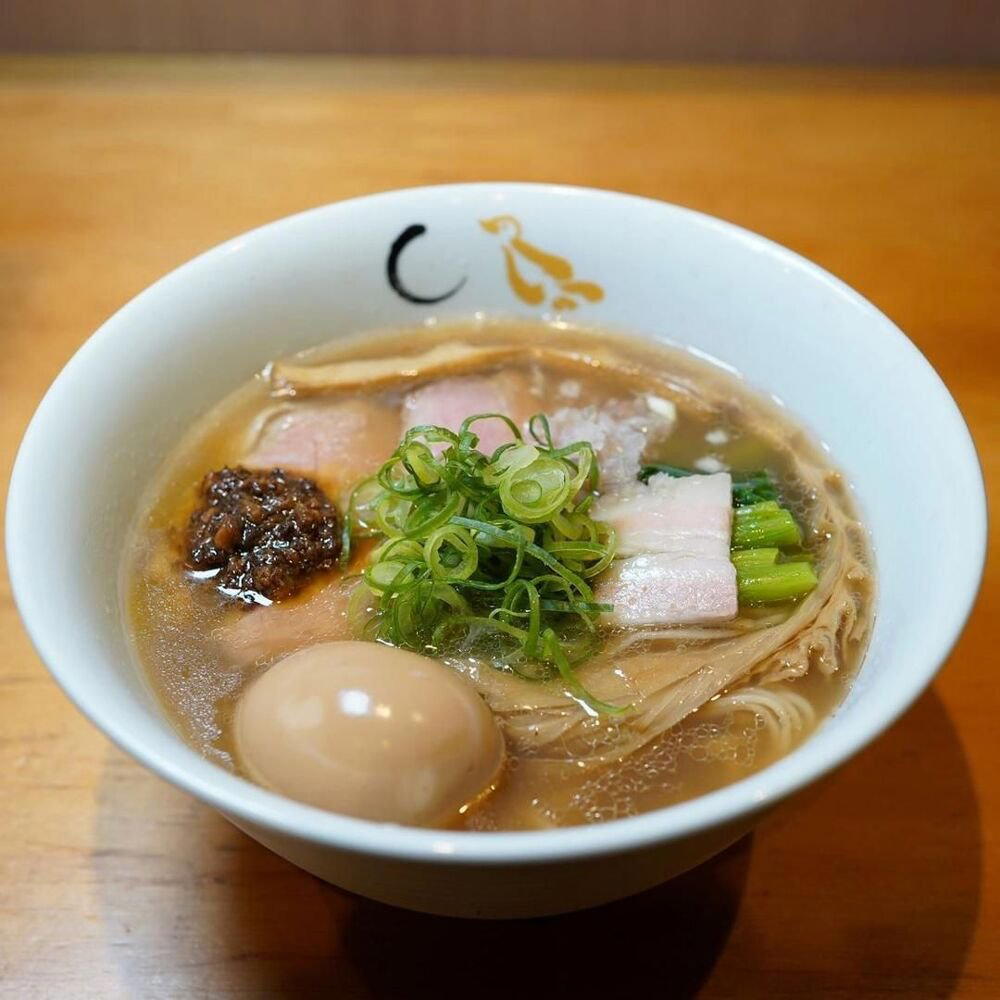
Sobahouse Konjiki Hototogisu in Shinjuku holds a Michelin Bib Gourmand and a consistent place in Opinionated About Dining's Japan Casual rankings, reaching as high as #24 in 2023. Chef Hiroto Honma's clam-and-truffle broth sits within Tokyo's premium ramen tier, where a single bowl commands serious craft attention. Open Tuesday through Saturday, lunch service only, at the single-yen price point that defines the category.

Pearl is the En Primeur Club membership app, where members save venues, book tables and use the concierge.
Where Tokyo Ramen Became a Serious Discipline
There is a moment, somewhere in the mid-2010s, when Tokyo ramen stopped being a quick meal and became a subject of critical scrutiny on par with any tasting-menu format. The city's Michelin inspectors began arriving at counter seats. It holds a Michelin Bib Gourmand for 2024 and 2025, and its OAD Casual Japan ranking has moved between #24 (2023), #61 (2024), and #71 (2025), a trajectory that reflects both the intensifying competition in the category and the shop's continued presence in the top tier. For context on how that competition plays out across Tokyo dining at large, our full Tokyo restaurants guide maps the city's categories from ramen through kaiseki.
The Broth Tradition and What It Represents
Konjiki Hototogisu is associated with a style of ramen that departs from the pork-forward tonkotsu and soy-heavy shoyu schools that dominate overseas perception of the category. The approach here draws on clam dashi and incorporates truffle, placing it in a premium shoyu-adjacent tier that treats the soup as a fine-dining product. This matters for how you read the beverage question, because a broth with the depth and aromatic register of clam and truffle calls for a pairing approach more like those you'd apply to a delicate French consommé than to the beer-and-ramen combination that remains standard in casual ramen contexts.
The rise of this cleaner, more aromatic broth style across Tokyo's recognised shops has coincided with greater attention to what you drink alongside it. Several of the city's Bib Gourmand ramen counters now offer a short sake selection, and the reasoning is structural: a junmai ginjo with restrained acidity and a mineral finish works with clam-based broths in the same way a white Burgundy works with shellfish. The pairing logic is not decorative, it follows the actual flavour architecture of the soup. If you are exploring Tokyo's ramen scene through a beverage lens, this address and shops like Chukasoba Ginza Hachigou represent the tier where that conversation is most coherent.
Shinjuku's Position in Tokyo's Ramen Geography
Tokyo's ramen geography rewards some attention. The city has recognised clusters in Shinjuku, Shibuya, and the train-hub zones of Ikebukuro and Shinbashi, but the distribution of critically ranked shops is less neighbourhood-defined than it might be for sushi or izakaya. A Bib Gourmand ramen-ya in Shinjuku 2-chome competes in an assessment pool that spans the entire city, and its recognition reflects quality relative to all of Tokyo rather than a local neighbourhood dynamic. That said, Shinjuku's ramen density is real: the area supports enough volume to sustain multiple serious operations within a short walk of one another, which is useful context if you are planning a day around the category. For a broader picture of the city's accommodation options, our full Tokyo hotels guide covers the range from Shinjuku-area business hotels to the luxury tier.
Shops at the OAD Casual Japan level tend to attract a mix of local regulars and a growing cohort of international visitors who arrive specifically for the rankings., a score that, at that volume, reflects sustained satisfaction rather than a spike from a single wave of attention. The relatively modest score at high volume is characteristic of shops where the core audience is local and critical, rather than tourist-driven.
Within Tokyo's ranked ramen field, Konjiki Hototogisu sits in a specific cohort: shops with Michelin recognition and OAD placement that operate at the single-yen price tier, meaning a bowl is accessible by price even if the craft and recognition place it in a serious critical conversation. Compare this to Fuunji, recognised for its tsukemen (dipping noodle) format, or Chukasoba KOTETSU and Afuri, each representing a distinct broth philosophy. These shops are not interchangeable; they reflect different technical priorities and regional influences, and visiting across the tier teaches you more about Japanese noodle craft than any single visit can. The ramen category's reach outside Japan is visible in addresses like Afuri Ramen in Portland and Akahoshi Ramen in Chicago, where Tokyo-trained sensibilities meet local ingredient contexts.
For visitors approaching Tokyo as a broader Japan itinerary, the recognised dining tier extends well beyond the capital. HAJIME in Osaka, Gion Sasaki in Kyoto, akordu in Nara, Goh in Fukuoka, 1000 in Yokohama, and 6 in Okinawa each represent their region's critical tier and are worth building an itinerary around. For Tokyo's wider drinking scene, our full Tokyo bars guide covers the range, and our full Tokyo experiences guide and our full Tokyo wineries guide are available for those extending further. The Chinese-influenced ramen heritage also connects to Tokyo dining rooms working in adjacent tradition: Chuogo Hanten Mita is relevant context for how Chinese culinary lineage operates at the higher end of the Tokyo spectrum.
Planning Your Visit
Konjiki Hototogisu operates a lunch-only format. Hours: Tuesday through Saturday, 11am to 3pm; closed Sunday and Monday. Location: Shinjuku City, 2 Chome-4-1, ground floor unit 105. Budget: Single-yen price tier, a bowl falls within the standard Tokyo ramen price range, well under ¥2,000. Booking: Dress: No dress code applies at this format.
What is the signature dish at Sobahouse Konjiki Hototogisu?
Konjiki Hototogisu is associated with a shoyu-adjacent ramen that uses clam dashi as the broth base, typically finished with truffle. This positions it in the premium aromatic tier of Tokyo ramen, distinct from tonkotsu or standard soy-heavy styles. The bowl, priced at the accessible single-yen level despite its technical ambition, is the reason the shop holds consecutive Michelin Bib Gourmand recognition (2024, 2025) and has placed consistently in Opinionated About Dining's Casual Japan rankings since at least 2023. Chef Hiroto Honma leads the kitchen.
Frequently asked questions
How would you describe the cuisine at SOBAHOUSE KONJIKI HOTOTOGISU?
What part of town is SOBAHOUSE KONJIKI HOTOTOGISU in?
SOBAHOUSE KONJIKI HOTOTOGISU is located at Japan, 〒160-0022 Tokyo, Shinjuku City, Shinjuku, 2 Chome−4−1 1階105号室, Tokyo.
Is SOBAHOUSE KONJIKI HOTOTOGISU award-winning?
SOBAHOUSE KONJIKI HOTOTOGISU has received recognition including: Opinionated About Dining Casual in Japan Ranked #71 (2025); Michelin Bib Gourmand (2025); Opinionated About Dining Casual in Japan Ranked #61 (2024); Michelin Bib Gourmand (2024); Opinionated About Dining Casual in Japan Ranked #24 (2023).
What's the signature dish at SOBAHOUSE KONJIKI HOTOTOGISU?
Konjiki Hototogisu is associated with a shoyu-adjacent ramen built on clam dashi, typically finished with truffle, a combination that separates it from both tonkotsu and conventional shoyu styles. This approach earned the shop Michelin Bib Gourmand recognition in 2024 and 2025, and an OAD Casual Japan ranking of #24 in 2023, rising to #61 and then #71 by 2025. Chef Hiroto Honma's clam-and-truffle format has become the reference point for what critics now call luxury-casual ramen in Tokyo.
What should I budget for a meal at SOBAHOUSE KONJIKI HOTOTOGISU?
Pricing at SOBAHOUSE KONJIKI HOTOTOGISU is listed as ¥.
What are SOBAHOUSE KONJIKI HOTOTOGISU's hours?
Hours at SOBAHOUSE KONJIKI HOTOTOGISU: Hours: Monday Closed Tuesday 11 am–3 pm Wednesday 11 am–3 pm Thursday 11 am–3 pm Friday 11 am–3 pm Saturday 11 am–3 pm Sunday Closed.
In Context: Similar Options
| Venue | Cuisine | Price | Awards | Notes |
|---|---|---|---|---|
| SOBAHOUSE KONJIKI HOTOTOGISUThis venue (the venue you are viewing) | Modern Seafood Soba Ramen | $10–20 | Michelin Bib Gourmand | Not listed |
| Harutaka | Edo-Style Omakase Sushi | $200–300 | 3 Michelin Stars · World's 50 Best #76 | Sushi |
| RyuGin | Modern Kaiseki | $500+ | 3 Michelin Stars · World's 50 Best #41 | Kaiseki, Japanese |
| L'Effervescence | Modern French with Japanese Influences | $200–300 | 3 Michelin Stars · World's 50 Best #69 | French |
| HOMMAGE | Modern French with Japanese Influences | $150–200 | 2 Michelin Stars · World's 50 Best #78 | Innovtive French, French |
| MAZ | Innovative Peruvian-Japanese Fusion | $150–200 | 2 Michelin Stars · World's 50 Best #28 | Innovative |
Recognition history
Dated appearances from independent guides and award organizations, with the underlying list record or original source where available.
Michelin Bib Gourmand
Michelin
Opinionated About Dining Casual in Japan Ranked #82
Opinionated About Dining
Full recognition history (6 entries)
Opinionated About Dining Casual in Japan Ranked #71
Opinionated About Dining
Michelin Bib Gourmand
Michelin
Opinionated About Dining Casual in Japan Ranked #61
Opinionated About Dining
Opinionated About Dining Casual in Japan Ranked #24
Opinionated About Dining