Our verdict
Ramen Gojuban occupies a quiet corner of Zoshigaya, one of Tokyo's least-touristed residential neighbourhoods, and ranked ninth on Ramen Beast's Top 10 Bowls of 2025 list. Its featured bowl, the Uma-Kara Shibi-Men, places it in the category of numbing-spicy ramen that has gained serious critical traction across the city. The address alone signals that this shop rewards the deliberate visitor.

Pearl is the En Primeur Club membership app, where members save venues, book tables and use the concierge.
A Residential Quarter That Takes Its Ramen Seriously
Zoshigaya sits in the southwestern corner of Toshima City, a neighbourhood better known to Tokyo residents for its historic cemetery and the literary associations of nearby Ikebukuro than for its dining scene. It is precisely this remove from the city's ramen circuits that makes a shop like Ramen Gojuban worth tracking. In Tokyo's ramen geography, the restaurants drawing the deepest local loyalty are rarely on Shinjuku's main drag or in the tourist corridors around Shibuya. They surface in places where the clientele is almost entirely neighbourhood-based, where the shop owner's relationship with a particular street is years in the making, and where a bowl's reputation travels by word of mouth before it ever reaches a list. Zoshigaya operates that way.
The address, 1 Chome-30-15 Zoshigaya, places the shop within a low-rise residential pocket of the ward, the kind of block where the signage is modest, the queue forms on a narrow pavement, and the surrounding apartment buildings make you feel, correctly, that you have crossed into someone else's daily life rather than a dining destination. That context matters when reading the bowl.
The Bowl That Earned the Ranking
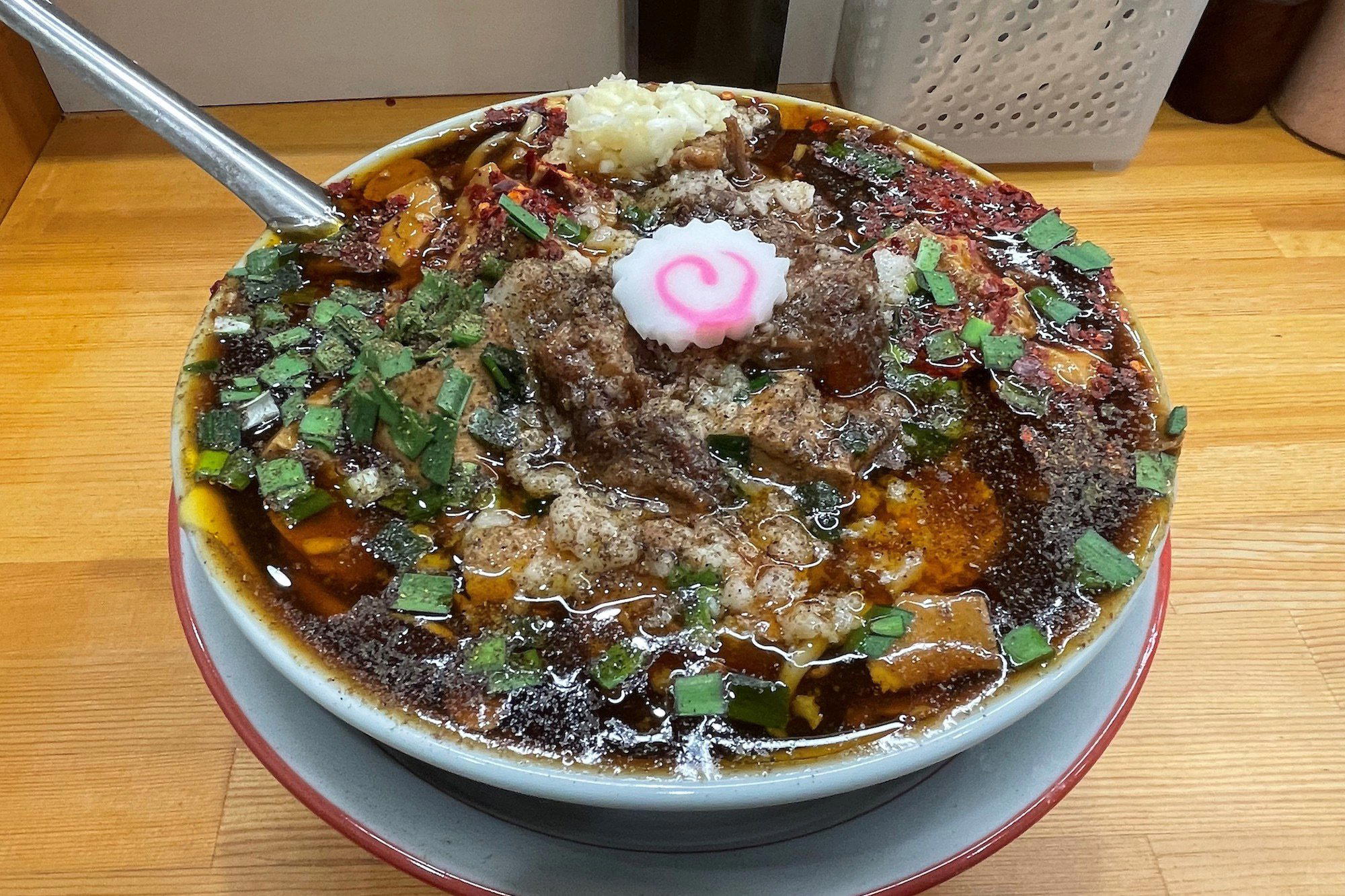
In 2025, Ramen Beast, one of the more credible English-language sources tracking Tokyo ramen with consistent specificity, placed Ramen Gojuban ninth on its annual Top 10 Bowls list, citing the Uma-Kara Shibi-Men as the featured bowl. The name translates roughly to horse-spicy numbing noodles, a construction that positions this dish squarely within the broader shibi-kara current that has moved through Tokyo's serious ramen conversation over the past several years. Shibi refers to the tongue-numbing quality of Sichuan peppercorn; uma-kara layers that with a deeper, more lingering heat. The combination has attracted serious kitchen attention across the city because it requires a calibrated hand: too much numbing and the broth loses its savoury depth, too much heat and the dish becomes a test of endurance rather than an eating experience.
For Ramen Gojuban to earn a ranking on that list from an address this far off the established ramen trail is a signal worth paying attention to. Ramen Beast's 2025 list covers a city of roughly 14 million people with more ramen shops per capita than almost any comparable urban area. A rank of ninth, attributed to a single bowl from a Zoshigaya address, is not incidental. Shops like Fuunji in Shinjuku or Afuri across its multiple Tokyo locations built reputations through higher-visibility positions. Gojuban's recognition arrives from a different direction entirely.
Where It Sits in Tokyo's Ramen Tier
Tokyo's ramen scene has always been segmented by style and geography, but the past decade has added a third axis: critical visibility. Some shops accumulate press through proximity to tourist infrastructure; others earn their rankings in spite of it. The shibi-kara format that Gojuban's Uma-Kara Shibi-Men represents belongs to a category that attracts a particular kind of enthusiast, someone more interested in the structural logic of a broth than in the comfort of a familiar tonkotsu. It places the shop in a different peer conversation from the delicate chintan houses of Ginza, such as Chukasoba Ginza Hachigou, or the heavily technique-forward shoyu operations like Chukasoba KOTETSU. The spice-and-numbing register demands a different kind of broth engineering, and the fact that Gojuban's version reached a top-ten placement suggests the execution is precise rather than merely provocative.
Across Japan, the ramen category is producing ranked shops in increasingly unexpected locations. Chukasoba Mugen in Osaka and Chukasoba Oshitani in Nara are examples of how the serious ramen conversation has extended well beyond the capital, though Tokyo retains the densest concentration of ranked shops. Within that concentration, a Zoshigaya entry at number nine on a 2025 annual list is the kind of data point that should redirect a planning itinerary.
The Neighbourhood Table, Literally
Editorial angle matters here. Zoshigaya is not a neighbourhood you pass through en route to something else in Tokyo. Getting there requires intention: the nearest access points are Zoshigaya Station on the Toden Arakawa Line, one of the city's last surviving tram routes, or Higashi-Ikebukuro Station on the Tokyo Metro Yurakucho Line, both of which put you in a residential quarter that feels at deliberate distance from the tourist-infrastructure corridors of central Tokyo. The Toden Arakawa tram specifically is worth noting as a logistical detail with its own character, the kind of slow, ground-level transit that matches the pace of the neighbourhood it serves.
That access pattern shapes the customer mix. A shop at this address, drawing the kind of recognition that lands a spot on Ramen Beast's 2025 list, is feeding people who live nearby or who have made the trip specifically. There is no accidental foot traffic from a Shinjuku hotel. The result, in any ramen shop that earns it, is a particular seriousness in the room, the kind of concentrated, quiet attention to the bowl that makes a Tokyo ramen counter feel like a different category of eating from a restaurant meal.
For readers building a Tokyo itinerary around the city's serious eating, Gojuban warrants the detour that Zoshigaya demands. The Uma-Kara Shibi-Men represents a style category that is technically demanding to execute and, when done with the precision that a top-ten ranking implies, offers a register of flavour that the more accessible ramen formats do not. The neighbourhood context is not incidental to that experience; it is part of what the bowl tastes like.
Planning a Visit
Ramen Gojuban is located at 1 Chome-30-15 Zoshigaya, Toshima City, Tokyo 171-0032. Walk-in is the standard format for a shop at this level and address. Midweek visits typically carry shorter waits at ranked Tokyo ramen shops, though this is a general pattern rather than a Gojuban-specific guarantee. If you are building a wider Tokyo eating itinerary, our full Tokyo restaurants guide covers the city across formats and price points.
For those extending their Japan travels beyond the capital, the serious eating network reaches into every region: HAJIME in Osaka, Gion Sasaki in Kyoto, akordu in Nara, Goh in Fukuoka, aki nagao in Sapporo, affetto akita in Akita, Aji Arai in Oita, Ajidocoro in Yubari District, Akakichi in Imabari, and Abon in Ashiya each occupy specific positions in their local scenes and are covered in depth on EP Club. For Tokyo dining across a broader category range, Chuogo Hanten Mita represents the Chinese fine dining side of the city's eating map, a useful counterpoint when building a week across multiple formats.
What Dish Is Ramen Gojuban Famous For?
Ramen Gojuban is recognised for the Uma-Kara Shibi-Men, a numbing-spicy ramen bowl that ranked ninth on Ramen Beast's Top 10 Bowls of 2025 list. The dish sits within the shibi-kara style category, which combines Sichuan peppercorn-derived numbing with layered chilli heat. It is the bowl that brought the Zoshigaya shop to wider critical attention.
Frequently asked questions
Is Ramen Gojuban Michelin-listed?
Ramen Gojuban has received recognition including:
What style of cooking does Ramen Gojuban do?
What dish is Ramen Gojuban famous for?
Ramen Gojuban is recognised for the Uma-Kara Shibi-Men, a numbing-spicy bowl that secured ninth place on Ramen Beast's Top 10 Bowls of 2025, one of the more rigorous English-language rankings tracking Tokyo ramen with consistent specificity. The name signals its profile: uma-kara (rich heat) combined with the tongue-numbing sensation associated with Sichuan-influenced spice. That combination, rather than a conventional Tokyo shoyu or tonkotsu approach, is what distinguishes this Zoshigaya shop within the broader critical conversation.
Where exactly is Ramen Gojuban?
Ramen Gojuban is located at 1 Chome-30-15 Zoshigaya, Toshima City, Tokyo 171-0032, Japan, Tokyo.
A Pricing-First Comparison
Comparable venues nearby, for context on price, style, and recognition.
| Venue | Cuisine | Price | Awards | Notes |
|---|---|---|---|---|
| Ramen GojubanThis venue (the venue you are viewing) | Spicy Stamina Ramen | $10–20 | Not listed | Not listed |
| Harukor Ainu Restaurant | Ainu Indigenous Cuisine | $20–30 | Not listed | Shinjuku, Ainu Indigenous Cuisine |
| Hamburg Will | Japanese Hamburg steak & yoshoku | $30–50 | Tabelog 100 #29 | Shinjuku, Japanese Hamburg steak & yoshoku |
| Usagiya CAFE | Not listed | $10–20 | Tabelog 100 #5 | Taitō, Traditional Japanese sweets cafe (dorayaki & kakigori) |
| M & C Cafe Marunouchi oazo | Not listed | $10–20 | Tabelog 100 #6 | Chiyoda, Yoshoku-style cafe in a bookstore |
| Kusa Makura | Japanese Kissaten / Coffee Shop | Not listed | Tabelog 100 | Minato, Japanese Kissaten / Coffee Shop |