

Fuunji in Yoyogi, Tokyo, ranks among Japan's most consistently recognised ramen shops, placing in the Opinionated About Dining Casual Japan top 20 every year from 2023 to 2025. Chef Shigeyuki Miyake's kitchen occupies a small ground-floor space in Shibuya's quieter northern fringe, drawing a queue of regulars for tsukemen and tori paitan bowls that sit at the serious end of Tokyo's Kanto ramen tradition.
Pearl is the En Primeur Club membership app — saves, bookings, and concierge access live there. Same editors, same standards.
- Address
- Japan, 〒151-0053 Tokyo, Shibuya, Yoyogi, 2 Chome−14−3 北斗第一ビル 1F
- Phone
- +81364138480
- Website
- fu-unji.com
- Directions
- Get directions
 Saves & bookings on Pearl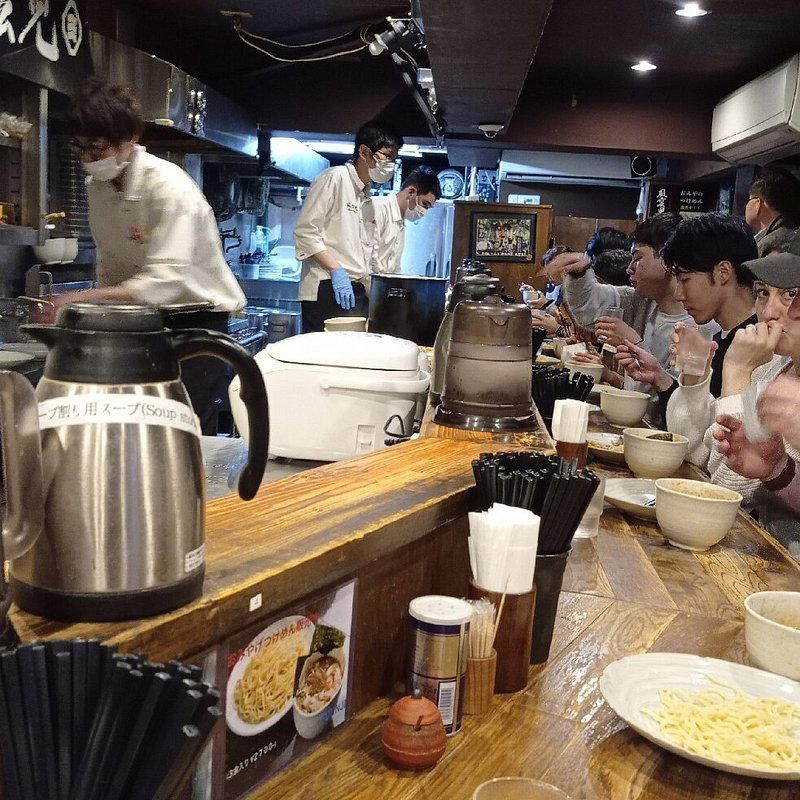
Yoyogi's Ramen Queue and What It Tells You About Kanto Bowl Culture
The pavement outside the first floor of a low-rise building on a side street in Yoyogi holds a queue that forms before the shutters go up. It is not especially theatrical address in Shibuya, no neon, no engineered footfall from a transit hub, yet Fuunji has held a place in the Opinionated About Dining Casual Japan rankings every year since 2023, climbing from #9 that year to #15 in 2024, before settling at #17 in 2025. For a category where momentum is often everything and fashionable new shops can push established ones down the list within a season, that consistency across three consecutive years places the shop in a different tier from most.
The address matters to understanding the offer. Yoyogi sits at the northern end of Shibuya, close enough to Shinjuku to pull from both catchment areas but not embedded in either's tourist circuit. The neighbourhood runs quieter than the main Shibuya scramble and quieter than the Shinjuku ramen corridors to the north.
Kanto Style in Context: Where Tokyo Ramen Comes From
To understand what Fuunji represents in the broader ramen conversation, it helps to place it within Japan's regional fault lines. The Kanto tradition, Tokyo and its surrounding prefectures, has long favoured shoyu-based broths with a lean, saline clarity. The Kansai tradition, centred on Osaka and extending toward Kyoto, tends toward lighter shio stocks and a different relationship with dashi. Neither is monolithic. Fukuoka, on Kyushu's northern tip, produced the tonkotsu style that now appears everywhere from Seoul to Chicago; Sapporo owns miso ramen as a regional calling card; Hakodate claims some of the oldest shio preparations in the country, a lineage that Hakodate Shioramen Goryokaku carries into its Tokyo outpost.
What Tokyo did, particularly from the 1990s onward, was absorb all of those traditions and develop something more syncretic. The city's leading tsukemen and tori paitan shops draw from Kanto technique, attention to noodle calibration, controlled brine levels, precisely managed broths, but they do not confine themselves to shoyu orthodoxy. The result is a scene where the Kanto label signals method and discipline rather than a fixed flavour profile. Fuunji operates in that evolved Kanto mode, with chef Shigeyuki Miyake at the kitchen.
The tsukemen format, in which cold or room-temperature noodles are served separately from a concentrated dipping broth, became one of Tokyo's defining ramen developments from the mid-2000s onward. It demands more technical precision than a standard bowl because the broth must be dense enough to coat noodles dipped repeatedly, yet balanced enough that the dish does not collapse under its own weight by the halfway point. The format's popularity in Yoyogi and Shinjuku-adjacent neighbourhoods reflects a regular-customer model: commuters and local office workers who return weekly and expect consistency rather than novelty.
Ramen at This Level: How Fuunji Sits Among Tokyo's Serious Shops
Ramen criticism in Japan has matured considerably over the past decade. OAD's Casual Japan list, which placed Fuunji at #9 in 2023, applies a methodology closer to restaurant criticism than to crowd-sourced aggregation. The list weights repeat visits and qualitative assessment, which means a shop ranking in the top 20 across three years is not benefiting from a single wave of attention. By comparison, shops like Afuri in Tokyo have built recognition around yuzu shio broths at a more accessible price point, while Chukasoba Ginza Hachigou and Chukasoba KOTETSU represent the chukasoba end of the spectrum, where lighter, more delicate construction is the point of difference. Fuunji sits in neither of those camps. Its OAD positioning suggests a kitchen working in the denser, more technically demanding register that serious tsukemen commands.
The city's broader fine-dining ecosystem does not share a category with ramen, but it provides useful orientation for the visitor trying to understand spend and expectation. High-end kaiseki at venues like RyuGin, multi-course French at L'Effervescence, or premium sushi at Harutaka all price into the ¥¥¥¥ bracket. Ramen, even at shops with sustained critical recognition, operates at a fraction of that spend, which is part of what makes OAD's Casual Japan methodology significant: it evaluates quality independent of price tier. Fuunji earning a position in the top 20 on that basis means the kitchen is performing against a standard that has nothing to do with cover charges or minimums.
For context across the wider Japan ramen scene, the gap between Tokyo and Osaka in this category remains real. Osaka-based ramen culture intersects more with the Kansai dashi tradition and the city's own street-food economy, producing a different flavour baseline. Tokyo's Kanto scene is where the tsukemen form has developed most intensively, and Fuunji's Yoyogi address places it in the geographic heart of that development. Internationally, the influence of this style is visible in shops like Akahoshi Ramen in Chicago and the Afuri Ramen outpost in Portland, both drawing from Kanto technique to serve Western markets.
Planning Your Visit
Fuunji is located at 2 Chome-14-3, Yoyogi, Shibuya, Tokyo, on the ground floor of the Hokuto Daiichi Building. The nearest transit access is Yoyogi Station, served by the JR Yamanote Line and the Toei Oedo Line. Shinjuku Station is also within walking range. The shop operates on a walk-in model typical of this ramen category, which means queue time is the primary variable to plan around. Early arrival or off-peak timing on weekday visits is standard practice at shops with this level of recognition.
| Venue | Style | OAD Casual Japan (2025) | Access | Booking |
|---|---|---|---|---|
| Fuunji | Tsukemen / Tori Paitan | #17 | Yoyogi Station | Walk-in |
| Afuri | Yuzu Shio Ramen | Listed | Multiple Tokyo locations | Walk-in |
| Chukasoba Ginza Hachigou | Chukasoba / Shoyu | Listed | Ginza area | Walk-in |
| Hakodate Shioramen Goryokaku | Shio / Hakodate tradition | Listed | Tokyo outpost | Walk-in |
Additional Tokyo ramen context is available through Chukasoba KOTETSU and Chuogo Hanten Mita.
Budget Reality Check
Comparable venues nearby, for context on price, style, and recognition.
| Venue | Cuisine | Price | Notes |
|---|---|---|---|
| FuunjiThis venue — the venue you are viewing | Shibuya, Rich Tsukemen Ramen | $$ | Not listed |
| Tonki | Meguro, Classic Tonkatsu | $$ | Not listed |
| Oishi | Not listed | $$ | Chūō, Creative Japanese with Sake Pairings |
| Aoyama Jin | Minato, Seasonal Kaiseki Omakase | $$$ | Not listed |
| Sushi Ogawa | Chūō, Edomae Sushi Omakase | $$$ | Not listed |
| 白寧 | Minato, Internationally prominent Sushi | Not listed | Not listed |
Recognition history
Dated appearances from independent guides and award organizations, with the underlying list record or original source where available.
Opinionated About Dining Casual in Japan Ranked #147
Opinionated About Dining
Opinionated About Dining Casual in Japan Ranked #17
Opinionated About Dining
Tabelog 100 #10 · No. 10
Tabelog · Tabelog 100 - Ramen - TOKYO - 2025
Opinionated About Dining Casual in Japan Ranked #15
Opinionated About Dining
Opinionated About Dining Casual in Japan Ranked #9
Opinionated About Dining











At a Glance
- Trendy
- Lively
- Casual Hangout
- Solo
- Open Kitchen
- Sake Program
Current opening hours
- Monday
- 11 AM–3 PM, 5–9 PM
- Tuesday
- 11 AM–3 PM, 5–9 PM
- Wednesday
- 11 AM–3 PM, 5–9 PM
- Thursday
- 11 AM–3 PM, 5–9 PM
- Friday
- 11 AM–3 PM, 5–9 PM
- Saturday
- 11 AM–3 PM, 5–9 PM
- Sunday
- 11 AM–3 PM, 5–9 PM
Hours can change for holidays and private events. Last verified .
Narrow, energetic counter seating facing the open kitchen with quick turnover and queues, creating an authentic fast-paced Tokyo ramen experience.