
Michelin Plate
Our verdict
A prix fixe Italian restaurant in Kyoto's Kamigyo Ward, Komatsu Cucina Italiana holds a Michelin Plate (2025) and builds each course around Kyoto's seasonal produce. The menu runs two pasta courses, one dry, one handmade, and frames the cooking through the rhythm of the city's four seasons rather than any fixed regional Italian template.

Pearl is the En Primeur Club membership app, where members save venues, book tables and use the concierge.
The menu
What to order
- Handmade fresh pasta
- Seasonal meat mains
- Seafood appetizers
Where Italian Structure Meets Kyoto's Seasonal Calendar
In Kyoto's northern Kamigyo Ward, the relationship between Italian cooking and Japanese seasonal sensibility is not the novelty it was twenty years ago. The city has produced a small but serious cohort of Italian restaurants that treat the kaiseki principle of shun, ingredients at their seasonal peak, as a structural guide rather than a marketing footnote. Komatsu Cucina Italiana operates inside that tradition. The Michelin Plate recognition it has held in both the 2024 and 2025 guides places it within a tier of Kyoto Italian addresses that have earned critical acknowledgment without yet crossing into starred territory, sitting below the one-star ceiling currently occupied in Kyoto's Italian scene by cenci.
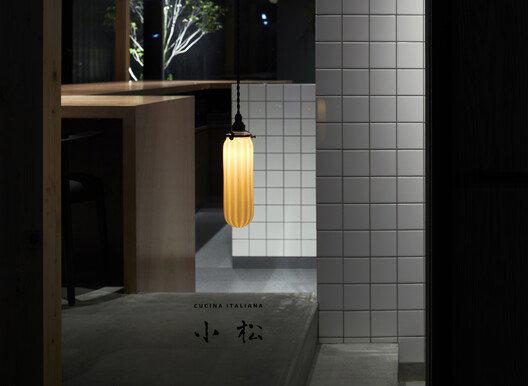
The building itself carries a specific kind of weight: Chef Shinji Ishida refurbished a space formerly run by his grandmother, and the family name continues to identify the restaurant. That continuity shapes the atmosphere before a single dish arrives. There is no studied minimalism imported from a design studio, and no attempt to signal Italian heritage through terracotta or chalkboard menus in Italian script. The room holds its own quiet character, one that has accumulated through use and family history rather than been installed at opening.
How the Menu Is Built, and What That Architecture Says
The prix fixe format is where the editorial logic of Komatsu sits most clearly. A fixed course is not an unusual choice for serious Italian in Japan, it mirrors the tasting structure common in kaiseki and allows the kitchen to control ingredient sourcing tightly. What distinguishes the approach here is how seasonal Kyoto produce functions as the organising principle for dish composition, not as an accent. The course is designed so that the diner is reminded, course by course, that the meal is happening in Kyoto. That is an editorial decision as much as a culinary one.
Pasta architecture within that fixed menu is specific and worth noting. Two pasta courses appear in each meal: one built on dry pasta, the other on handmade. This is not a duplication but a deliberate contrast. Dry pasta, with its structural firmness and ability to carry sauces with concentration, occupies a different expressive register than fresh handmade pasta, which tends to soften flavour, absorb fat, and offer a different textural conversation with whatever surrounds it. Running both within the same course is a structural choice that implicitly argues against the false binary, common in Japan's Italian restaurant marketing, between pasta fresca as refinement and pasta secca as everyday. Both are given equal standing, and both are put in service of the seasonal ingredients on the plate.
Cooking philosophy, as described in the Michelin notes, prioritises honest expression of ingredient flavour over technique that draws attention to itself. Seasoning is calibrated to reveal rather than to transform. In Kyoto's context, where the dominant fine dining tradition (kaiseki) also prizes subtlety over intervention, this is the expected register, but applying it through an Italian framework requires real restraint. The risk in this kind of cooking is that it collapses into flatness. The Michelin Plate recognition, sustained across two consecutive guide years, suggests the execution clears that bar.
Kyoto's Italian Scene: Where Komatsu Sits
Kyoto's Italian restaurant tier is thinner than Tokyo's but more coherent in its identity. The city's leading Italian addresses consistently absorb the kaiseki structure, fixed courses, seasonal rotation, local ingredient sourcing, rather than reproducing any specific regional Italian tradition wholesale. cenci operates at the starred level within this cohort. Komatsu occupies the Michelin Plate band, which in Kyoto's Italian context represents a category of restaurants that have passed critical scrutiny without being drawn into the full omakase pricing and ceremony of the starred tier. For comparison, other Italian restaurants in the city worth considering include Bini, Vena, and BOCCA del VINO. For Japanese cooking at higher price points in the same city, TAKAYAMA represents the kaiseki tradition Komatsu is implicitly in dialogue with.
Across Japan more broadly, the question of how European cooking traditions are absorbed into place-specific Japanese contexts is answered differently in each city. HAJIME in Osaka operates at the starred French-influenced end; akordu in Nara applies Spanish technique to Nara's produce; Goh in Fukuoka and 1000 in Yokohama each frame their menus through their respective cities' identities. Komatsu's answer, Italian structure, Kyoto ingredients, family provenance, is one of the more personal resolutions to that question currently receiving Michelin recognition in Japan.
For a point of contrast outside Japan, 8½ Otto e Mezzo Bombana in Hong Kong and Frasca Food & Wine in Boulder both demonstrate how Italian fine dining adapts when placed in cities far from Italy's source regions. Komatsu is doing something adjacent but culturally distinct: it is not transplanting Italian cooking into a new geography, it is using Italian form to express a geography that already has one of the world's most developed fine dining traditions of its own.
Know Before You Go
| Detail | Information |
|---|---|
| Address | Motohyakumanbencho 557, Kamigyo Ward, Kyoto 602-0953, Japan |
| Price Range | ¥¥¥ (mid-upper tier; prix fixe format) |
| Awards | Michelin Plate 2024, Michelin Plate 2025 |
| Format | Prix fixe only; includes two pasta courses (dry and handmade) |
| Booking | No website or phone listed; contact via local reservation channels or in person |
For a broader view of where to eat, drink, and stay in the city, see our full Kyoto restaurants guide, our full Kyoto hotels guide, our full Kyoto bars guide, our full Kyoto wineries guide, and our full Kyoto experiences guide. Also worth consulting: Harutaka in Tokyo and 6 in Okinawa for other precision-focused Japanese dining outside Kyoto.
Frequently asked questions
What do people recommend at Komatsu Cucina Italiana?
The prix fixe course is the only format available, so the question of what to order is answered by the kitchen. The two pasta courses, one dry, one handmade, are the structural centrepiece of the meal, and the Michelin notes specifically highlight how seasonal Kyoto ingredients are woven through each dish. The restaurant holds a Michelin Plate in both 2024 and 2025, which reflects sustained quality across the full course rather than any single signature dish.
Can I walk in to Komatsu Cucina Italiana?
Given the prix fixe format, the family-run nature of the kitchen, and the Michelin Plate recognition, walk-ins are unlikely to be reliably accommodated. No booking website or phone number is publicly listed, which means advance planning is necessary. The ¥¥¥ pricing tier and fixed-course structure both indicate a kitchen operating at close to full capacity on most service days. If you are planning a visit to Kyoto's Italian tier more broadly, booking well ahead is standard practice across this category.
What's the standout thing about Komatsu Cucina Italiana?
The dual pasta structure within a single prix fixe course, dry pasta and handmade pasta as distinct courses, both oriented around seasonal Kyoto ingredients, is the most architecturally specific element. Few Italian restaurants at this price tier run both as separate, equal-weight courses. The Michelin Plate recognition and the restaurant's family provenance (the chef refurbished his grandmother's space, retaining the family name) give it a character that distinguishes it from the more design-conscious Italian addresses in the city's Michelin-recognised tier.
Recognition Snapshot
| Venue | Cuisine | Price | Awards | Notes |
|---|---|---|---|---|
| Komatsu Cucina ItalianaThis venue (the venue you are viewing) | Contemporary Italian with Seasonal Ingredients | $50–100 | Michelin Plate | Not listed |
| Gion Sasaki | Modern Kaiseki | $300–500 | 3 Michelin Stars · La Liste Top Restaurants | Kaiseki, Japanese |
| cenci | Innovative Italian-Japanese Fusion | $100–150 | 1 Michelin Star · World's 50 Best #76 | Italian |
| Ifuki | Sumibi Kappo Kaiseki | $200–300 | 2 Michelin Stars · La Liste Top Restaurants | Kaiseki |
| Kyokaiseki Kichisen | Kyoto Kaiseki | $200–300 | 2 Michelin Stars · La Liste Top Restaurants | Japanese |
| Kyo Seika | Modern Chinese Fine Dining | $150–200 | 1 Michelin Star · Tabelog Bronze #216 | Chinese |
Recognition history
Dated appearances from independent guides and award organizations, with the underlying list record or original source where available.
Michelin Plate
Michelin
Full recognition history (3 entries)
Michelin Plate
Michelin
Michelin Plate
Michelin
Continue exploring
More in Kyoto
Restaurants in Kyoto
All restaurants in Kyoto →
Bars in Kyoto
All bars in Kyoto →
Hotels in Kyoto
All hotels in Kyoto →
Wineries in Kyoto
Browse all →
Details
- Intimate
- Elegant
- Quiet
- Sophisticated
- Date Night
- Special Occasion
- Celebration
- Open Kitchen
- Historic Building
- Private Dining
- Extensive Wine List
- Sommelier Led
- Local Sourcing
- Prix Fixe
- Counter Dining
- Wine Pairing
- Organic Focus
Current opening hours
- Monday
- Closed
- Tuesday
- 11:30 AM–3 PM, 6–11 PM
- Wednesday
- 11:30 AM–3 PM, 6–11 PM
- Thursday
- 11:30 AM–3 PM, 6–11 PM
- Friday
- 11:30 AM–3 PM, 6–11 PM
- Saturday
- 11:30 AM–3 PM, 6–11 PM
- Sunday
- 11:30 AM–3 PM, 6–11 PM
Hours can change for holidays and private events. Hours as of .
Stylish, relaxing space with black walls and preserved original wooden columns and beams; open kitchen counter creates an immersive atmosphere filled with cooking sounds and aromas.