Hanagatami sits in Osaka's Kita Ward, within the dense dining grid that radiates out from Umeda station. The restaurant occupies a position in one of Japan's most competitive urban food scenes, where the intersection of kaiseki tradition and contemporary sourcing ethics is reshaping what premium dining means in the city. A considered stop for those tracking Osaka's quieter, more deliberate restaurant tier.
Pearl is the En Primeur Club membership app — saves, bookings, and concierge access live there. Same editors, same standards.
- Address
- Japan, 〒530-0001 Osaka, Kita Ward, Umeda, 2 Chome−5−25 ザ・リッツ・カールトン大阪
- Phone
- +81663437020
- Directions
- Get directions
 Saves & bookings on Pearl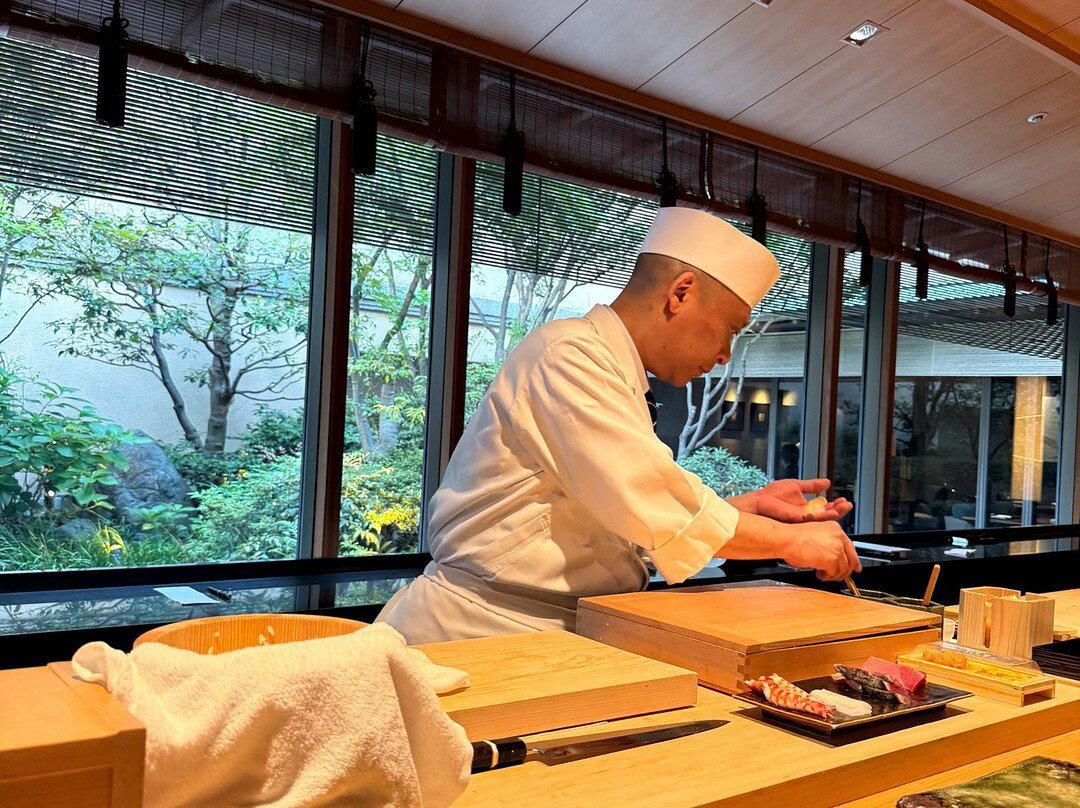
Umeda's Quieter Register
Kita Ward's restaurant density is among the highest in any Japanese city. The blocks around Umeda draw commuters, business diners, and destination seekers in roughly equal measure, and the result is a layered market where the loudest venues are not always particularly considered ones. Hanagatami occupies an address in this grid, inside the Cha Cha Nishiki-Karuton Osaka building on Umeda's 2-chome. That positioning is deliberate and consistent with a broader pattern across Osaka's more serious mid-to-upper dining tier, where restraint at the entrance is often matched by precision inside.
Osaka's culinary reputation is built on abundance and directness: kuidaore, the city's self-described tendency to eat until you are ruined, is the cultural frame most visitors arrive with. But that frame misses the quieter current running through the city's more considered restaurants, places where portion logic, ingredient selection, and kitchen discipline matter more than spectacle. Hanagatami belongs to that current, positioned in a neighbourhood where diners move between destinations with purpose rather than impulse.
Sourcing as Structure, Not Decoration
Across Japan's premium dining tier, the relationship between kitchen and producer has shifted from an optional talking point to a structural element of the menu itself. In Kyoto's kaiseki tradition, which continues to exert gravitational pull on Osaka kitchens, seasonal ingredient sourcing was always foundational. What has changed in the last decade is the extension of that logic into waste reduction, whole-ingredient thinking, and traceable supply chains that can withstand scrutiny from a diner who asks questions.
Osaka sits at an interesting intersection here. Its proximity to Kyoto's formal ingredient culture and to the fishing ports of the Seto Inland Sea gives its kitchens access to a range of produce that many comparable cities lack. Restaurants operating in the Kita Ward and Minami belt have increasingly used that access not as a marketing point but as a kitchen discipline, building menus around what is available and at its natural peak rather than what a set format requires. This approach inherently reduces waste: when the menu follows the ingredient rather than the reverse, there is less pressure to source out-of-season or over-order to maintain consistency.
Hanagatami's placement in this context matters. The Umeda address puts it within the commercial core, but the venue's profile, low-key entry suggests an operation that has chosen depth of practice over breadth of visibility. In Osaka's dining scene, that configuration tends to correlate with a kitchen that takes ingredient provenance seriously, because word-of-mouth from knowledgeable diners is the primary acquisition channel. Venues in this tier cannot afford to source carelessly; their regulars will notice.
For a sense of what rigorous sourcing looks like at the upper end of the Osaka spectrum, HAJIME in Osaka represents the formal extreme. Ajikitcho Bunbuan and Ajihei Sonezaki occupy a comparable tier of seriousness in the kaiseki-adjacent space. Hanagatami's profile suggests it belongs to this broader current without necessarily competing in the same award-chasing bracket.
The Kansai Context
Understanding any Osaka restaurant requires understanding the Kansai competitive frame. Kyoto is forty minutes away by shinkansen, and its dining culture, more formal, more ceremonial, more expensive at the leading end, sets a ceiling that Osaka kitchens either aspire to or deliberately diverge from. Gion Sasaki in Kyoto exemplifies the Kyoto high-end, where the room, the service choreography, and the ingredient sourcing are all calibrated to a specific cultural performance. Osaka's better restaurants tend to deliver similar ingredient quality with less ceremony, the city's directness extends into the dining room as well as the kitchen.
That directness has its own sustainability logic. Less theatrical plating means less waste in garnish and decorative elements. Shorter menus mean tighter ordering and less spoilage. The stripped-back format that characterises many of Osaka's serious mid-tier restaurants is not only an aesthetic choice; it is also an operationally efficient one. Elsewhere in Japan, this pattern is visible at venues like Goh in Fukuoka and akordu in Nara, where a similar discipline around ingredient selection and format restraint produces kitchens with minimal structural waste.
Internationally, the sourcing-forward model has precedent at the level of Le Bernardin in New York City, where whole-fish utilisation and supplier relationships are documented and central to the kitchen's identity, or Atomix in New York City, where Korean ingredient provenance is treated as editorial content rather than background detail. The difference in Osaka is that the sourcing conversation tends to happen between kitchen and regular diner rather than between kitchen and press.
comparable set and Price Positioning
Osaka's Kita Ward dining market covers an unusually wide price band within a compact geography. At one end, the standing sushi counters and kushikatsu bars around Dotonbori and Shinsekai offer some of Japan's most competitive street-level eating. At the other, destination restaurants in Namba and Umeda hold Michelin stars and command comparable pricing to Tokyo equivalents.
For comparison, Aka to Shiro, Calendrier, and Az represent the kind of precision-focused, format-led restaurants that define Osaka's serious mid-tier. Birdland in Sakai and venues like Harutaka in Tokyo illustrate how the broader Kansai and national premium dining network connects, with Osaka sitting as a natural hub between Kyoto formality and Tokyo volume. Beyond the main islands, similar sourcing-driven models appear at 旧山ガ川乃 in Sapporo, 一本木 名川製 in Nanao, 湖畔荘庵 in Takashima, and 羽根屋 in Nishikawa Machi, confirming that ingredient-led discipline is a national pattern rather than a metropolitan trend.
Planning a Visit
Hanagatami's address in the Cha Cha Nishiki-Karuton building places it within walking distance of Umeda station, one of Osaka's major rail interchanges connecting JR, Hankyu, Hanshin, and subway lines. For visitors arriving from Tokyo or Kyoto by shinkansen, Shin-Osaka station is one stop north, with direct subway access to Umeda. The venue operates through existing guest networks rather than open-channel reservations. The practical approach is to contact the building's management or seek a local intermediary, a hotel concierge familiar with Kita Ward's quieter dining tier is often one reliable route. Timing matters in Osaka: the city's dining rhythm runs later than Kyoto's, with second seatings and post-work dinner traffic extending well into the evening. Visiting outside peak business-dinner windows, mid-week, earlier seatings, tends to allow more considered service across the Umeda restaurant tier. For a broader orientation to Osaka's dining options before or after visiting Hanagatami, our full Osaka Shi restaurants guide maps the city's key neighbourhoods and dining categories in detail.
Cuisine and Credentials
Comparable venues nearby, for context on price, style, and recognition.
| Venue | Cuisine | Price | Notes |
|---|---|---|---|
| HanagatamiThis venue — the venue you are viewing | Multi-Format Japanese Fine Dining | $$$$ | Not listed |
| ハジメ | Modern French-Japanese Fine Dining | $$$$ | Nishi |
| Tenjinbashi Aoki | Michelin-Starred Kaiseki | $$$$ | Kita |
| Kushiage 010 | Creative Kushiage with Global Influences | $$$ | Kita |
| Kawaharasaki | Kamigata Tempura | $$$$ | Kita |
| Wayōshusai Hide | Japanese Izakaya | $$$ | Chūō |
Continue exploring
More in Osaka
Restaurants in Osaka
Browse all →




Bars in Osaka
Browse all →


Hotels in Osaka
Browse all →




Wineries in Osaka
Browse all →
At a Glance
- Elegant
- Sophisticated
- Intimate
- Special Occasion
- Business Dinner
- Celebration
- Chefs Counter
- Open Kitchen
- Garden
- Hotel Restaurant
- Sake Program
- Garden
Current opening hours
- Monday
- 11:30 AM–3 PM, 5:30–9 PM
- Tuesday
- 11:30 AM–3 PM, 5:30–9 PM
- Wednesday
- Closed
- Thursday
- 11:30 AM–3 PM, 5:30–9 PM
- Friday
- 11:30 AM–3 PM, 5:30–10 PM
- Saturday
- 11:30 AM–3 PM, 5:30–10 PM
- Sunday
- 11:30 AM–3 PM, 5:30–9 PM
Hours can change for holidays and private events. Last verified .
Sleek, sophisticated modern-Zen atmosphere with dining facing a Ryoanji-inspired garden, surrounded by traditional Japanese aesthetics for a timeless oasis.