



An eight-seat counter in Kitashinchi that has earned two Michelin stars and consecutive Tabelog Silver Awards (2025, 2026), Numata sits at the sharper end of Osaka's premium tempura tier. Dinner runs JPY 40,000 to 49,999 and reservations are notoriously difficult to secure, placing it firmly among the city's most sought-after counter experiences.
Pearl is the En Primeur Club membership app — saves, bookings, and concierge access live there. Same editors, same standards.
- Address
- Japan, 〒530-0002 Osaka, Kita Ward, Sonezakishinchi, 1 Chome−10−2 7階
- Phone
- +81 6-6347-0707
- Website
- tenpura-tenboshi.com
- Directions
- Get directions
 Saves & bookings on Pearl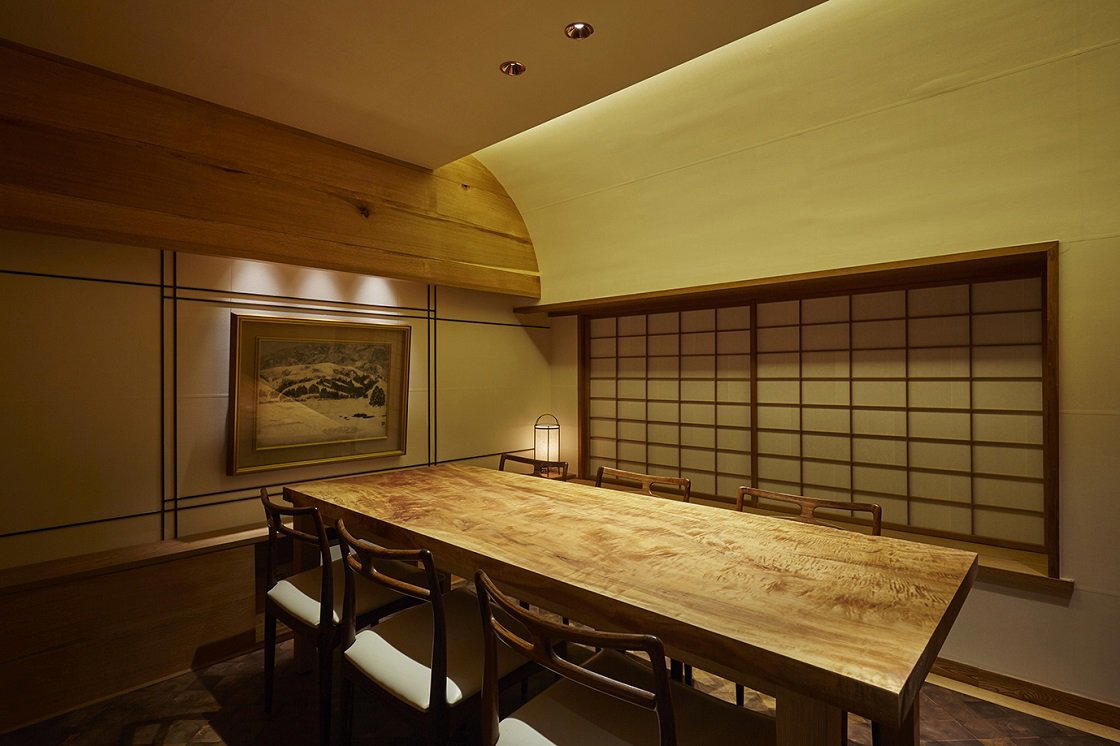
A Counter in Kitashinchi, at the summit of Osaka's Tempura Hierarchy
Numata is a Michelin-starred tempura omakase restaurant in Osaka, awarded two Michelin stars in 2025, with dinner priced at about ¥40,000 to ¥49,999. Seventh floors in Osaka's entertainment district do not typically announce themselves. The building at Kitashinchi Place on Sonezakishinchi offers no street-level theatre; the statement is made upstairs, at an eight-seat hinoki counter where the cook's movements are the only spectacle on offer. That compression of space and focus is not incidental. Japan's leading tempura counters have long operated on the logic that intimacy between cook and diner produces better outcomes than scale. The fryer is close, the oil temperature is readable by sound, and there is nowhere for imprecision to hide.
Kitashinchi is Osaka's most concentrated zone for high-end counter dining, a neighbourhood where kaiseki houses, sushi-ya, and specialized frying counters occupy upper floors of low-profile buildings within a few hundred metres of one another. Numata sits at the northern end of this cluster, roughly 140 metres from Kitashinchi Station, and operates in the same price tier as the neighbourhood's kaiseki rooms: dinner at JPY 40,000 to JPY 49,999 places it alongside ¥¥¥¥ peers in the Osaka fine dining conversation, including French-rooted houses such as Hajime and La Cime and Japanese format rooms like Fujiya 1935.
What Tempura Demands at This Level
Tempura's philosophical premise is disarmingly direct: batter applied to an ingredient, submerged in hot oil. The complication is that the batter's only legitimate function is to capture and concentrate the moisture already present in the ingredient. An asparagus spear, a prawn, a shard of sea urchin on shiso leaf, each carries its own heat tolerance, moisture content, and optimal extraction window. At the counter level that Numata occupies, the craft is not in adding flavour but in preserving and intensifying what is already there. Getting that right across a full sequence of pieces, at oil temperatures calibrated to each ingredient, is where years of training become visible in the outcome.
This is the frame through which Numata's awards record should be read. A Tabelog score of 4.41 in a category as technically specific as tempura, where peer restaurants are scored by diners who cross-reference across Tokyo, Kyoto, and Osaka counters, reflects accumulated performance rather than a single memorable meal. Selection to the Tabelog Tempura "100" in 2022, 2023, and 2025 alongside back-to-back Silver Awards in 2025 and 2026 positions Numata inside a small national cohort. Michelin's two-star assessment (held in both 2024 and 2025) adds a second independent reference point from a different evaluative tradition.
Seasonal Rhythm and Kaiseki Principles at a Frying Counter
The kaiseki tradition that defines high Japanese dining is not the exclusive property of multi-course Japanese cuisine restaurants. Its underlying logic, ingredient selection driven by season, course progression shaped by texture and temperature contrast, restraint as an aesthetic position, transfers directly to a well-run tempura counter. At Numata, the kaiseki angle assigned to this editorial frame is most evident not in any named dish but in the structural discipline of the sequence. A tempura course at this level functions like a kaiseki progression: light to substantial, delicate to strong in flavour, spring or autumn ingredients appearing only when they are at their peak moisture content and flavour density.
Osaka's seasonal produce calendar differs enough from Tokyo's to make counter positioning matter. The city's proximity to the Seto Inland Sea shifts which seafood items carry greater weight in summer; the Kinki region's agricultural hinterland provides vegetables that don't travel the distance to Tokyo's leading counters. A Kitashinchi tempura counter drawing on those supply chains is not simply running the same course as a Tokyo peer, it is working with ingredients whose character is specific to this geography and this moment in the year.
Where Numata Sits in Osaka's Premium Counter Scene
Osaka's premium counter dining has not converged on a single format. The city supports Michelin-starred kaiseki in the ¥¥¥ range (Taian, Kashiwaya at Senriyama), alongside ¥¥¥¥ creative and French-Japanese houses. Within the specifically Japanese tempura category, Numata's national recognition through Tabelog's category-specific "100" list places it in a distinct peer group. For regional context, consider that OIMATSU Tempura Suzuki operates in the same city and category, while the kaiseki tradition that informs this counter's pacing can be tracked through Osaka's broader Japanese dining scene at restaurants like Shunsaiten Tsuchiya and Hiraishi.
For diners comparing across Japan's tempura counter tier, Tempura Ginya in Tokyo and Mudan Tempura in Taipei offer useful reference points for how the format has been interpreted beyond Osaka's specific supply networks. Beyond tempura, Osaka's fine dining circuit includes Gochiso nene and Shintaro, and the city's broader culinary range is documented in our full Osaka restaurants guide.
Nationally, two-starred tempura at this price point invites comparison with other high-precision Japanese counter formats. Harutaka in Tokyo operates in the sushi counter category at a comparable recognition level. Regional Japanese restaurant culture at a similarly considered level can be found at Gion Sasaki in Kyoto, akordu in Nara, Goh in Fukuoka, 1000 in Yokohama, and 6 in Okinawa.
Planning a Visit
The eight-seat counter configuration means demand materially exceeds supply. Reservations are available through the restaurant's affiliated booking channel, but the combination of two Michelin stars, consistent Tabelog recognition, and a physically small room creates a booking window that requires planning several months in advance for non-local visitors.
| Venue | Category | Price Range (Dinner) | Recognition |
|---|---|---|---|
| Numata | Tempura, Counter | JPY 40,000 to 49,999 | Michelin 2-star; Tabelog Silver 2025 to 26; Tabelog 100 |
| Hajime | French / Innovative | ¥¥¥¥ | Michelin-starred, Osaka |
| La Cime | French | ¥¥¥¥ | Michelin-starred, Osaka |
| Taian | Kaiseki / Japanese | ¥¥¥ | Michelin-starred, Osaka |
| Fujiya 1935 | Innovative | ¥¥¥¥ | Michelin-starred, Osaka |
How It Stacks Up
Comparable venues nearby, for context on price, style, and recognition.
| Venue | Cuisine | Price | Awards | Notes |
|---|---|---|---|---|
| NumataThis venue — the venue you are viewing | Michelin-Starred Tempura Omakase | $$$$ | Michelin 2 Star | Not listed |
| Miyamoto | Michelin-Starred Kaiseki | $$$$ | Michelin 2 Star | Kita |
| KAHALA | Creative Kaiseki Fusion | $$$$ | Michelin 2 Star | Kita |
| Tenjimbashi Aoki | Michelin-Starred Kaiseki | $$$$ | Michelin 2 Star | Kita |
| Yugen | Michelin-Starred Kaiseki | $$$$ | Michelin 2 Star | Tennōji |
| Koryu | Modern Japanese Omakase | $$$$ | Michelin 2 Star | Chūō |
Recognition history
Dated appearances from independent guides and award organizations, with the underlying list record or original source where available.
La Liste Top Restaurants
La Liste
Michelin 2 Stars
Michelin
Opinionated About Dining Top Restaurants in Japan Recommended
Opinionated About Dining
Tabelog Silver #94
Tabelog
La Liste Top Restaurants
La Liste
Michelin 2 Stars
Michelin
Tabelog 100 #93 · No. 93
Tabelog · Tabelog 100 - Tempura - 2025
Tabelog Silver
Tabelog
Michelin 2 Stars
Michelin
Continue exploring
More in Osaka
Restaurants in Osaka
Browse all →




Bars in Osaka
Browse all →



Hotels in Osaka
Browse all →



Wineries in Osaka
Browse all →
At a Glance
- Modern
- Elegant
- Intimate
- Sophisticated
- Date Night
- Special Occasion
- Business Dinner
- Chefs Counter
- Open Kitchen
- Sake Program
Clean, modern interior with understated elegance, warm wood tones, and a tranquil counter seating atmosphere.