

Michelin Bib Gourmand · Tabelog 100 #96
Our verdict
Among Tokyo's Italian restaurants, falò in Daikanyama earns its Michelin Bib Gourmand through fire rather than finesse: an open-hearth counter where live-flame grilling anchors the menu. The porchetta and straw-grilled fish place it in a different register from the city's white-tablecloth Italian tier, keeping prices accessible at ¥¥ while the technique remains serious.

Pearl is the En Primeur Club membership app, where members save venues, book tables and use the concierge.
The menu
What to order
- Porchetta
- Straw-grilled fish
- Charcoal-grilled vegetables
- Carbonara pasta
- Grilled risotto
Fire as the Central Argument
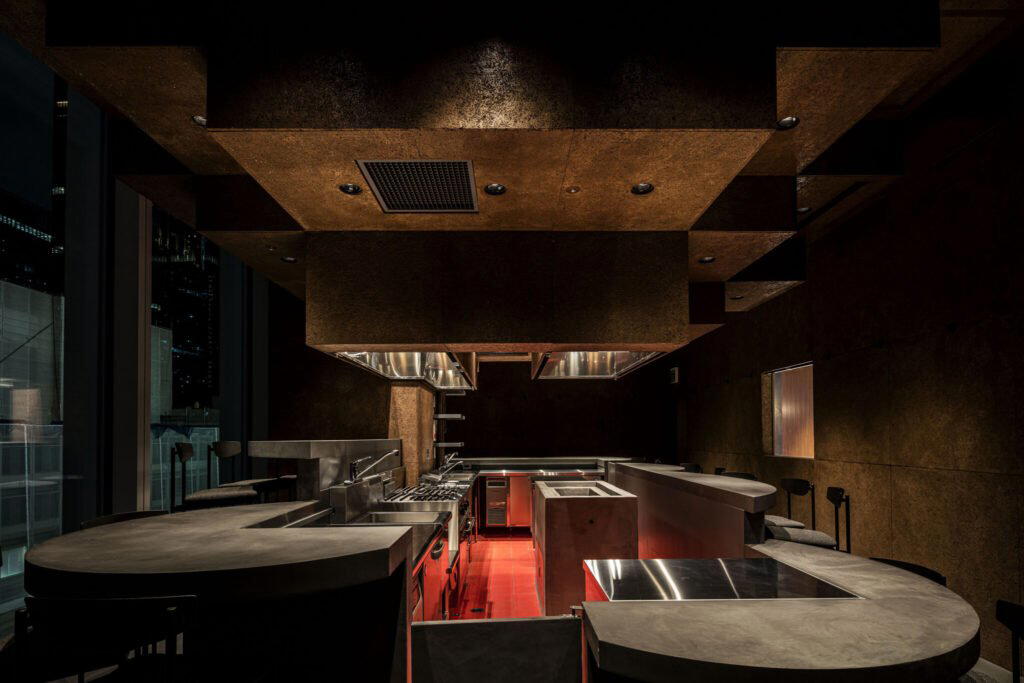
Descend the stairs into falò's basement space in Daikanyama's LUZ building and the visual logic is immediate: a counter arrayed around a working hearth, smoke threading upward, charcoal catching the light. In a city where Italian restaurants tend to sort themselves into either white-tablecloth refinement or casual trattorias, falò occupies a third position, one defined by the primacy of live fire. The kitchen is not incidental to the dining room; it is the dining room, and every seat faces it.
Open-hearth cooking has a long Italian tradition, particularly in regions like Tuscany and Emilia-Romagna where the braciere or fogolar was as much a social focal point as a cooking method. What Tokyo's Italian scene has done with this tradition is instructive: rather than importing the aesthetic wholesale, a generation of Italian-leaning kitchens in the city have found ways to filter it through Japanese precision and product obsession. falò sits at the sharper end of that tendency, where the fire is not decorative but operational, charcoal is thrown directly onto the flame, ingredients are placed on the charcoal itself, and the grilling method shifts register depending on the ingredient, from proximity grilling to full open-hearth exposure.
The Arc of the Meal
Thinking through a meal at falò as a progression reveals how thoroughly fire organises the sequence. The early passes tend toward items that reward direct-flame intensity: straw-grilled fish occupies that early-course logic well, where the smoke from burning straw gives a brief, aromatic crust without overwhelming the protein underneath. Straw grilling, a technique with roots in Japanese robatayaki and Kochi's famous katsuo tataki, read here through an Italian lens, producing something that belongs to neither tradition cleanly but functions credibly in both.
Foil-grilled vegetables arrive mid-meal in the way that secondary-heat cooking merits: slower, more patient, parcelled inside foil to concentrate their own moisture before the outer wrapper peels away. The structural contrast between direct-flame items and foil-wrapped ones gives the meal its pacing, a rhythm between the aggressive and the considered that good fire cooking requires.
The porchetta is where falò makes its clearest statement. Requiring over an hour of patient cooking, it is the kind of item that only appears on a menu when the kitchen has committed to fire not as a style choice but as a working method. Porchetta cooked properly, skin crackling, fat rendered into the meat rather than pooled beneath it, demands real-time attention of a kind that complicates the usual service logistics. The fact that it anchors the menu here, and is the dish most frequently cited by diners in reference to this address, reflects the kitchen's willingness to organise the entire operation around what the fire needs rather than around what is convenient.
Chef Tanisha works the counter with the focused economy of someone who has learned that fire does not wait: the charcoal throws must be timed, the proximity adjusted, the resting period judged. The counter format means this is all visible, which is part of the deal at falò. You are not merely watching cooking; you are watching the negotiation between a cook and a live heat source, which is a different kind of theatre.
Where falò Sits in Tokyo's Italian Picture
Tokyo's Italian restaurant tier has widened considerably over the past decade. At the upper end sit multi-Michelin-starred operations: Aroma Fresca and Gucci Osteria da Massimo Bottura Tokyo represent the kind of high-investment, formal Italian dining that competes with the city's French and kaiseki institutions at the ¥¥¥¥ tier. PRISMA, Principio, and AlCeppo fill out the mid-to-upper range with their own emphases. falò at ¥¥ and Michelin Bib Gourmand (2024) occupies a deliberately different bracket: accessible by Tokyo standards, with recognition that reflects quality-to-value rather than prestige-tier positioning. The Bib Gourmand is the Guide's signal for exactly this category, and falò's placement there locates it accurately, this is serious food at a price that does not require the same planning commitment as the starred tier.
For comparison with Tokyo's broader dining context, the ¥¥¥¥ restaurants that hold two and three Michelin stars, places like Harutaka for sushi or RyuGin for kaiseki, operate at a completely different price point and booking horizon. For more on the broader Italian dining conversation across Japan, cenci in Kyoto and 8½ Otto e Mezzo Bombana in Hong Kong illustrate how the Italian tradition lands differently depending on the city.
Daikanyama and the Address
Daikanyama has operated as Tokyo's most coherently designed neighbourhood for at least two decades, lower-rise, tree-lined, with a retail and hospitality character that leans toward considered independents rather than chain density. The basement position within LUZ Daikanyama, a mixed-use building on Daikanyamacho, gives falò a degree of insulation from the street: the descent into the space amplifies the transition from neighbourhood to counter, which suits the intimacy of open-fire dining. The neighbourhood's general character means the room will skew toward a design-literate, locally-engaged crowd rather than the tourist concentrations of Shinjuku or Shibuya proper.
For visitors building a broader Tokyo itinerary around dining, the EP Club guides to Tokyo restaurants, Tokyo bars, and Tokyo hotels provide the wider picture. Japan beyond the capital is well covered through HAJIME in Osaka, Gion Sasaki in Kyoto, akordu in Nara, Goh in Fukuoka, 1000 in Yokohama, and 6 in Okinawa, along with the full Tokyo experiences guide and Tokyo wineries guide.
Planning a Visit
| Detail | falò | Peer context (Bib Gourmand tier) | Starred tier reference |
|---|---|---|---|
| Price range | ¥¥ | ¥¥–¥¥¥ | ¥¥¥¥ |
| Michelin recognition | Bib Gourmand (2024) | Bib Gourmand typical | 2–3 Stars |
| Typically 4.0–4.4 | Varies; often less public data | ||
| Location | Daikanyama, Shibuya | Spread across Tokyo wards | Ginza, Minami-Aoyama concentration |
| Format | Open-hearth counter | Counter or small dining room | Counter or formal dining room |
| Cuisine | Italian, fire-focused | Various | Italian, French, Japanese |
The basement address is LUZ代官山 B1, 14-10 Daikanyamacho, Shibuya, Tokyo.
What Dish Is falò Famous For?
The porchetta is the item most associated with this address: whole-roasted pork requiring over an hour on the open hearth, with crackling formed by sustained proximity to live fire rather than oven heat. The straw-grilled fish draws on a technique with both Italian and Japanese precedents and is frequently noted alongside the porchetta as a reason to visit. Both dishes exist because the kitchen has committed to fire as its primary method, not as one option among several. If you are arriving with a specific dish in mind, the porchetta is the reference point, though its availability on any given service is worth confirming in advance.
Frequently asked questions
Does falò have a Michelin star or similar recognition?
falò has received recognition including: The counter kitchen arrayed around a hearth suggests an open-air bonfire. The eyes are riveted to the chef as he grills the meat, throwing charcoal on the fire. The use of grilling close to the flame, grilling over an open hearth and direct….
What dish is falò famous for?
The porchetta is the signature item: whole pork roasted on the open hearth for over an hour, with crackling formed through sustained direct-flame cooking. It appears consistently across accounts of the counter and is the clearest expression of how falò applies its fire-first method to a classic Italian preparation. The Michelin Bib Gourmand recognition in 2024 names the kitchen broadly, but the porchetta is the dish most associated with this address.
What price level is falò?
Pricing at falò is listed as ¥¥.
Where is falò located?
falò is located at Japan, 〒150-0034 Tokyo, Shibuya, Daikanyamacho, 14−10 LUZ代官山 B1階, Tokyo.
A quick snapshot of similar venues for side-by-side context.
| Venue | Cuisine | Price | Awards | Notes |
|---|---|---|---|---|
| falòThis venue (the venue you are viewing) | Modern Italian Charcoal Grill | $50–100 | Michelin Bib Gourmand · Tabelog 100 #96 | Not listed |
| Harutaka | Edo-Style Omakase Sushi | $200–300 | 3 Michelin Stars · World's 50 Best #76 | Sushi |
| RyuGin | Modern Kaiseki | $500+ | 3 Michelin Stars · World's 50 Best #41 | Kaiseki, Japanese |
| L'Effervescence | Modern French with Japanese Influences | $200–300 | 3 Michelin Stars · World's 50 Best #69 | French |
| HOMMAGE | Modern French with Japanese Influences | $150–200 | 2 Michelin Stars · World's 50 Best #78 | Innovtive French, French |
| MAZ | Innovative Peruvian-Japanese Fusion | $150–200 | 2 Michelin Stars · World's 50 Best #28 | Innovative |
Recognition history
Dated appearances from independent guides and award organizations, with the underlying list record or original source where available.
Michelin Bib Gourmand
Michelin
Tabelog 100 #96 · No. 96
Tabelog · Tabelog 100 - Italian - TOKYO - 2025
Full recognition history (3 entries)
Michelin Bib Gourmand
Michelin
Continue exploring
More in Tokyo
Restaurants in Tokyo
All restaurants in Tokyo →


Bars in Tokyo
All bars in Tokyo →




Details
- Intimate
- Elegant
- Cozy
- Date Night
- Casual Hangout
- After Work
- Group Dining
- Open Kitchen
- Chefs Counter
- Extensive Wine List
- Sommelier Led
- Local Sourcing
- Counter Dining
- A La Carte
- Tasting Menu
- Wine
- Natural Wine
- Vegetarian Friendly
- Allergy Accommodating
Current opening hours
- Monday
- 5–11 PM
- Tuesday
- 5–11 PM
- Wednesday
- 5–11 PM
- Thursday
- Closed
- Friday
- 5–11 PM
- Saturday
- 3–11 PM
- Sunday
- 3–11 PM
Hours can change for holidays and private events. Hours as of .
Dim lighting with a cozy, sophisticated atmosphere; counter seating surrounds an open kitchen with a charcoal hearth, creating an intimate bonfire-like setting with rock music.