

A 1920s former bank building in Nihonbashi Kabutochō, Tokyo's historic financial district, K5 holds a Michelin One Key (2024) and a place on the Tatler Best Hotels Asia-Pacific 2025 list. Twenty rooms blend custom Swedish design with Japanese craft traditions, and the hotel's fluid public spaces dissolve the boundary between café, wine bar, and restaurant.
Pearl is the En Primeur Club membership app — saves, bookings, and concierge access live there. Same editors, same standards.
- Address
- 〒103-0026 Tokyo, Chuo City, Nihonbashikabutochō, 3−5 K5ビル 1階
- Phone
- +81 3-5962-3485
- Website
- k5-tokyo.com
- Directions
- Get directions
 Saves & bookings on Pearl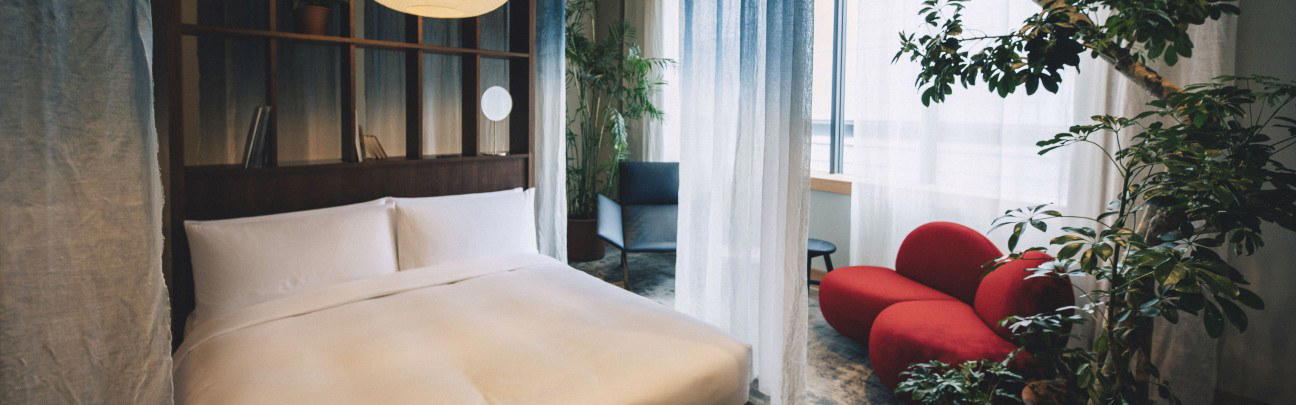
Banking District, Borrowed Time: The Building That Became K5
Nihonbashi Kabutochō has been Tokyo's financial nerve centre since the Meiji era. The neighbourhood sits east of Tokyo Station, its low-rise streets lined with brokerage houses and exchange buildings that predate the city's postwar reconstruction by decades. In most global cities, a district like this would have been hollowed out by corporate redevelopment or left to slow decay. In Tokyo, a handful of its pre-war structures have found a third life as design destinations, and K5 is among the more considered examples of that transition.
The building dates to the 1920s, constructed during a period when Japanese financial institutions were commissioning architecture that could signal permanence and institutional confidence. Bank buildings of that era share a vocabulary across cultures: thick stone or concrete envelopes, tall ceilings designed to project authority, and load-bearing structures built to last generations rather than decades. What Stockholm-based architecture firm Claesson Koivisto Rune found, when commissioned to transform the structure into a hotel, was a shell of genuine spatial quality, the kind that new construction rarely achieves without extraordinary cost. The firm worked with the existing bones rather than against them, preserving the sense of civic weight while introducing the warm, material-led approach that characterises contemporary Scandinavian interiors practice.
The result earned K5 a Michelin One Key in 2024 and a listing on the Tatler Leading Hotels Asia-Pacific 2025 roster. Tatler's description, "fluid spaces and billowing textiles in the unspoilt riches of a former bank", points to what makes the building's conversion legible: the decision to leave the spatial logic of a bank intact rather than carving it into conventional hotel rooms and corridors.
Swedish Design, Japanese Craft, One Building
Conversation between Nordic and Japanese aesthetics is not a new observation in design circles, but K5 makes the argument physically rather than rhetorically. Both traditions share an investment in material honesty, pared-back form, and the belief that function and beauty are not in tension. In the rooms, live plants and warm organic textures sit alongside custom furniture designed by the Swedish architects and objects hand-crafted by Japanese makers. The absence of a television is deliberate: in its place, a record player and access to a vinyl library. That substitution tells you something about the register K5 is operating in, not the amenity arms race of the city's large luxury towers, but a slower, more considered proposition.
Hotel's 20 rooms span several configurations. Studios and standard rooms are compact, though not noticeably more so than peer properties in central Tokyo, where land cost makes floor area a genuine variable across price points. Suites and lofts add sitting areas and freestanding bathtubs, offering the kind of spatial breathing room that justifies lingering rather than treating the room as a place to sleep between appointments. Across all categories, the design brief appears to have been consistency of material quality rather than variation through amenity quantity. Just about every object in the interiors was either custom-designed by the architects, hand-crafted by Japanese makers, or carries both credentials.
Tokyo's boutique hotel sector is smaller than the city's scale might suggest. The market has historically skewed toward large, full-service properties, places like Aman Tokyo, Four Seasons Hotel Tokyo at Otemachi, and Bvlgari Hotel Tokyo, where tower footprints and full dining programs define the offering. Palace Hotel Tokyo and Andaz Tokyo occupy adjacent territory. K5, with 20 keys and a converted heritage building, sits in a different category entirely: lower key count, tighter physical footprint, and a design identity that cannot be replicated by a new-build tower regardless of budget. That structural distinction gives the property a comparable set that extends beyond Tokyo, properties like Aman Venice or Aman New York, which similarly repurpose buildings with prior civic lives, come closer as comparisons than any Tokyo tower.
The Public Spaces and the Concept of Aimai
The hotel's ground-floor public areas are organised around the Japanese concept of aimai, ambiguity, or the deliberate blurring of defined states. There are no hard borders between the lounge, the café, the wine bar, and the restaurant. Guests and visitors from the neighbourhood move between zones without the formal thresholds that mark most hotel lobbies. This is not unusual in Tokyo's more adventurous hospitality projects, where the relationship between hotel and neighbourhood has become a design variable rather than an afterthought, but K5 applies the principle with unusual commitment. The Tatler listing suggests that commitment reads clearly to the people who stay and visit.
For those assessing K5 against other Tokyo properties at this tier, the relevant comparison is less about amenity count and more about what kind of stay each property is designed to produce. JANU Tokyo, Bellustar Tokyo, and The Capitol Hotel Tokyu are all credible alternatives with different spatial and service propositions. K5 is the option for guests whose priorities are design depth, neighbourhood integration, and historical fabric over tower views or extensive spa facilities.
Planning a Stay
K5 is located at 3-5 Nihonbashi Kabutocho, Chuo City, Tokyo 103-0026, directly reachable by the Tokyo Metro Tozai Line to Kayabacho Station, a short walk from the hotel entrance. The building's position in the former financial district puts it within reach of Nihonbashi's department store culture, the Tsukiji outer market, and the quieter walking streets of Kayabacho, which has seen a broader wave of café and restaurant openings over the past several years that fits the same independent, neighbourhood-embedded register as K5 itself. Reservations can be made through the hotel's website at k5-tokyo.com or by telephone at +81 3-5962-3485. With 20 rooms and recognition from both Michelin and the Tatler Asia-Pacific list, the property books ahead of the typical Tokyo boutique option, particularly during cherry blossom season in late March and early April and during the autumn foliage period in November. Booking three to four weeks in advance is a reasonable minimum for standard room categories; lofts and suites warrant earlier attention.
Travellers building a Japan itinerary around design and heritage properties have a strong national circuit to consider. HOTEL THE MITSUI KYOTO occupies a similarly significant historic site in Kyoto. Benesse House in Naoshima integrates a museum collection into the guest experience. Ryokan properties including Gora Kadan in Hakone, Asaba in Izu, and Nishimuraya Honkan in Kinosaki-cho offer the traditional accommodation counterpart to K5's contemporary design position. Further afield, Amanemu in Mie, Zaborin in Hokkaido, ENOWA Yufu, Halekulani Okinawa, Jusandi in Ishigaki, Sekitei in Hatsukaichi-shi, Fufu Kawaguchiko, and Fufu Nikko extend the design and craft-focused hospitality circuit across the country.
Price Lens
Comparable venues nearby, for context on price, style, and recognition.
| Venue | Cuisine | Price | Awards | Notes |
|---|---|---|---|---|
| K5This venue — the venue you are viewing | Not listed | $$$$ | Michelin 1 Key | Not listed |
| Hyatt Regency Tokyo (ハイアットリージェンシー東京) | Not listed | $$$$ | 5-Star | Nishi-Shinjuku, Contemporary urban luxury with Shinjuku-inspired reinvention |
| InterContinental Tokyo Bay | Minato, Luxury waterfront high-rise | $$$$ | 5-Star | Not listed |
| Ascott Marunouchi Tokyo | Not listed | $$$$ | 5-Star | Chiyoda, Luxury serviced residence in a skyscraper with residential comforts and hotel services |
| Trunk Hotel Cat Street | Not listed | $$$$ | 4-Star | Shibuya, Eco-chic boutique with upcycled materials and socialising ethos. |
| Imperial Hotel Tokyo | Not listed | $$$$ | 5-Star | Chiyoda, Classic luxury heritage property with modern amenities |
Recognition history
Dated appearances from independent guides and award organizations, with the underlying list record or original source where available.
Mr & Mrs Smith Smith Seal of Approval
Mr & Mrs Smith
Michelin 1 Key
Michelin
Tatler Listed in Best Hotels Asia-Pacific
Tatler
Michelin 1 Key
Michelin
Continue exploring
More in Tokyo
Hotels in Tokyo
Browse all →


Bars in Tokyo
Browse all →


Restaurants in Tokyo
Browse all →



At a Glance
- Modern
- Elegant
- Sophisticated
- Minimalist
- Trendy
- Romantic Getaway
- Business Trip
- Weekend Escape
- Design Destination
- Historic Building
- Wi Fi
- Room Service
- Concierge
- Restaurant
- Wi Fi
- Room Service
- Concierge
- Restaurant
Calm and tasteful with mood lighting, plants, and a blend of industrial chic Scandi-Japanese aesthetics creating a quiet, sensory-stimulating retreat.