


Michelin Plate · Tabelog 100 #8
Our verdict
A converted neighbourhood workshop in Shirokane, Alternative applies classical French technique as a foundation rather than a destination, folding in Japanese and Chinese culinary logic to produce cooking that sits outside easy categorisation. Chef Takayuki Saito holds a Michelin Plate and an Opinionated About Dining ranking, making this one of the more considered mid-tier French addresses in Tokyo's densely competitive field.

Pearl is the En Primeur Club membership app, where members save venues, book tables and use the concierge.
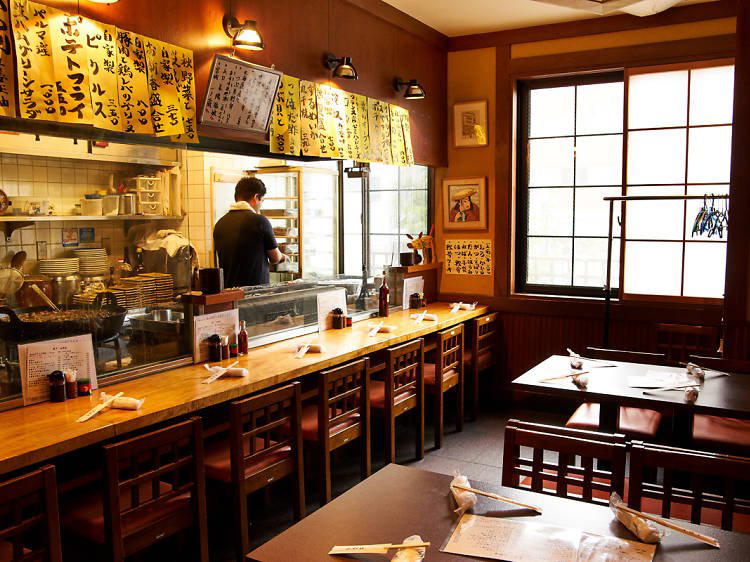
A Workshop Turned Dining Room in Shirokane
Tokyo's French restaurant scene has always been layered. At the leading sit the grand-format addresses, multi-starred rooms like L'Effervescence and Sézanne where the budget per head climbs steeply and the ceremony is part of the proposition. Below that, a second tier has been quietly expanding: French restaurants that treat classical technique as infrastructure rather than spectacle, using it to support cooking that draws from wider culinary sources. Alternative, in the Shirokane district of Minato City, occupies that second tier with something to prove.
The room itself sets the tone before a single dish arrives. The building formerly housed a neighbourhood workshop, functional, low-ceiling, built for craft rather than display. That industrial past is still visible in the bones of the space, and the contrast with the precision of what arrives on the plate is one of the more interesting tensions in the dining experience. Shirokane is a quiet residential address, a significant step away from the dining-district concentration of Ginza or Roppongi, and reaching it requires purpose. The restaurant occupies the ground floor of the T-building on a side street in 5 Chome, with service running Tuesday through Saturday for both lunch (noon to 2pm) and dinner (6 to 10:30pm). Monday carries the same hours. Sunday the kitchen closes entirely.
What the Name Signals About the Cooking
The word Alternative functions as a declaration of method. In rock music, the term describes material that resists categorical placement, not because it lacks rigour, but because its sources are too varied to resolve into a single genre. Chef Takayuki Saito applied the same logic to his kitchen after a period working in France, where Gallic cuisine showed him how much freedom a strong classical framework could accommodate. The restaurant's name was chosen to reflect that: French theory and technique as the foundation, Japanese and Chinese culinary traditions as the material that shapes what gets built on leading.
That cross-referencing approach places Alternative inside a broader pattern visible across Tokyo's more interesting mid-tier French rooms. Addresses like Florilège and ESqUISSE have each developed distinct relationships between French and Japanese culinary logic, and the question for any kitchen working in that space is whether the synthesis feels considered or merely fashionable. At Alternative, the intent is structural, the classical French framework is not ornamental, and the Japanese and Chinese elements are not garnish. Whether any individual dish resolves that balance is for the diner to assess, but the conceptual architecture is coherent.
The Evolution of a Mid-Tier French Address
Alternative's trajectory in recognition reflects the slow accumulation that characterises the better independent rooms in Tokyo. The restaurant first appeared in the Opinionated About Dining rankings in 2023 as a recommended address, a signal that it had registered with the kind of repeat, high-frequency diners whose opinions carry weight in that index. By 2024, a Michelin Plate followed, confirming the consistency that earlier OAD recognition had indicated. The 2025 cycle retained both signals: a Michelin Plate and an OAD ranking of #615 in Japan, a country where the ranked list is long and competitive enough that placement at any position represents a real credential.
That upward movement over a three-year window is the pattern of a kitchen that has been refining rather than repositioning. The cooking has not pivoted toward a different audience or a different format, it has deepened. For Tokyo's French scene, that kind of incremental recognition is meaningful. The best of that scene, anchored by rooms like Château Restaurant Joël Robuchon at the grand-institution end, applies pressure downward that tends to push mid-tier restaurants toward either greater specialisation or greater accessibility. Alternative has moved toward the former.
Where It Sits in the Competitive Field
Pricing at Alternative sits at ¥¥¥, which places it below the ¥¥¥¥ bracket occupied by the city's starred French rooms. That pricing tier in Tokyo tends to attract a specific kind of diner: knowledgeable enough to recognise technical cooking, willing to travel to an off-pitch neighbourhood for the right meal, less interested in the formal ceremony of the grand-dining format.
For context within Japan's wider French scene, the relevant comparisons are not just within Tokyo. HAJIME in Osaka and akordu in Nara represent different points on the same spectrum of European technique filtered through Japanese culinary sensibility. Outside Japan, the tradition that Alternative draws from has deep roots in kitchens like Hotel de Ville Crissier in Crissier and Les Amis in Singapore, both of which demonstrate how rigorous French classical training can sustain significant independent expression over time.
Planning a Visit
Shirokane is accessible via the Tokyo Metro Namboku Line (Shirokanedai station), and the address on 5 Chome puts it within a short walk of the station. The restaurant runs a full six-day week of service, lunch and dinner Monday through Saturday, which makes scheduling more flexible than many comparable addresses in the city. For dinner, arriving at the 6pm service start allows the full duration of the kitchen's programme without pressure from the 10:30pm close. Reservations are advisable given the size of the converted space; walk-in availability at this tier and with this level of recognition is unlikely on most evenings.
For a broader sense of where Alternative fits within Tokyo's dining field, our full Tokyo restaurants guide covers the range from grand-format starred rooms to neighbourhood-scale independents. The city's broader hospitality context, from accommodation to drinking and cultural experiences, is mapped across our full Tokyo hotels guide, our full Tokyo bars guide, our full Tokyo wineries guide, and our full Tokyo experiences guide. For travel beyond the capital, Gion Sasaki in Kyoto, Goh in Fukuoka, 1000 in Yokohama, and 6 in Okinawa each represent different registers of serious Japanese dining worth considering alongside a Tokyo itinerary.
Frequently asked questions
What price level is Alternative?
Pricing at Alternative is listed as ¥¥¥.
Nearby-ish Comparables
| Venue | Cuisine | Price | Awards | Notes |
|---|---|---|---|---|
| AlternativeThis venue (the venue you are viewing) | Modern French Fusion | $100–150 | Michelin Plate · Tabelog 100 #8 | Not listed |
| Harutaka | Edo-Style Omakase Sushi | $200–300 | 3 Michelin Stars · World's 50 Best #76 | Sushi |
| RyuGin | Modern Kaiseki | $500+ | 3 Michelin Stars · World's 50 Best #41 | Kaiseki, Japanese |
| L'Effervescence | Modern French with Japanese Influences | $200–300 | 3 Michelin Stars · World's 50 Best #69 | French |
| HOMMAGE | Modern French with Japanese Influences | $150–200 | 2 Michelin Stars · World's 50 Best #78 | Innovtive French, French |
| MAZ | Innovative Peruvian-Japanese Fusion | $150–200 | 2 Michelin Stars · World's 50 Best #28 | Innovative |
Recognition history
Dated appearances from independent guides and award organizations, with the underlying list record or original source where available.
Michelin Plate
Michelin
Opinionated About Dining Top Restaurants in Japan Recommended
Opinionated About Dining
Tabelog 100 #8 · No. 8
Tabelog · Tabelog 100 - French - TOKYO - 2025
Full recognition history (7 entries)
Michelin Plate
Michelin
Opinionated About Dining Top Restaurants in Japan Ranked #615
Opinionated About Dining
Michelin Plate
Michelin
Opinionated About Dining Top Restaurants in Japan Recommended
Opinionated About Dining
Continue exploring
More in Tokyo
Restaurants in Tokyo
All restaurants in Tokyo →



Bars in Tokyo
All bars in Tokyo →






Details
- Sophisticated
- Minimalist
- Date Night
- Special Occasion
- Chefs Counter
- Extensive Wine List
- Sommelier Led
- Tasting Menu
- Vegetarian Friendly
Current opening hours
- Monday
- 12–2 p.m., 6–10:30 p.m.
- Tuesday
- 12–2 p.m., 6–10:30 p.m.
- Wednesday
- 12–2 p.m., 6–10:30 p.m.
- Thursday
- 12–2 p.m., 6–10:30 p.m.
- Friday
- 12–2 p.m., 6–10:30 p.m.
- Saturday
- 12–2 p.m., 6–10:30 p.m.
- Sunday
- Closed
Hours can change for holidays and private events. Hours as of .
Relaxing, stylish urban hideout with spacious seating, counter, and intimate atmosphere in a former workshop space.