Our verdict
Located in Osaka's Kita Ward, U.KAI occupies basement space in Sonezakishinchi, one of the city's most concentrated blocks for serious dining. The address places it squarely within Osaka's competitive mid-to-upper tier, where the wine list and beverage program often carry as much weight as the kitchen. For visitors planning a meal in this district, advance reconnaissance on availability is advisable.

Pearl is the En Primeur Club membership app, where members save venues, book tables and use the concierge.
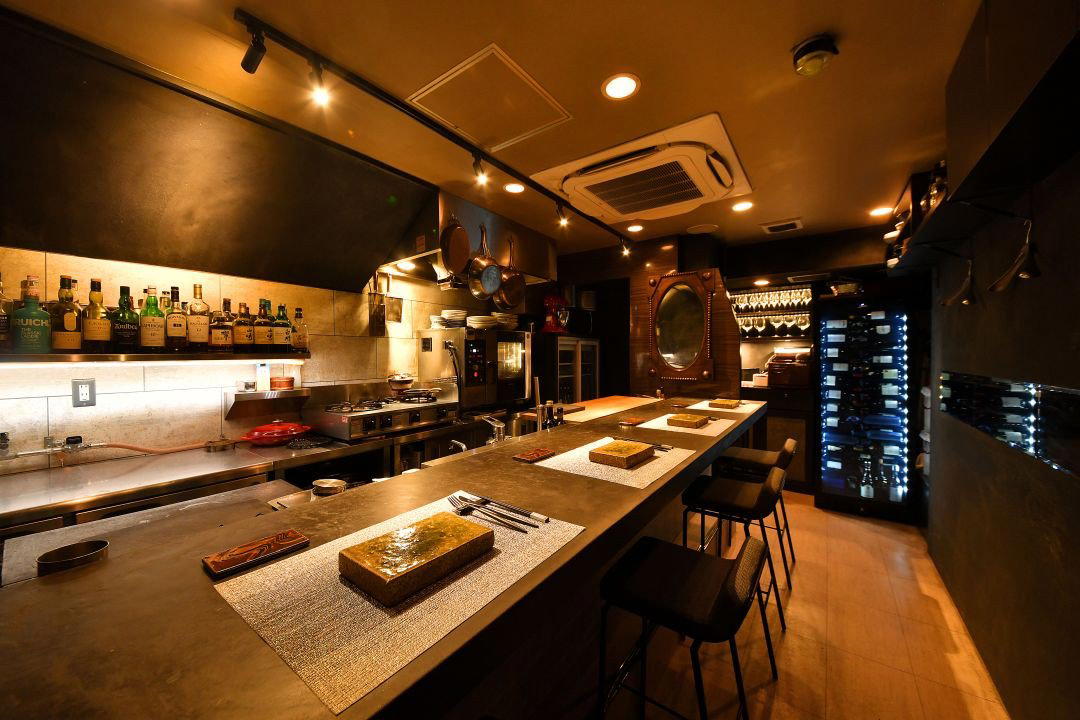
The menu
What to order
- Wagyu fillet cutlet roll
- Clay pot rice
- Wagyu steak
Sonezakishinchi and the Basement Dining Tier
Osaka's Kita Ward has developed a particular dining typology over the past two decades: serious restaurants operating below street level, where the absence of signage and natural light is compensated by focus. Sonezakishinchi, the entertainment and dining quarter that runs north of Umeda, concentrates a disproportionate number of these below-grade rooms. The logic is partly real estate, partly atmospheric. A basement removes distractions, narrows the field of attention, and creates the kind of stillness that precision cooking and considered wine service both require. U.KAI, located in the B1F of a building at 1-1-41 Sonezakishinchi, fits this pattern. The address is not incidental, it places the restaurant inside a neighbourhood that takes its dining seriously and expects its guests to do the same.
The Wine List as Organizing Principle
In Osaka's upper dining tier, the wine list has become a credibility document. A decade ago, the dominant expectation was sake or shochu alongside Japanese cuisine, or a token European selection alongside Western-inflected cooking. That boundary has dissolved. The restaurants in Sonezakishinchi and the broader Kita Ward that have sustained reputations into the mid-2020s tend to carry wine programs with genuine depth, not simply broad coverage by country and varietal, but evidence of a curation philosophy.
For a basement dining room like U.KAI, the wine program is especially load-bearing. Without the visual drama of a view or an architectural gesture, the room's identity is carried by what arrives at the table. A wine list with range and intellectual backbone functions as both a draw for serious drinkers and a signal to first-time visitors about the register of the meal they should expect. For context, restaurants operating at this level in comparable Japanese cities, consider Harutaka in Tokyo or Gion Sasaki in Kyoto, treat the beverage program as inseparable from the kitchen's ambitions. The same expectation applies in this district.
Osaka's Drinking Culture and the Sommelier Role
Osaka has a food culture that prizes directness and value, which occasionally creates friction with the slower, more ceremonial approach of formal wine service. The restaurants that have resolved this tension most successfully tend to employ sommeliers who can read the table, knowing when to offer guidance and when to step back, rather than defaulting to script. The Kita Ward dining circuit has produced a cohort of floor professionals who have absorbed this lesson. The leading wine service in this part of the city functions as a conversation, not a presentation.
This matters for how visitors should approach a meal at a venue like U.KAI. The decision about how much to engage with the wine program is genuine: the list likely rewards visitors who arrive with a point of view, but should not penalise those who want a single well-chosen glass per course. In both cases, the sommelier's ability to calibrate is the relevant variable. For those planning a more extended beverage experience, arriving with some familiarity with the regional and international producers the restaurant might carry is a reasonable preparation, particularly if the cuisine draws on Japanese technique where sake pairings remain an equally legitimate option alongside wine.
Placing U.KAI in Osaka's Broader Scene
Osaka's restaurant scene in 2024 and 2025 has been defined by a bifurcation: on one side, the internationally visible tier anchored by venues like HAJIME in Osaka, which operates at the level of global fine dining conversation; on the other, a denser mid-tier of serious rooms that serve Osaka's own professional and food-literate population without courting international press. U.KAI sits closer to the second category. Sonezakishinchi is a local circuit, known to regulars, less frequently visited by tourists whose Osaka itinerary is organised around the obvious anchors of Dotonbori and Namba.
For comparison within the immediate district, Ajihei Sonezaki and Ajikitcho Bunbuan represent the kaiseki strand of the neighbourhood's offering, long-established, format-disciplined, rooted in seasonal Japanese progression. Aka to Shiro, Az, and Calendrier each represent a different angle on the Western-Japanese cooking conversation that Kita Ward has been having for the better part of fifteen years. U.KAI occupies its own position within this set, though the specifics of its cuisine type and format are best confirmed directly before booking, given the limited publicly available detail.
Further afield, for readers building a Japan itinerary around this calibre of dining, the Kansai circuit extends naturally to akordu in Nara, and the national grid connects to venues like Goh in Fukuoka, 一本杉 川島酒造 in Nanao, and 夕佳亭山乃 in Sapporo, each operating within the same general tier of considered, locally-rooted dining that characterises U.KAI's neighbourhood context. For those interested in how Japanese restaurant culture connects to international fine dining reference points, Le Bernardin in New York City and Atomix in New York City represent the closest Western analogues for technique-forward, beverage-serious dining of this register. Regional comparisons within Japan also extend to 琵琶荘 in Takashima and 庭羽屋 in Nishikawa Machi, both of which operate within the broader Kansai dining network. Birdland in Sakai rounds out the regional picture for those exploring the greater Osaka metropolitan dining circuit.
Planning a Visit
Sonezakishinchi operates as a walkable evening district, most accessible from Higashi-Umeda or Nishi-Umeda stations on the Osaka Metro network, both within a few minutes on foot. The neighbourhood is dense with restaurants and bars, so arriving with a confirmed reservation rather than browsing on the night is the practical default. Given that venue-specific booking details for U. For a broader orientation to the city's dining options across price tiers and cuisines, the full Osaka Shi restaurants guide provides the necessary context.
Frequently asked questions
Where do I go for U.KAI?
U.KAI is located at Japan, 〒530-0002 Osaka, Kita Ward, Sonezakishinchi, 1 Chome−1, 曽æ ¹崎新地1-1-41ジロービルB1F, Osaka Shi.
How does U.KAI's location below street level in Sonezakishinchi affect the dining experience?
U.KAI operates from basement level at 1-1-41 Sonezakishinchi, Kita Ward, an address pattern that in Osaka's dining culture has come to signal deliberate separation from the street-level foot traffic of the surrounding entertainment district. The Sonezakishinchi basement format typically produces an enclosed, acoustically controlled room where the focus shifts entirely to the counter and the plate. Both Higashi-Umeda and Nishi-Umeda stations on the Osaka Metro network are within walking distance, making access straightforward despite the below-grade setting.
What should I order at U.KAI?
Specific menu details for U. Given its placement in Sonezakishinchi's serious basement dining tier, the kitchen likely operates within Osaka's broader premium counter format, a setting where the chef's selection typically drives the meal rather than à la carte ordering. Confirm the current menu structure directly with the venue before visiting.
Should I book U.KAI in advance?
Sonezakishinchi's basement restaurants in Osaka's Kita Ward consistently fill on weekends and during the city's busier dining seasons. U.KAI's position in this tier suggests walk-ins carry real risk, particularly Thursday through Saturday. Advance reservation is the practical approach; contact details are best sourced via a current Japanese dining platform such as Tableall or Omakase.
What's the defining dish or idea at U.KAI?
The body content positions U.KAI within Osaka's upper dining tier, where the wine list functions as an organizing editorial document and the sommelier role carries genuine weight alongside the kitchen. That pairing orientation, wine-led, counter-format, below street level, appears to be the venue's structural identity rather than any single dish.
Is U.KAI allergy-friendly?
No allergy policy or dietary accommodation details are publicly documented for U.KAI. Restaurants operating at this level in Osaka's Kita Ward frequently handle dietary requirements on a case-by-case basis when notified at the time of booking. Communicate any requirements directly and clearly when making your reservation.
Does U.KAI justify its prices?
No price range for U.KAI is currently documented in public editorial sources. Sonezakishinchi's serious basement dining venues generally sit in Osaka's upper spend bracket, where value is measured against kitchen precision and the quality of the wine programme rather than portion size. Cross-reference current pricing via a Japanese reservation platform before committing.
At-a-Glance Comparison
Comparable venues nearby, for context on price, style, and recognition.
| Venue | Cuisine | Price | Awards | Notes |
|---|---|---|---|---|
| U.KAIThis venue (the venue you are viewing) | Modern Italian-Japanese Fusion Steak Omakase | $100–150 | Not listed | Not listed |
| カピ | Innovative Fusion Omakase | $200–300 | 1 Michelin Star · Tabelog 100 #25 | Kita |
| 奈良きみや -別邸柘榴(ざくろ)- | Premium Yakiniku - Filet Specialist | $200–300 | Tabelog 100 #47 | Kita |
| アドック | Modern French with Japanese Sensibilities | $150–200 | 1 Michelin Star · Tabelog Bronze #5 | Fukushima |
| Presqu'île | Modern French with Japanese Influences | $200–300 | 1 Michelin Star · Tabelog 100 #85 | Chūō |
| 靱本町がく | Modern Kappo | $150–200 | Michelin Plate · Star Wine List | Nishi |
Continue exploring
More in Osaka
Restaurants in Osaka
All restaurants in Osaka →
Bars in Osaka
All bars in Osaka →
Hotels in Osaka
All hotels in Osaka →
Wineries in Osaka
Browse all →
Details
- Sophisticated
- Elegant
- Intimate
- Special Occasion
- Date Night
- Chefs Counter
- Sake Program
- Extensive Wine List
- Local Sourcing
- Omakase
- Wine
- Sake
Current opening hours
- Monday
- 6–11:30 PM
- Tuesday
- 6–11:30 PM
- Wednesday
- 6–11:30 PM
- Thursday
- 6–11:30 PM
- Friday
- 6–11:30 PM
- Saturday
- 5–10:30 PM
- Sunday
- Closed
Hours can change for holidays and private events. Hours as of .
Sophisticated and intimate counter seating with a focus on the chef's craft, creating an elegant and personal dining atmosphere.