2 Michelin Stars · Tabelog Bronze #152
Our verdict
Open since August 1971, KAHALA in Osaka's Kitashinchi district holds two Michelin stars and consecutive Tabelog Awards across nearly a decade, with chef Yoshifumi Mori building an innovative Japanese creative menu around rigorously sourced domestic ingredients and a declared focus on fish. The eight-seat counter operates dinner-only in two seatings, with reservations opening three months ahead and average per-person spend in the JPY 50,000–59,999 range.

Pearl is the En Primeur Club membership app, where members save venues, book tables and use the concierge.
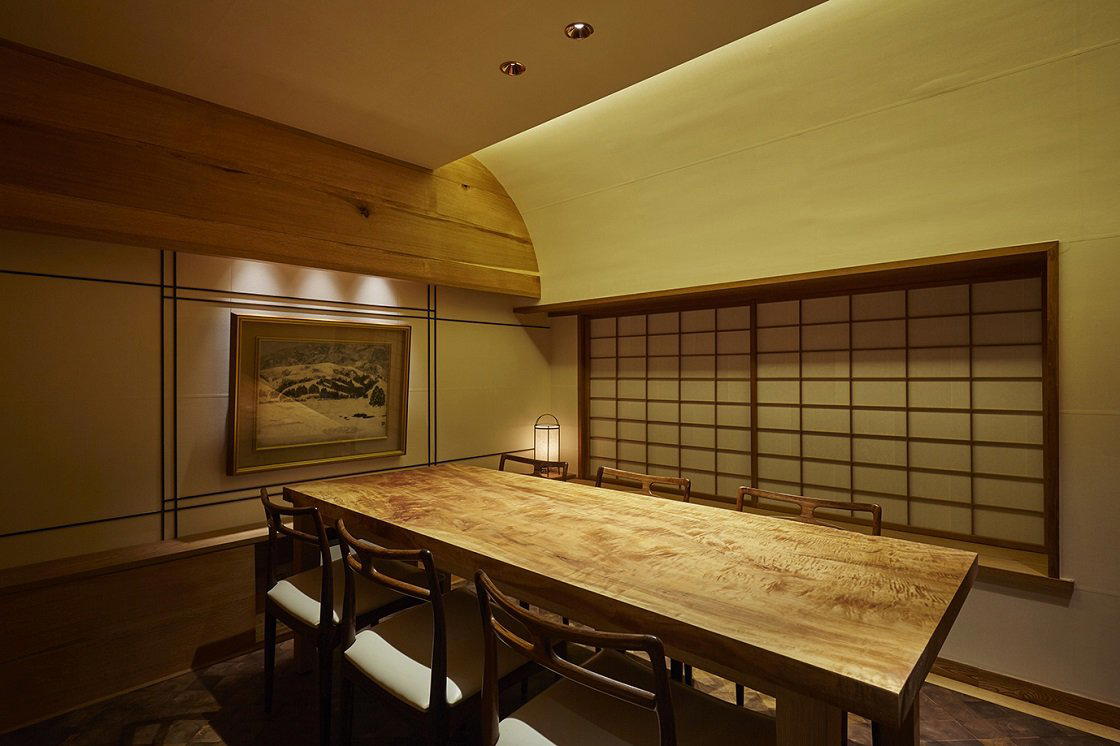
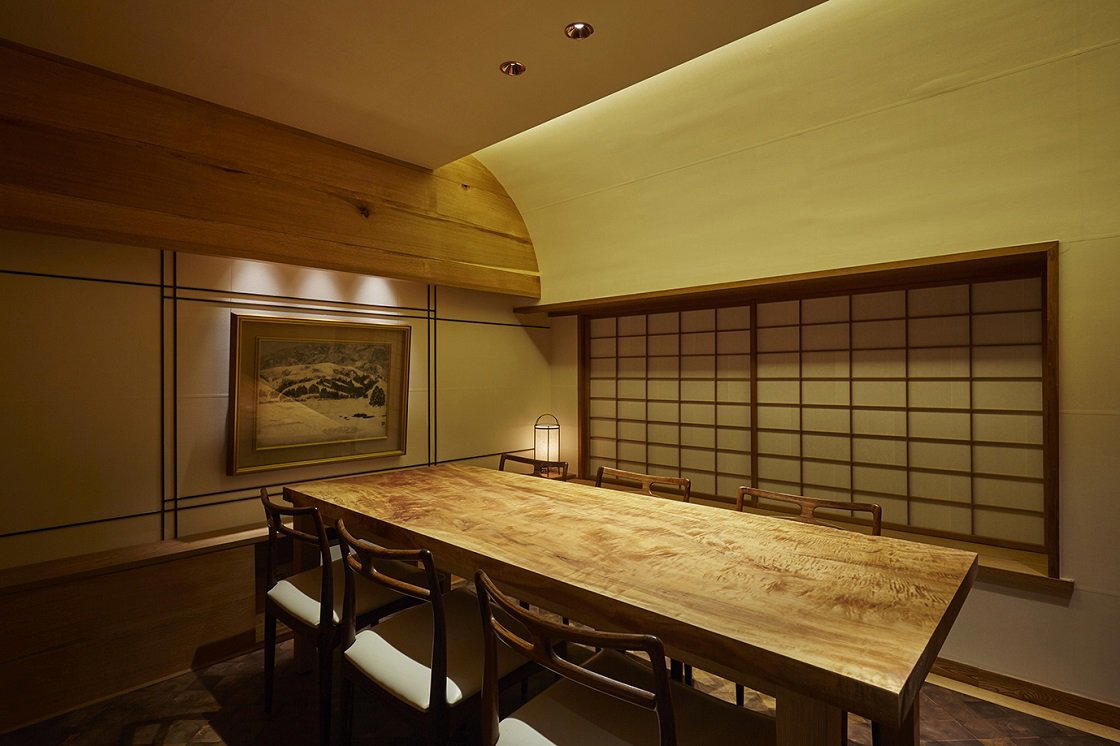
The second floor of a low-rise building on Sonezakishinchi's main artery gives little away. There is no signage visible from the street that signals ceremony, no queue marking territory on the pavement. What greets you inside is an eight-seat hinoki counter, the quiet of a room built around proximity between cook and guest, and a dining format that has remained almost unchanged in its bones since the restaurant opened on the 16th of August, 1971. In Kitashinchi, Osaka's most concentrated district for serious dining, this kind of restraint reads as confidence.
Kitashinchi and the Creative Cuisine Tier
Osaka's fine dining scene has organised itself around two geographic nodes: Kitashinchi to the north, with its dense network of counter restaurants running from kaiseki to contemporary creative formats, and Namba to the south, where the city's more casual register plays out. The highest-spending tier of Kitashinchi operates at JPY 40,000 and above per person, a bracket that in 2025 includes a small cluster of Michelin-starred creative counters sitting alongside long-standing kaiseki houses.
Within this peer group, KAHALA is one of the older operating creative restaurants in Osaka, and its award trajectory across Tabelog tells a specific story. The restaurant held Tabelog Silver from 2017 through 2021 before transitioning to Bronze from 2022 onward, a shift that coincides with changes in how Tabelog calibrated its upper tier. Its current Tabelog score of 4.26 and inclusion in the Tabelog Innovative/Creative Cuisine 100 for 2025 position it comfortably inside the top tier of the city's creative cuisine category, alongside neighbours such as Fujiya 1935 and capi.
The Michelin two-star designation, held in both 2024 and 2025, places KAHALA in the same star bracket as La Cime and Fujiya 1935 in Osaka, and below only HAJIME, which holds three. Among Osaka's innovative category, KAHALA's longevity sets it apart from its peers: most of the restaurants in this tier have opened within the last fifteen years, while KAHALA has been building its record since 1971.
The Language of Japanese Creative Cuisine
This distinction matters when placing the restaurant in the context of how creative cuisine has developed in Japan. Osaka and Kyoto represent the densest concentration of multi-generational creative dining outside Tokyo, and the tradition that shapes KAHALA is one that sees ingredient sourcing as the central act of creative cooking, with technique in service of material rather than the reverse. The Ministry of Agriculture, Forestry and Fisheries has formally recognised chef Yoshifumi Mori's contribution in this area, a credential that speaks to the institutional weight placed on domestic ingredient development in Japanese food culture.
The approach extends beyond the kitchen: Mori has engaged with wine production and rice cultivation as part of the restaurant's ingredient sourcing practice, a model that is increasingly visible among Japan's leading independent creative restaurants. Gion Sasaki in Kyoto and akordu in Nara represent different regional expressions of this same orientation, where the chef's role extends into the supply chain rather than stopping at the kitchen pass.
Format, Scale, and the Counter Discipline
Eight seats. Two seatings per evening, starting at 18:00 and 20:40 respectively. Dinner only. Closed Sundays, Thursdays, and public holidays. These parameters define the operational character of KAHALA as clearly as any critical description. The format places the restaurant in the same disciplined counter tier as some of Japan's most demanding bookings, where small capacity and fixed-time seatings are structural commitments rather than marketing choices.
At this scale, every seat at the counter is within direct reach of the kitchen, and the chef's presence is a constant rather than an occasional appearance. This format has a specific cultural logic in Japanese counter dining: the counter is not a casual bar arrangement but a space where the sequence of service unfolds with the same precision as a performance, and where the eight-person capacity creates an intimacy that influences pacing, temperature, and the conversation that sometimes accompanies the meal. Comparable counter disciplines in other Japanese cities include Harutaka in Tokyo and Goh in Fukuoka, each operating within similarly tight parameters.
Reservations open three months in advance, and the dinner course runs in the JPY 50,000–59,999 range before a 10% service charge. For context against the broader Osaka creative tier: this places KAHALA at the top of the city's innovative dining band, pricing in line with or above two-Michelin-star peers. The restaurant's longevity at this price point, more than fifty years in operation, suggests a sustained audience rather than a speculative positioning.
Opinionated About Dining Rankings and What They Signal
KAHALA's performance on Opinionated About Dining, Japan's most data-intensive independent restaurant ranking compiled from critic and senior-diner votes, provides a useful supplement to Michelin and Tabelog data. The restaurant ranked 80th in Japan in 2023, 88th in 2024, and 114th in 2025, tracking a modest downward movement in rank across three consecutive years. This is worth noting without over-reading: OAD rankings reflect a voter pool with particular aesthetic preferences, and a restaurant operating in the Japanese creative tradition rather than French fine dining does not always translate uniformly across that electorate.
Taken together, the award record from 2017 onward, spanning Tabelog Silver, Tabelog Bronze, Michelin two stars, and consistent OAD top-150 placement, describes a restaurant with deep institutional standing in the Osaka creative scene rather than one defined by recent momentum. That is a different kind of argument for a booking, and for certain diners, the more persuasive one.
Osaka's Creative Dining in a National and Regional Context
Japan's innovative cuisine tier operates in several cities simultaneously, and each carries distinct character. Tokyo's creative restaurants, including MAZ, tend toward international influence and global ingredient sourcing. Fukuoka's Goh works within Kyushu's regional produce identity. Yokohama's 1000 and Okinawa's 6 demonstrate how locally-rooted ingredient logic varies across Japan's geography. Seoul's alla prima reflects how the Korean creative tier has begun developing its own counter-format discipline.
Osaka's contribution to this network is partly historical. The city's food identity, built over centuries on market culture, merchant-class eating, and a tradition that values ingredient quality over visual elaboration, provided conditions for creative cuisine to develop differently here than in Tokyo. KAHALA, open since 1971, predates the contemporary innovative dining category by a considerable margin and can reasonably be read as one of the formative addresses in what that category became.
For a fuller account of what Osaka's restaurant scene now offers across formats, see our full Osaka restaurants guide. For planning the wider trip, our full Osaka hotels guide, our full Osaka bars guide, our full Osaka wineries guide, and our full Osaka experiences guide cover the rest of the city.
Know Before You Go
- Address: 1-9-2 Sonezakishinchi, Kita Ward, Osaka (Kishimoto Building, 2F)
- Nearest station: Kitashinchi Station (JR Tozai Line), approximately 311 metres
- Dinner price range: JPY 50,000–59,999 per person, plus 10% service charge
- Seats: 8 (counter only)
- Seatings: 18:00 and 20:40; entry begins 10 minutes before each seating
- Reservations: Accepted from three months in advance; lunch is not currently served
- Closed: Sundays, Thursdays, and public holidays
- Payment: Major credit cards accepted (VISA, Mastercard, JCB, AMEX, Diners); electronic money and QR code payments not accepted
- Drinks: Sake (nihonshu), wine; wine is a program focus
- Smoking: Non-smoking throughout
- Private rooms: Not available; full private hire of the restaurant is available
- Family: High school students and above only, on the adult course
- Parking:
- Awards: Michelin 2 Stars (2024, 2025); Tabelog Bronze 2022–2026; Tabelog Silver 2017–2021; Tabelog Innovative/Creative Cuisine 100 (2025); OAD Leading Restaurants in Japan #114 (2025)
Frequently asked questions
What's the price range at KAHALA?
Pricing at KAHALA is listed as ¥¥¥¥.
What distinctions does KAHALA have?
KAHALA has received recognition including:
What dish is KAHALA famous for?
KAHALA does not publicise a single signature dish. The menu responds to seasonal availability and Yoshifumi Mori's ongoing search for lesser-known Japanese ingredients, a practice the Ministry of Agriculture, Forestry and Fisheries has formally recognised. The kitchen holds a particular emphasis on fish, which runs as a consistent thread across the counter's creative format, priced at JPY 50,000–59,999 per person for dinner.
What should I expect cuisine-wise at KAHALA?
Reputation First
Comparable venues nearby, for context on price, style, and recognition.
| Venue | Cuisine | Price | Awards | Notes |
|---|---|---|---|---|
| KAHALAThis venue (the venue you are viewing) | Creative Kaiseki Fusion | $300–500 | 2 Michelin Stars · Tabelog Bronze #152 | Not listed |
| Miyamoto | Michelin-Starred Kaiseki | $200–300 | 2 Michelin Stars · La Liste Top Restaurants | Kita |
| Tenjimbashi Aoki | Michelin-Starred Kaiseki | $200–300 | 2 Michelin Stars | Kita |
| Oimatsu Hisano | Modern Seasonal Kaiseki Omakase | $200–300 | 2 Michelin Stars | Chūō |
| Teruya | Luxury Japanese À La Carte | $100–150 | 2 Michelin Stars | Chūō |
| Shunsaiten Tsuchiya | Tempura & Kaiseki | Not listed | 2 Michelin Stars · Tabelog Bronze #482 | Not listed |
Recognition history
Dated appearances from independent guides and award organizations, with the underlying list record or original source where available.
Michelin 2 Stars
Michelin
Opinionated About Dining Top Restaurants in Japan Ranked #137
Opinionated About Dining
Tabelog Bronze #152
Tabelog
Full recognition history (10 entries)
Michelin 2 Stars
Michelin
Opinionated About Dining Top Restaurants in Japan Ranked #114
Opinionated About Dining
Tabelog Bronze
Tabelog
Tabelog 100 #37 · No. 37
Tabelog · Tabelog 100 - Innovative / Creative cuisine - 2025
Michelin 2 Stars
Michelin
Opinionated About Dining Top Restaurants in Japan Ranked #88
Opinionated About Dining
Opinionated About Dining Top Restaurants in Japan Ranked #80
Opinionated About Dining