
Michelin Plate
Our verdict
Jimbocho Gokita occupies a first-floor space in Chiyoda's bookshop district, where chef Yuto Gokita applies French sauce technique to the yakitori format. Madeira reductions, red-wine jus built from chicken bones and calf broth, and herb butter in the Bourgogne style replace the conventional tare. The set menu, which requires advance reservation, includes wood-grilled pigeon alongside skewers of chicken and shrimp. Michelin Plate recognition in both 2024 and 2025.

Pearl is the En Primeur Club membership app, where members save venues, book tables and use the concierge.
The menu
What to order
- Wood-grilled_pigeon
- Chicken_breast_skewers
- Tsukune_with_herb_butter
Jimbocho, the Street, and the Counter
Nishikanda's Jimbocho quarter is most legible as a district through its bookshops: dense, specialist, and indifferent to passing trends. The neighbourhood's restaurant culture follows a similar logic. Dining here tends to be deliberate rather than spontaneous, with a higher proportion of reservation-only counters and format-specific kitchens than you find in, say, Ebisu or Nakameguro. Jimbocho Gokita, tucked into the first floor of a low-rise building at 2 Chome-4-9 Nishikanda, reads exactly like the neighbourhood that surrounds it: a specific argument, made quietly, for a particular way of eating grilled chicken.
The broader yakitori category in Tokyo operates across a wide range of registers, from high-volume standing counters in train-station underpasses to Michelin-recognised set-menu formats where every skewer is a considered piece of cooking. Gokita sits near the latter end of that range, but its distinguishing move is not simply refinement of convention. The kitchen imports a French sauce vocabulary into the yakitori structure, and the result sits in a small, genuinely distinct subset of Tokyo's grilled-bird tradition. For context on the wider yakitori scene across the city, Yakitori Omino and Asagaya BIRD LAND represent different points on the same spectrum, the former leaning into craft-counter precision, the latter rooted in a more classical Asagaya idiom.
The French Sauce Argument
The standard yakitori service organises itself around tare, the soy-mirin-sake reduction that accumulates complexity through repeated dipping over the course of a grill's life. It is one of the oldest condiment traditions in Japanese cooking, and most yakitori counters treat it as a fixed point around which everything else pivots. Chef Yuto Gokita removes that fixed point entirely.
In its place, the kitchen prepares Madeira and red-wine sauces built from chicken bones and calf broth, the architecture of French classical sauce-making applied to material that is, in this room, being charred over wood. Skewers of chicken breast and shrimp arrive smothered in crustacean-inflected sauces. Chicken meatball skewers are finished with herb butter calibrated toward a Bourgogne profile. The logic is consistent: French technique serves as the saucing system, while the grill and the skewer format remain intact as the structural frame.
This is not a hybrid cuisine in the fusion sense of the term. Fusion implies a splitting of loyalty; what Gokita does is more like a technical substitution within an otherwise coherent yakitori grammar. The skewer is still the unit of service. The fire is still wood. The progression still follows a yakitori sequence. Only the sauce register has been replaced, and the replacement is thorough rather than decorative.
Tokyo has a handful of kitchens working at the intersection of French and Japanese technique, Aria di Takubo approaches that intersection from a different angle, and 124. KAGURAZAKA works in Kagurazaka's historically Francophile dining corridor, but none are doing it specifically through the yakitori format at this price tier. That specificity is what keeps Gokita's position in the market relatively isolated from direct competition.
Wood-Grilled Pigeon and the Set Menu Structure
The set menu is the correct way to approach this kitchen. It is the format for which reservations are required, and it includes wood-grilled pigeon alongside the chicken and shrimp skewers. Pigeon on a yakitori menu is significant: the bird demands a different heat management strategy than chicken, and its pairing with French sauce traditions is historically coherent in a way that makes the kitchen's synthesis feel less arbitrary and more considered.
The ¥¥¥ price tier places Gokita at a similar level to other Tokyo set-menu formats that sit below the four-symbol tier occupied by restaurants like Aramaki and the top-end kaiseki and sushi counters. For comparison, Den occupies the same ¥¥¥ bracket with two Michelin stars and an innovative Japanese format; Gokita's Michelin Plate recognition in 2024 and 2025 places it in the next recognition tier down, which at this price point and with this level of format specificity signals a kitchen that the guide is watching rather than a venue it has passed over.
Across Japan, the French-Japanese intersection shows up in very different forms by city. HAJIME in Osaka operates at the three-star level in a fully French idiom. Gion Sasaki in Kyoto works in kaiseki. akordu in Nara approaches European-Japanese technique from a different geography altogether. Gokita's version, French sauces, yakitori format, Chiyoda address, does not appear elsewhere in that national map at a directly comparable specification.
For further context on how the yakitori format extends beyond Tokyo, Ichimatsu in Osaka and Torisaki in Kyoto each show how grilled-bird traditions develop distinct regional characters outside the capital.
The Neighbourhood as Frame
Jimbocho rewards visitors who approach it as an itinerary rather than a single stop. The bookshop density along Yasukuni-dori and the surrounding streets means that an afternoon spent here before a dinner reservation at Gokita follows a recognisable pattern among the neighbourhood's regulars: browse, then eat, with both activities sharing a preference for the specialist over the generalist. The area does not attract the same concentration of international diners as Shinjuku or Ginza, which means the reservation environment at a counter like Gokita is shaped primarily by local and domestic demand rather than inbound tourism. For visitors, that shifts the planning calculation: booking lead times here are driven by local appetite for a specific format, not by hotel concierge traffic.
High satisfaction from a modest sample size, in this context, points to a kitchen that is serving a deliberate audience rather than a broad one.
Planning Your Visit
Reservations: Required for the set menu; book in advance given the limited capacity implied by the format. Budget: ¥¥¥ tier. Address: 2 Chome-4-9 Nishikanda, Chiyoda City, Tokyo, first floor of the Dai-Ni Kinsuiビル (second Kinsui Building). Getting there: Jimbocho Station (Toei Shinjuku, Toei Mita, and Tokyo Metro Hanzomon lines) is the natural access point for this address. Timing: Michelin Plate recognition has been maintained across 2024 and 2025, confirming current-year standing. Evenings only, consistent with set-menu format conventions at this tier.
For a broader picture of dining and staying in the capital, see our full Tokyo restaurants guide, our full Tokyo hotels guide, our full Tokyo bars guide, our full Tokyo wineries guide, and our full Tokyo experiences guide. For dining beyond the capital, Goh in Fukuoka, 1000 in Yokohama, and 6 in Okinawa each represent distinct regional formats worth knowing.
Frequently asked questions
What is Jimbocho Gokita known for?
What is the signature dish at Jimbocho Gokita?
How far ahead should I plan for Jimbocho Gokita?
Recognition Snapshot
| Venue | Cuisine | Price | Awards | Notes |
|---|---|---|---|---|
| Jimbocho GokitaThis venue (the venue you are viewing) | Yakitori with French Sauces | $200–300 | Michelin Plate | Not listed |
| Harutaka | Edo-Style Omakase Sushi | $200–300 | 3 Michelin Stars · World's 50 Best #76 | Sushi |
| RyuGin | Modern Kaiseki | $500+ | 3 Michelin Stars · World's 50 Best #41 | Kaiseki, Japanese |
| L'Effervescence | Modern French with Japanese Influences | $200–300 | 3 Michelin Stars · World's 50 Best #69 | French |
| HOMMAGE | Modern French with Japanese Influences | $150–200 | 2 Michelin Stars · World's 50 Best #78 | Innovtive French, French |
| MAZ | Innovative Peruvian-Japanese Fusion | $150–200 | 2 Michelin Stars · World's 50 Best #28 | Innovative |
Recognition history
Dated appearances from independent guides and award organizations, with the underlying list record or original source where available.
Michelin Plate
Michelin
Full recognition history (3 entries)
Michelin Plate
Michelin
Michelin Plate
Michelin
Continue exploring
More in Tokyo
Restaurants in Tokyo
All restaurants in Tokyo →


Bars in Tokyo
All bars in Tokyo →




Details
- Intimate
- Elegant
- Sophisticated
- Minimalist
- Date Night
- Special Occasion
- Business Dinner
- Chefs Counter
- Open Kitchen
- Private Dining
- Extensive Wine List
- Sake Program
- Sommelier Led
- Local Sourcing
- Prix Fixe
- Counter Dining
- Wine
- Sake
Current opening hours
- Monday
- 5:30–11 PM
- Tuesday
- 5:30–11 PM
- Wednesday
- 5:30–11 PM
- Thursday
- 5:30–11 PM
- Friday
- 5:30–11 PM
- Saturday
- 5:30–11 PM
- Sunday
- 5:30–10 PM
Hours can change for holidays and private events. Hours as of .
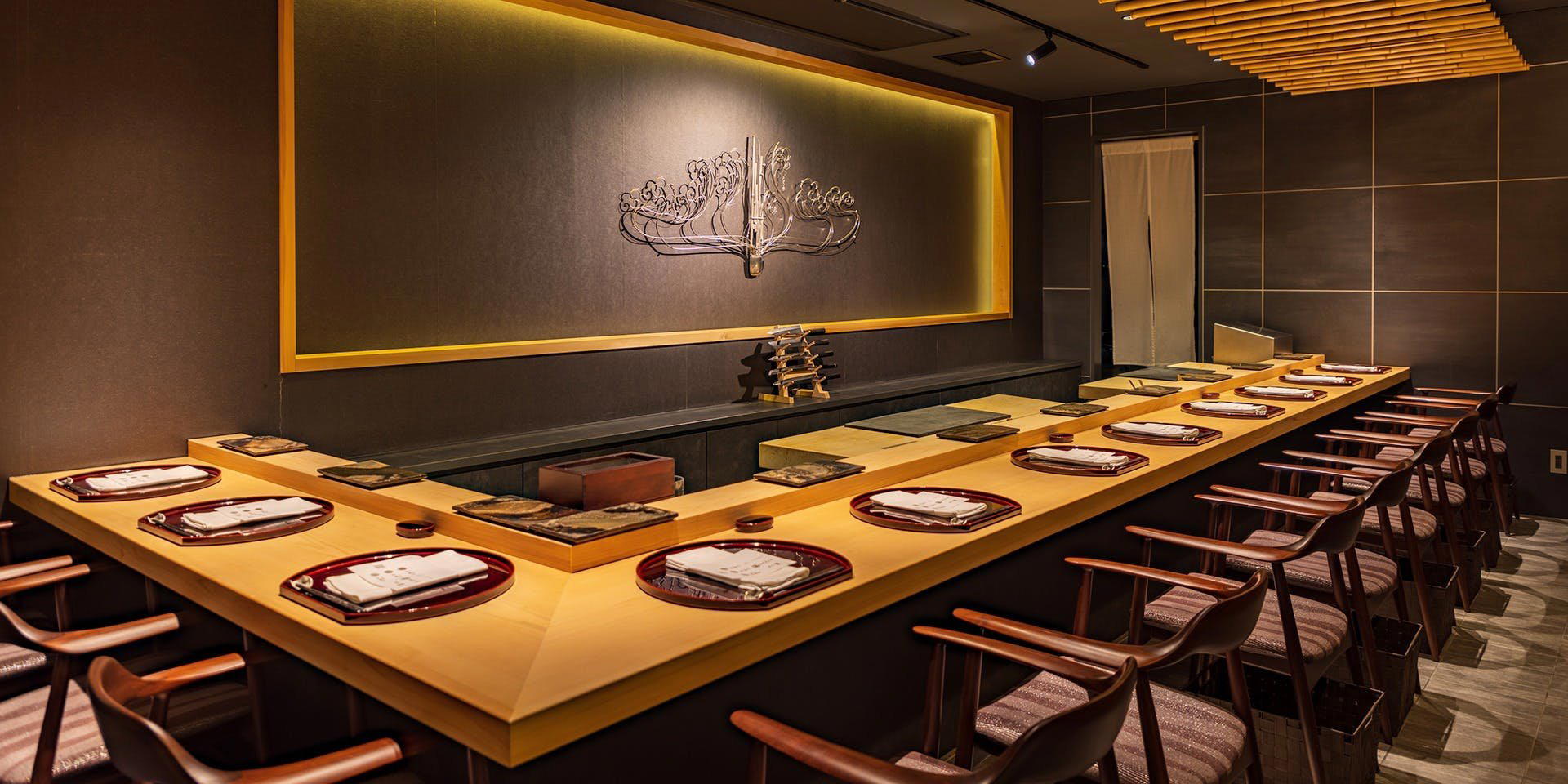
Minimalist counter with warm wooden interior and binchotan glow, creating a calm, elegant, and cozy atmosphere.