

Iwaki holds a Michelin star in Osaka's Sonezakishinchi district, where Chef Yoshiro Iwai applies kappo technique without a fixed menu, each service moves forward, never repeating past dishes. Hamo deboned to silken plumpness and eel salt-grilled rather than lacquered in tare signal the kitchen's commitment to rethinking received wisdom. At the ¥¥¥ price tier, it represents serious cooking without the ceiling-tier tariff of Osaka's three-star houses.
Pearl is the En Primeur Club membership app — saves, bookings, and concierge access live there. Same editors, same standards.
- Address
- Japan, 〒530-0002 Osaka, Kita Ward, Sonezakishinchi, 1 Chome−6−29 宝ビル 2F 割烹いわき
- Phone
- +81 6-6345-1108
- Website
- k-iwaki.com
- Directions
- Get directions
 Saves & bookings on Pearl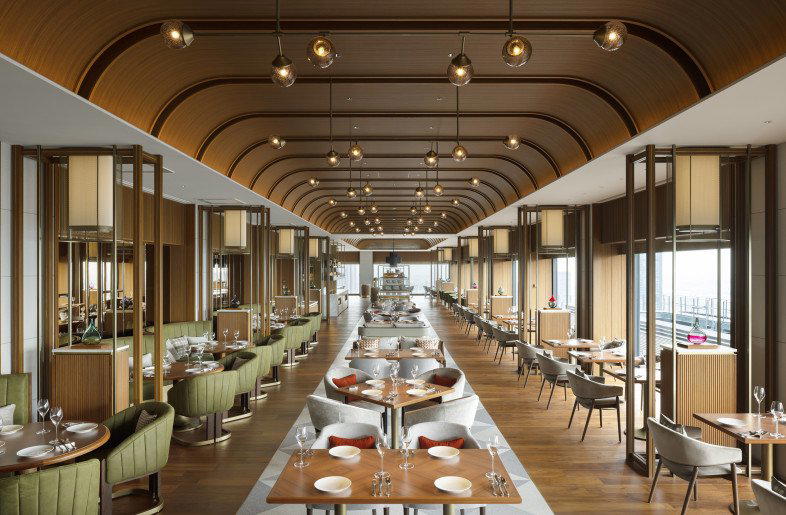
A Counter Where the Menu Expires After Each Service
Sonezakishinchi, the dense grid of hostess bars, izakayas, and specialist restaurants in Osaka's Kita Ward, is not where you expect to find a kitchen that treats repetition as a form of failure. The building is ordinary, a mid-century commercial block, second floor, no fanfare at street level. What happens inside is the opposite of ordinary. Iwaki operates without a standing menu. Chef Yoshiro Iwai has committed to a forward-only direction: dishes are created, served, and retired.
This is an unusual position inside even Osaka's highly competitive kappo and kaiseki scene. Osaka's most decorated rooms, including three-Michelin-star houses like Kashiwaya Osaka Senriyama and Taian, achieve their authority partly through refined mastery of established forms. Iwaki's single Michelin star reflects a different kind of discipline: the restraint required to keep reinventing rather than perfecting what already works.
What the Michelin Star Actually Represents Here
In the context of Japan's Michelin ecosystem, a single star carries specific meaning. It signals cooking worth a detour, which in a city as food-dense as Osaka is a meaningful distinction.
The ¥¥¥ price tier places Iwaki well below the ¥¥¥¥ ceiling occupied by Osaka's French-influenced innovators like Hajime (three Michelin stars) and La Cime (two Michelin stars). Against that context, Iwaki represents the more honest value case: Michelin-recognised Japanese cooking at a price point that doesn't require the kind of financial commitment those tasting-menu-format rooms demand. For readers already familiar with Miyamoto or Tenjimbashi Aoki, Iwaki sits within the same accessible-premium tier, serious technique, serious ingredients, without the top-floor tariff.
Technique, Tradition, and the Kitchen's Governing Logic
Iwai's training runs through two distinct traditions. Ryotei experience gave him the technical grounding of formal Japanese haute cuisine, where precision in cutting, seasoning, and presentation is non-negotiable. Kappo gave him something harder to teach: a responsiveness to the guest, a directness in cooking, and the confidence to work without the ceremony of kaiseki sequencing. Kappo as a format has always sat between the strictness of kaiseki and the relative informality of izakaya, the cook visible, the interaction genuine, the menu responsive rather than prescribed.
The combination produces a kitchen philosophy that reads clearly in the two techniques most often cited in the restaurant's own description. Hamo, the pike conger eel native to Osaka Bay and a defining ingredient of Kansai summer cooking, is notoriously difficult to prepare. Its flesh is threaded with fine bones that require a cutting technique known as honekiri, upwards of 24 cuts per centimetre, to render edible. Most kitchens that handle hamo well consider that technical achievement sufficient. Iwai goes further, deboning entirely, and the result is described as producing a texture of luxuriant plumpness. The technique changes the eating experience, not just the prep process.
The approach to eel makes a similar point through contrast with convention. Standard unagi preparation in Japan involves kabayaki: the eel split, grilled, steamed, and then lacquered repeatedly in a sweet soy-based tare that is, in most famous eel houses, a proprietary recipe accumulated over generations. The sauce often becomes the story. At Iwaki, eel is salt-grilled. The tare is absent. What remains is the eel itself, its fat, its smoke, its texture, evaluated on its own terms. This is either a provocation or a statement of confidence in the ingredient, depending on how you read it. Given the kitchen's stated commitment to never looking back on past dishes, it reads as the latter.
The Value Case in Osaka's Star-Rated Tier
EA-GN-06 question worth asking about any Michelin-starred room at the ¥¥¥ level is: what do you actually receive relative to what you pay? Iwaki's case rests on several compounding factors. First, the no-repeat-menu policy means returning guests receive genuinely new cooking, not a refined version of what they've had before. This matters for the Osaka visitor who treats the city as a regular destination rather than a once-in-a-decade stop. Second, Iwai's dual training, ryotei precision overlaid with kappo spontaneity, produces cooking that operates at a technical level typically found higher up the price scale.
Comparable single-star kappo and kaiseki addresses in Osaka, including Oimatsu Hisano and Yugen, occupy the same ¥¥¥ tier. What differentiates Iwaki within this peer group is the explicit emphasis on creative momentum. Where some ¥¥¥ addresses refine seasonal kaiseki within established parameters, Iwaki generates new cooking at every service. That creative overhead is built into the price rather than charged upward, which is, by any measure, an efficient proposition for the guest.
Visitors to Japan with broader itineraries can benchmark Iwaki against the single-star tier in other cities. Harutaka in Tokyo, Gion Sasaki in Kyoto, and akordu in Nara each represent distinct regional takes on serious cooking. Iwaki's positioning within Osaka's kappo tradition gives it a character that doesn't overlap cleanly with any of them, it is specifically Osakan in its energy and directness, even as its technical register aligns with national peers. Further afield, Goh in Fukuoka, 1000 in Yokohama, and 6 in Okinawa show how Japan's starred tier spans formats and geographies. For context on how Tokyo's Japanese restaurants operate in the same creative register, Myojaku and Azabu Kadowaki are relevant reference points.
Planning a Visit
Iwaki sits on the second floor of a commercial building at 1 Chome-6-29, Sonezakishinchi, Kita Ward. The address places it in one of Osaka's most active after-dark districts, easily reached from either Osaka-Umeda or Higashi-Umeda stations on foot in under ten minutes. Given the no-standing-menu format and Michelin recognition, reservations are advisable well in advance, particularly for weekend evenings. The ¥¥¥ price range sits below Osaka's premium four-tier rooms, but the format is counter-first kappo, dress accordingly, which in practice means smart-casual rather than formal.
The Short List
Comparable venues nearby, for context on price, style, and recognition.
| Venue | Cuisine | Price |
|---|---|---|
| IwakiThis venue — the venue you are viewing | Kita, Kappo Kaiseki | $$$$ |
| Fushimimachi Kakoiyama | Chūō, Traditional Japanese Kaiseki | $$$$ |
| Nishitemma Ichigaya | Kita, Modern Kappo | $$$$ |
| Zeshin | Kita, Seasonal Kaiseki Omakase | $$$$ |
| Oryori Yamada | Kita, Japanese Kappo Omakase | $$$$ |
| Ajikitcho Horieten | Nishi, Traditional Kaiseki | $$$$ |
Recognition history
Dated appearances from independent guides and award organizations, with the underlying list record or original source where available.
Michelin 1 Star
Michelin
Opinionated About Dining Top Restaurants in Japan Ranked #525
Opinionated About Dining
Michelin 1 Star
Michelin
Continue exploring
More in Osaka
Restaurants in Osaka
Browse all →




Bars in Osaka
Browse all →




Hotels in Osaka
Browse all →




Wineries in Osaka
Browse all →
At a Glance
- Elegant
- Intimate
- Sophisticated
- Date Night
- Special Occasion
- Business Dinner
- Chefs Counter
- Open Kitchen
- Sake Program
- Local Sourcing
Current opening hours
- Monday
- 5:30–10 PM
- Tuesday
- 5:30–10 PM
- Wednesday
- 11:30 AM–2 PM, 5:30–10 PM
- Thursday
- 5:30–10 PM
- Friday
- 5:30–10 PM
- Saturday
- 11:30 AM–2 PM, 5:30–10 PM
- Sunday
- Closed
Hours can change for holidays and private events. Last verified .
Warm, serene Japanese atmosphere with clean, intimate counter dining and attentive service.