2 Michelin Stars
Our verdict
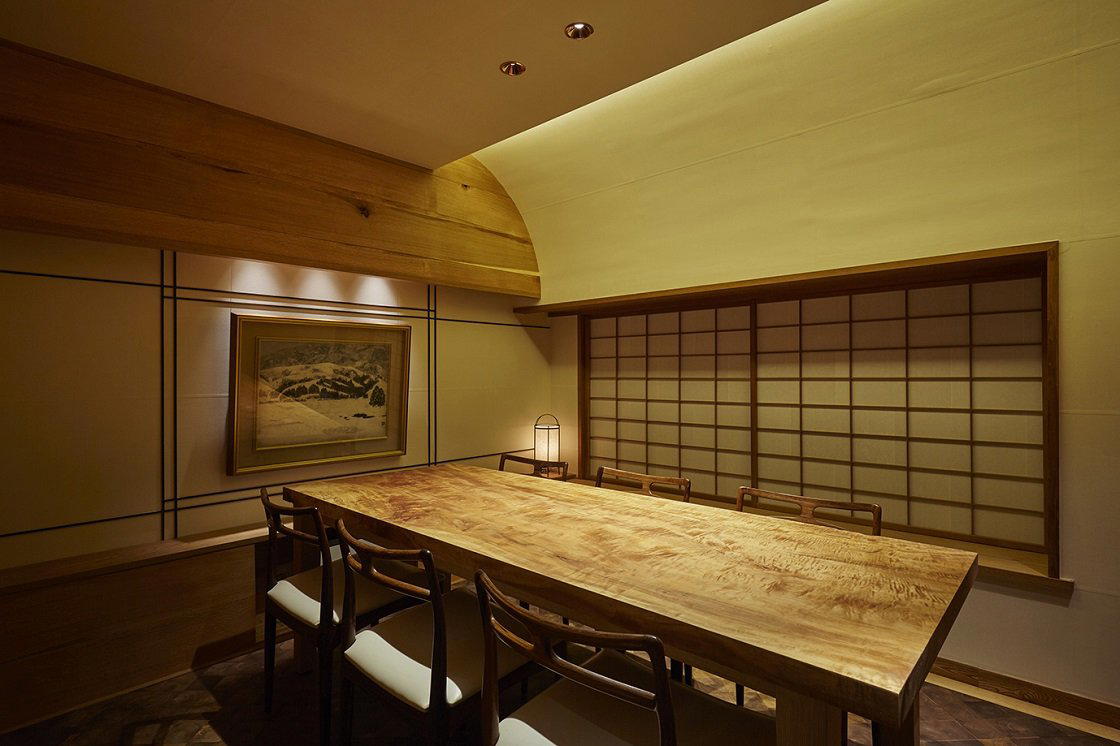
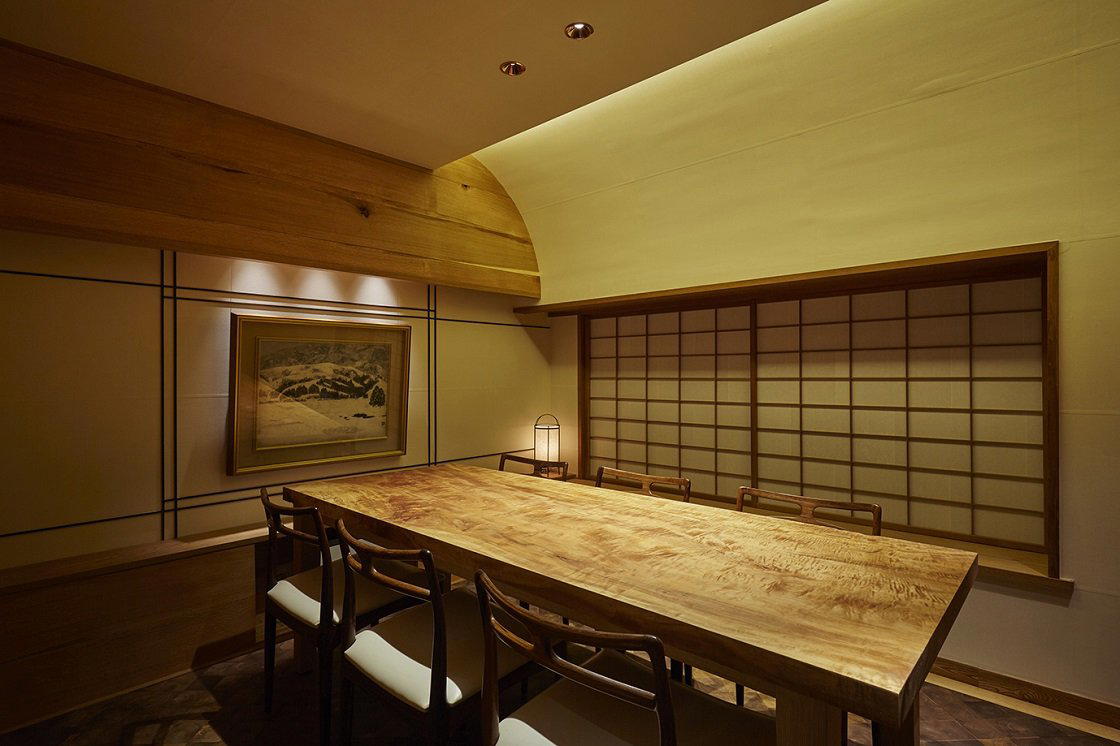
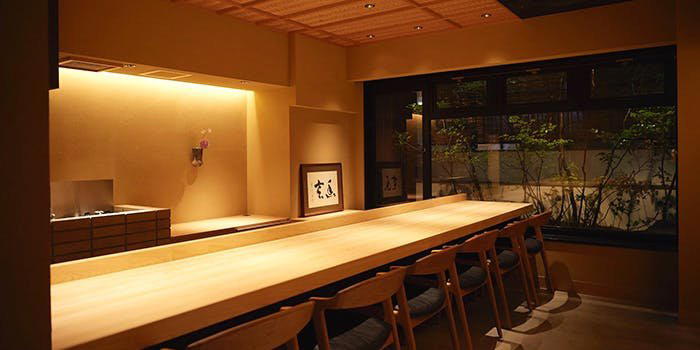
Among Osaka's two-Michelin-starred kaiseki houses, Yugen occupies a distinct position: a chef trained in the classical ryotei tradition who channels Kyushu's coastal larder through a menu that treats seasonal expression as its primary discipline. Located in Tennoji Ward, the room is compact and deliberate, with sourcing anchored to the Genkai Sea and Goto Islands rather than the better-known markets of the Kansai interior.

Pearl is the En Primeur Club membership app, where members save venues, book tables and use the concierge.
Where Tennoji Ward Meets the Ryotei Tradition
Osaka's fine dining map has long been dominated by two gravitational poles: the French-inflected innovation of restaurants like Hajime and La Cime at the ¥¥¥¥ tier, and the more rooted kaiseki houses that work within classical Japanese frameworks at ¥¥¥. Yugen, holding two Michelin stars in both 2024 and 2025, sits squarely in the latter group, but its sourcing logic sets it apart from peers such as Kashiwaya Osaka Senriyama and Ajikitcho Bumbuan, whose kitchens draw heavily on the Kansai interior and the central markets of Osaka itself. Here, the ingredients travel from the Genkai Sea and the Goto Islands off Kyushu's northwest coast, carrying a distinct salinity and weight that shifts the flavour register perceptibly from Kansai-centric counterparts.
The address in Tennoji Ward, a neighbourhood better known for its temples, the Shin-Sekai retro arcade district, and the transit hub of Tennoji Station, places Yugen outside the more predictable dining corridors of Namba and Minami. That geographic choice is itself a signal: this is not a restaurant positioning itself for tourist foot traffic. The room sits within Zenya Honpo Nishikan, a small mixed-use building, and the entrance requires a degree of intention that immediately calibrates expectations. In a city where high-end Japanese dining increasingly competes for visibility in prestige postcodes, a two-star kitchen in Tennoji operates on the assumption that guests are already committed before they arrive.
The Philosophy Behind the Plate
Japanese fine dining at this tier is organised around a set of well-understood disciplines: the reading of seasonal ingredients, the relationship between food and vessel, and the accumulation of technique across a career defined by apprenticeship. The ryotei system, formal Japanese restaurants that historically served as the highest expression of this tradition, remains the benchmark training ground, and it produces a particular kind of cook: one attentive to restraint, to the logic of a course sequence, and to the expressive potential of dishware. Chef Keisuke Mifune, a Fukuoka native, built his skills within that system, and the menu at Yugen reflects its discipline directly.
The term yugen itself is drawn from Japanese aesthetics, denoting a quality of mysterious profundity, a depth that cannot be fully measured or exhausted. It is a concept associated with Noh theatre and classical poetry, and its application to a dining room is not decorative. It frames the kitchen's intent: that the full meaning of a dish resists immediate extraction, that something remains to be discovered in the combination of ingredient, technique, and season. This is different from the more theatrical approach to surprise favoured by the innovative French-Japanese kitchens at the top of Osaka's price tier. The register here is quieter and more cumulative. Comparable practitioners working within the same broad tradition can be found at Gion Sasaki in Kyoto or, further afield, at Harutaka in Tokyo, though each kitchen reaches different conclusions from similar premises.
Kyushu's Larder at a Kansai Table
The sourcing from the Genkai Sea and the Goto Islands is the most concrete editorial point about Yugen, and it deserves direct attention. The Genkai Sea, which separates northern Kyushu from the Korean Peninsula and the Sea of Japan, produces fish that carry different characteristics from those caught in the more sheltered waters of Osaka Bay or the Seto Inland Sea. The currents are stronger, the waters colder in winter, and the resulting catch, which includes species prized in Hakata cuisine, arrives at Yugen carrying the authority of a distinct regional identity. The Goto Islands, an archipelago roughly 100 kilometres off Nagasaki's coast, are particularly associated with high-grade Goto udon and a seafood profile shaped by deep-water fishing traditions. Bringing this material to an Osaka kaiseki table is a deliberate act of culinary regionalism, and it connects Yugen laterally to the Fukuoka fine dining scene, where kitchens like Goh in Fukuoka have built reputations on similar coastal sourcing logic.
Within Osaka's ¥¥¥ Japanese tier, the peer comparison is instructive. Miyamoto, Oimatsu Hisano, and Tenjimbashi Aoki each work within the classical Japanese framework at comparable prices, but the sourcing geography and the specific training lineage of the chef create a different flavour signature at Yugen. The seasonal expression that the kitchen prioritises, adjusting combinations of ingredient and dishware as the year moves through its stages, means the menu in early spring will differ substantially from what arrives in autumn or winter. Guests returning across seasons are, in effect, visiting a sequence of related but distinct menus.
Lunch, Dinner, and the Logic of the Service Divide
In the kaiseki tradition, the distinction between lunch and dinner service carries real meaning, and it shapes both the practical and the experiential dimensions of a visit. Lunch at a two-star kaiseki counter typically offers a condensed menu that preserves the seasonal discipline of the full evening format while reducing the number of courses and, in most cases, the price. For guests who want to access the kitchen at its full technical level without the extended commitment of a dinner sitting, lunch is the rational entry point. The same seasonal ingredients, the same attention to vessel and presentation, compressed into a tighter arc.
Evening service at this tier extends the sequence and deepens the exploration of a single seasonal theme. The pacing changes, the interaction between courses becomes more deliberate, and the sense of cumulative effect that the concept of yugen implies is easier to sustain over a longer sitting. Where lunch might isolate a handful of the season's strongest ingredients in sharp relief, dinner builds a more layered argument. Guests coming from out of Osaka, perhaps as part of a broader Kansai itinerary that includes akordu in Nara or other regional fine dining, will generally find evening service the more complete expression of what the kitchen is building toward. For local guests or those with tighter schedules, lunch offers a calibrated version of the same sensibility. Two-star kitchens in Japan rarely dilute the ingredient quality between service formats; what changes is the scope, not the standard.
This service architecture is common across Japan's leading kaiseki tier but less often discussed than it deserves to be. At restaurants like Myojaku in Tokyo or Azabu Kadowaki, the same principle applies: lunch is a genuine access point, not a lesser version. The broader Osaka restaurant scene operates similarly at this tier, and visitors planning multi-day itineraries should factor lunch slots into their planning strategy rather than reserving high-end dining exclusively for evenings.
Placing Yugen in the Wider Japan Circuit
Japan's starred dining circuit rewards geographic patience. The kitchens that do the most interesting regional work are rarely in the same neighbourhood, and a considered itinerary might move from 1000 in Yokohama through Osaka and Kyoto before concluding in Fukuoka or, further south, at a table like 6 in Okinawa. Yugen fits naturally into a Kansai-anchored segment of that circuit, offering a Kyushu-inflected perspective from an Osaka address, which is itself a form of productive tension. The city's food identity is conventionally described through its street-food energy and its takoyaki-and-kushikatsu popular culture, but its fine dining tier is serious, competitive, and in some cases, as here, making arguments about Japanese cuisine that extend well beyond the city limits.
For context on where to stay or what else to do in the city, the Osaka hotels guide, Osaka bars guide, Osaka wineries guide, and Osaka experiences guide cover the broader city offer at the same editorial standard.
Planning Your Visit
Location: Zenya Honpo Nishikan 101, Ishigatsujicho 14-14, Tennoji Ward, Osaka. The address is walkable from Tennoji Station, one of Osaka's major transit interchanges, served by the JR Loop Line, the Midosuji subway line, and the Tanimachi Line. Budget: ¥¥¥ tier, placing it in the same price bracket as Kashiwaya Osaka Senriyama and below the ¥¥¥¥ French-inflected houses like Hajime and La Cime. Reservations: Advance booking is expected at two-Michelin-star level in Osaka; walk-in availability is not a reliable option and the restaurant's format does not accommodate unplanned arrivals at this tier. Booking through a hotel concierge or a specialist Japan dining reservation service is the practical approach for international visitors. Dress: Smart casual at minimum; formal attire is appropriate and consistent with the room's register. Ratings: Google 4.6 from 70 reviews; Michelin two stars in both 2024 and 2025.
Frequently asked questions
Who is the chef at Yugen?
The chef associated with Yugen is Yugen.
Is Yugen Michelin-listed?
Yugen has received recognition including: Yugen means ‘mysterious profundity’, grace whose depths can never be plumbed. It connotes the depths of Japanese cuisine, a product of constant refinement through the ages. Keisuke Mifune puts on display the skills and instincts he honed at….
What dish is Yugen famous for?
Yugen does not anchor its identity to a single signature dish. Chef Keisuke Mifune organises the menu around the changing seasons, drawing heavily on seafood from the Genkai Sea and the Goto Islands off Kyushu. The through-line is the ryotei discipline he trained under: precise ingredient pairings and considered dishware selection that shifts course by course across the calendar.
What cuisine category does Yugen fall under?
Is Yugen more mid-range or high-end?
Pricing at Yugen is listed as ¥¥¥.
What's Yugen's location?
Yugen is located at Japan, 〒543-0031 Osaka, Tennoji Ward, Ishigatsujicho, 14−14 銭屋本舗 西館 101, Osaka.
Do they take walk-ins at Yugen?
At the 2-Michelin-star tier in Osaka, walk-in availability is effectively zero for dinner service and extremely limited at lunch. Yugen occupies a small space at Zenya Honpo Nishikan 101 in Tennoji Ward, and demand at this level means advance reservations are the only reliable route in.
The Minimal Set
| Venue | Cuisine | Price | Awards | Notes |
|---|---|---|---|---|
| YugenThis venue (the venue you are viewing) | Michelin-Starred Kaiseki | $200–300 | 2 Michelin Stars | Not listed |
| HAJIME | Avant-Garde Japanese Fine Dining | $300–500 | 3 Michelin Stars · World's 50 Best #83 | French, Innovative |
| La Cime | Modern French with Japanese Ingredients | $150–200 | 2 Michelin Stars · World's 50 Best #13 | French |
| Kashiwaya Osaka Senriyama | Seasonal Kaiseki Omakase | $200–300 | 3 Michelin Stars · La Liste Top Restaurants | Japanese |
| Taian | Traditional Japanese Kaiseki Omakase | $150–200 | 3 Michelin Stars · La Liste Top Restaurants | Kaiseki, Japanese |
| Fujiya 1935 | Modern Japanese with European influences | $100–150 | 2 Michelin Stars · La Liste Top Restaurants | Innovative |
Recognition history
Dated appearances from independent guides and award organizations, with the underlying list record or original source where available.
Michelin 2 Stars
Michelin
Full recognition history (3 entries)
Michelin 2 Stars
Michelin
Michelin 2 Stars
Michelin