
Our verdict
A Kagurazaka sushi counter with a steady upward trajectory in serious dining circles — Hatou ranked #93 on Opinionated About Dining's Japan list in 2024 and climbed to #98 in 2025 alongside consistent top-tier recognition. Chef Daichi Kumagiri operates within the demanding shokunin tradition, five evenings a week plus Saturday, in one of Tokyo's most characterful old-city neighbourhoods.

Pearl is the En Primeur Club membership app — saves, bookings, and concierge access live there. Same editors, same standards.
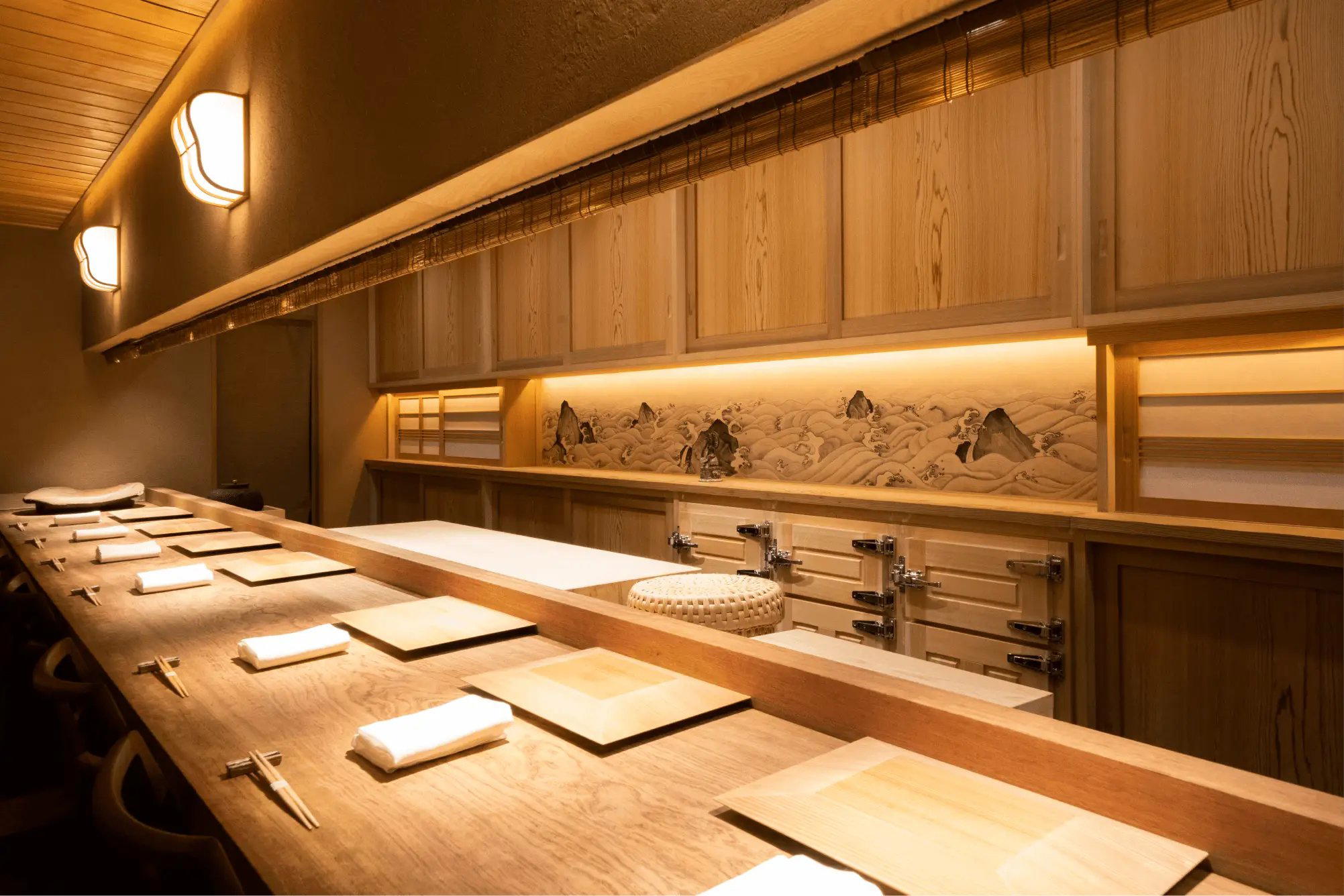
The menu
What to order
- Otsumami
- Nigiri
- Hamaguri soup
- Sakura masu
Kagurazaka and the Counter It Contains
Kagurazaka occupies a stretch of Shinjuku that resists Tokyo's usual logic of flash and density. The neighbourhood's narrow stone lanes, former geisha houses, and French-inflected café culture give it a texture closer to Kyoto's preserved quarters than to Ginza's retail towers. It is not, historically, a sushi district. The major omakase addresses — counters with the deep pedigrees and three-star Michelin weight of Harutaka or Sukiyabashi Jiro Roppongiten — cluster in Ginza and Minami-Aoyama. That Hatou has earned consecutive ranked placements on Opinionated About Dining's Japan list from this address says something about the discipline operating inside the room, not the neighbourhood's pre-existing gravitational pull.
The Shokunin Tradition Behind the Counter
Japanese sushi culture is structured around an apprenticeship model so demanding it has no real equivalent in Western kitchen hierarchies. A shokunin, a craftsperson fully committed to a single discipline, spends years, sometimes over a decade, before being entrusted with the rice, let alone the knife. The assumption is that mastery cannot be accelerated; it accumulates through repetition, correction, and proximity to someone who already possesses it. Lineage, therefore, is not a marketing device in Japanese sushi. It is a technical provenance, the equivalent of a winery naming its rootstock.
Chef Daichi Kumagiri works within this tradition at Hatou. The OAD ranking system, which aggregates assessments from a global network of serious diners and critics rather than anonymous inspectors, does not confer that recognition on counters operating outside the shokunin standard.
What the shokunin tradition produces, at its most disciplined, is a counter where the chef's ego is subordinated to the ingredient. The edomae techniques, marinating, searing, curing, resting fish at controlled temperatures before service, are not flourishes. They are methods developed over the nineteenth century to make the most of Tokyo Bay's seasonal catch in a pre-refrigeration city. Counters operating seriously in this tradition, including Edomae Sushi Hanabusa, treat those techniques as a living inheritance rather than a historical footnote.
Ranking Trajectory and What It Signals
Opinionated About Dining's Japan rankings are one of the more analytically credible signals in the country's dense fine-dining field. The list draws on a community of contributors who eat seriously and repeatedly across the country, weighting depth of engagement over the single-visit model. Moving from Highly Recommended in 2023 to a numbered rank in 2024, then maintaining a numbered rank in 2025, is not a static achievement. It reflects sustained performance across multiple assessments by multiple evaluators over a three-year period.
Within Tokyo's sushi tier specifically, the OAD rankings distribute across a wide price band and several distinct counter styles. The Google figure is a secondary signal, the sample size is modest, but the alignment between specialist-community rankings and general visitor feedback is a meaningful pattern. Hatou's alignment suggests neither.
For comparison within Tokyo's broader fine-dining structure, the counters at the three-star tier, Harutaka among them, operate with different booking depths and price floors. Hiroo Ishizaka represents another reference point in the serious but non-starred register. Hatou sits in the tier where OAD recognition carries more weight than Michelin designation, and where the counter's character is defined by the chef's technical choices rather than by the kind of international recognition that attracts speculative booking.
The Address and What to Expect
Hatou operates at 5 Chome-7 Kagurazaka, Shinjuku City. The neighbourhood is accessible from Kagurazaka Station on the Tokyo Metro Tozai Line, or from Iidabashi on the Tozai, Namboku, Yurakucho, and JR Chuo-Sobu lines. The surrounding streets reward a walk before or after the meal, the area's French bistros, sake bars, and preserved alley architecture are among the more atmospheric stretches in central Tokyo.
Service runs Monday through Friday from 6 to 9 pm, and Saturday from 5 to 9 pm. The counter is closed on Sundays. The compressed evening window, three hours on weekdays, four on Saturdays, is consistent with Tokyo's counter-sushi format, where a single seating allows the chef to manage rice temperature and fish preparation without the compromises that multi-seating service introduces.
For readers planning a wider Tokyo itinerary, our full Tokyo restaurants guide covers the city's dining range across cuisines and price tiers. Our full Tokyo hotels guide, Tokyo bars guide, Tokyo experiences guide, and Tokyo wineries guide cover the surrounding infrastructure for a complete stay.
Beyond Tokyo, the OAD-ranked sushi tradition has parallels in other Japanese cities and at international counters shaped by Japanese training. Sushi Shikon in Hong Kong and Shoukouwa in Singapore represent the export of this counter format to Southeast Asia. Within Japan, the broader fine-dining field includes HAJIME in Osaka, Gion Sasaki in Kyoto, akordu in Nara, Goh in Fukuoka, 1000 in Yokohama, and 6 in Okinawa.
Planning Your Visit
Hours: Monday–Friday 6–9 pm; Saturday 5–9 pm; closed Sunday. Reservations: Booking method not publicly listed, direct contact with the restaurant is advised, and advance planning is recommended given the counter's OAD-ranked status. Budget: Price range not published; expect omakase pricing consistent with a ranked Tokyo sushi counter. Getting there: Kagurazaka Station (Tokyo Metro Tozai Line) is the closest station; Iidabashi provides multiple line options. Address: 5 Chome-7 Kagurazaka, Shinjuku City, Tokyo 162-0825.
Frequently asked questions
Can I bring kids to Hatou?
Hatou is an omakase counter in the OAD Top 100 Japan ranking, which places it firmly in Tokyo's serious sushi tier. That format — a fixed chef-led sequence, counter seating, evening-only hours — is not suited to children. Most comparable counters in the city operate an implicit adults-only policy in practice.
What is the atmosphere like at Hatou?
Kagurazaka's residential character sets Hatou apart from Ginza's more trafficked sushi corridor. The neighbourhood's narrow lanes and low-rise streetscape carry over into a quieter, more focused dining context. Counter seating — standard at OAD-ranked addresses like Hatou — means conversation stays close and the room defers to the chef's pace.
What distinctions does Hatou have?
Hatou has received recognition including: Opinionated About Dining Top Restaurants in Japan Ranked #98 (2025); Opinionated About Dining Top Restaurants in Japan Ranked #93 (2024); Opinionated About Dining Top Restaurants in Japan Highly Recommended (2023).
What should I eat at Hatou?
There is no ordering at Hatou: the format is omakase, meaning chef Daichi Kumagiri determines the sequence. Within the edomae tradition that anchors counters at this level of the OAD Japan rankings, expect aged fish, hand-pressed nigiri, and seasoned rice as the technical constants — though the specific selection shifts with the season and market.
Is Hatou open every day?
Hours at Hatou: Hours: Monday 6–9 pm Tuesday 6–9 pm Wednesday 6–9 pm Thursday 6–9 pm Friday 6–9 pm Saturday 5–9 pm Sunday Closed.
How do I find Hatou?
Hatou is located at 5 Chome-7 Kagurazaka, Shinjuku City, Tokyo 162-0825, Japan, Tokyo.
The Short List
A short peer table to compare basics side-by-side.
| Venue | Cuisine | Price | Awards | Notes |
|---|---|---|---|---|
| HatouThis venue (the venue you are viewing) | Edomae Omakase | $200–300 | Not listed | Not listed |
| Harutaka | Edo-Style Omakase Sushi | $200–300 | 3 Michelin Stars · World's 50 Best #76 | Sushi |
| RyuGin | Modern Kaiseki | $500+ | 3 Michelin Stars · World's 50 Best #41 | Kaiseki, Japanese |
| L'Effervescence | Modern French with Japanese Influences | $200–300 | 3 Michelin Stars · World's 50 Best #69 | French |
| HOMMAGE | Modern French with Japanese Influences | $150–200 | 2 Michelin Stars · World's 50 Best #78 | Innovtive French, French |
| MAZ | Innovative Peruvian-Japanese Fusion | $150–200 | 2 Michelin Stars · World's 50 Best #28 | Innovative |
Recognition history
Dated appearances from independent guides and award organizations, with the underlying list record or original source where available.
Opinionated About Dining Top Restaurants in Japan Ranked #54
Opinionated About Dining
Full recognition history (4 entries)
Opinionated About Dining Top Restaurants in Japan Ranked #98
Opinionated About Dining
Opinionated About Dining Top Restaurants in Japan Ranked #93
Opinionated About Dining
Opinionated About Dining Top Restaurants in Japan Highly Recommended
Opinionated About Dining
Continue exploring
More in Tokyo
Restaurants in Tokyo
All restaurants in Tokyo →


Bars in Tokyo
All bars in Tokyo →





Details
- Intimate
- Elegant
- Quiet
- Special Occasion
- Date Night
- Chefs Counter
- Open Kitchen
- Sake Program
- Local Sourcing
- Sustainable Seafood
- Omakase
- Counter Dining
- Sake
Current opening hours
- Monday
- Closed
- Tuesday
- 5–9 PM
- Wednesday
- 5–9 PM
- Thursday
- 5–9 PM
- Friday
- 5–9 PM
- Saturday
- 12–9 PM
- Sunday
- Closed
Hours can change for holidays and private events. Last verified .
Warm, refined, and intimate atmosphere with meticulous attention to detail; guests feel respected and welcomed in a quiet, focused dining environment.