
1 Michelin Star
Our verdict
Among Akasaka's counter-sushi rooms, Edomae Sushi Hanabusa holds a Michelin star and a philosophy rooted in Edo-era tradition: red-vinegar rice, Tokyo Bay fish, and a chef whose maxim, everything begins and ends with tuna, shapes every sitting. The old-timey counter and generous portions signal a deliberate rejection of minimalist modernism in favour of a lineage that predates it.

Pearl is the En Primeur Club membership app, where members save venues, book tables and use the concierge.
Counter Sushi in Tokyo: The Edo Lineage That Refuses to Update
Tokyo's counter-sushi scene has fractured into recognisable tiers over the past decade. At one end, a constellation of counters, many carrying Kanesaka or Saito lineage, operate eight to twelve seats, charge upward of ¥50,000 per head, and have built reputations on obsessive aging protocols and single-origin sourcing. At the other, a broad middle tier of accomplished but less singular rooms fills the gap between the accessible and the rarefied.
This matters because the Edo-style approach, sushi as working food, fast-formed at a street stall, seasoned with assertive red vinegar, served generously, is increasingly the minority position among Tokyo's celebrated counters. Venues like Harutaka and Sushi Kanesaka, which hold three stars apiece, represent a different strand: refined, contemplative, rooted in post-war counter culture rather than the original street-stall form. Hanabusa doesn't compete on that terrain. Its points of reference are older, its rice more aggressively seasoned, its tuna philosophy more absolute.
What Keeps Regulars Returning
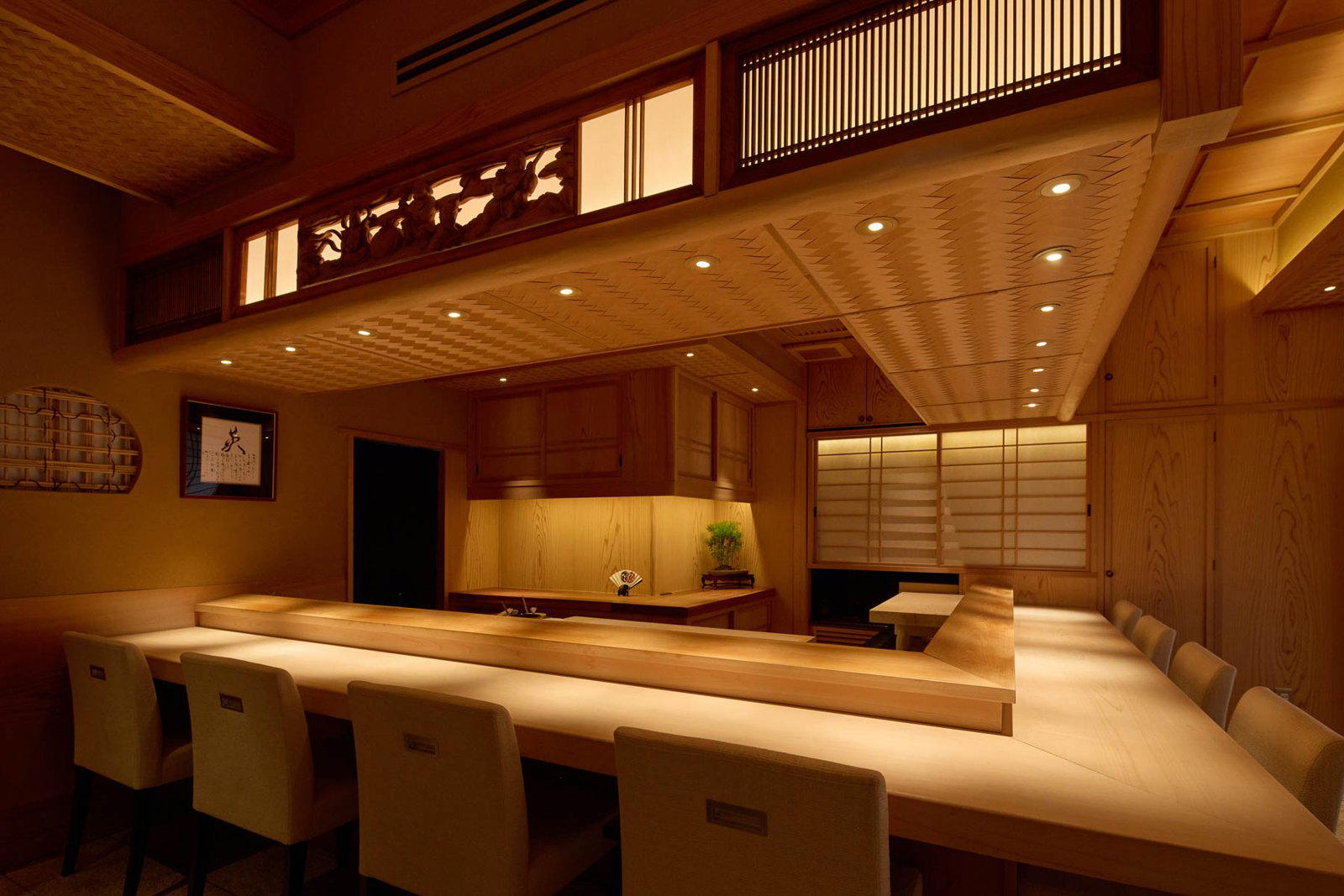
The sushi counter that earns a regular clientele in Tokyo is rarely the one with the most elaborate sourcing story. It is, more often, the one whose internal logic is so consistent that a guest sitting down for the twentieth time still finds the same economy of movement, the same rice temperature, the same conviction in the ordering of the meal. That coherence is what Hanabusa's returning guests describe, and it is encoded in the room itself: an old-timey counter that signals, without ambiguity, that the chef's attention is on technique and sequence, not décor.
The chef's lineage runs to a sushi shop with roots as an Edo-era food stall, a provenance that places the practice several generations before contemporary omakase conventions. That history shapes the rice: seasoned with red vinegar and salt rather than the sweeter, lighter vinegar profiles that became standard in post-war Tokyo. Red vinegar produces a denser, more assertive flavour that stands up to the fatty, high-iodine fish of Tokyo Bay. For regulars, this creates a very specific pleasure: the rice is not a neutral vehicle but an active participant in the flavour of each piece.
Meal's architecture is equally consistent. Fatty tuna arrives first, not as a flourish saved for the finale, but as a statement of priority. The chef's maxim, everything begins and ends with tuna, is not marketing language; it is a structural principle. Gizzard shad, a fish with a long history in Edo sushi that fell out of fashion in many modern rooms, remains an essential piece here. For guests who have eaten widely across Tokyo's counter circuit, that commitment to kohada carries its own signal: this is a room where the traditional canon holds, not because it is retro-affectation, but because the chef has decided the canon is correct.
Generous portions and thick tuna rolls are, likewise, part of the same inheritance. The aesthetic of Edo-period sushi was abundance and directness, not minimalism. Where many starred counters move toward jewel-sized pieces and restrained presentation, Hanabusa's generosity reads as fidelity to the original form. Regulars who come back know what they are getting, and that predictability, the specific predictability of a craft done the same way across hundreds of sittings, is precisely what they return for.
Akasaka and the Sushi Counter Neighbourhood
Akasaka sits within Minato City, one of Tokyo's denser concentrations of high-end dining rooms. The ward contains counter addresses ranging from Ginza's highest-priced omakase floors to neighbourhood-level specialists that draw local office and residential clientele rather than destination diners. Hanabusa's address in Akasaka places it in the latter category: a working professional neighbourhood where serious sushi is a regular occurrence, not a special-occasion pilgrimage, and where a counter with a Michelin star but without the theatrics of a reservation-war address has its own distinct appeal.
That positioning affects who sits at the counter. The Ginza rooms, Sukiyabashi Jiro Roppongiten among them, attract a high proportion of international visitors and once-a-year diners. Akasaka's counter rooms, at this tier, tend to accumulate a more local returning base. For guests interested in Tokyo's sushi culture beyond the most-photographed addresses, that distinction changes the character of a sitting considerably. See our full Tokyo restaurants guide for the wider range of options across neighbourhoods.
Edomae Tradition in the Wider Tokyo Sushi Scene
Counter sushi in Tokyo now spans an enormous range of approaches. The kaiseki-influenced rooms overlap with sushi in format and seasonality. Innovative Japanese rooms like Den operate on entirely different principles of playfulness and ingredient surprise. Even within strict sushi, the philosophical divisions are sharp: modernist counters treating rice as a canvas for precise sourcing; traditionalist rooms treating the canon as settled and executing it with accumulated skill.
Hanabusa belongs to the traditionalist camp in a way that carries specific meaning: the Edo-era food stall ancestry is not a heritage story told in the dining room, it is the actual operating logic of the kitchen. The distinction between this and a room that references Edo aesthetics while applying contemporary techniques is significant, and it is the distinction that orients repeat visitors. Comparable traditionalist commitment in the counter-sushi world can be found at Hiroo Ishizaka and Jizozushi, though each arrives at tradition from a different genealogy.
For those exploring the breadth of Japan's sushi culture beyond Tokyo, the form takes on different regional inflections: Sushi Shikon in Hong Kong and Shoukouwa in Singapore both export the Tokyo counter model to Southeast Asian contexts, while the Japanese dining scene more broadly, from HAJIME in Osaka to Gion Sasaki in Kyoto, akordu in Nara, Goh in Fukuoka, 1000 in Yokohama, and 6 in Okinawa, shows how far the country's serious dining has diverged from any single model.
Explore more of the city's drinking, lodging, and experience options through our full Tokyo bars guide, full Tokyo hotels guide, full Tokyo wineries guide, and full Tokyo experiences guide.
Know Before You Go
- Address: 9 Chome-1-7 Akasaka, Minato City, Tokyo 107-0052, Japan
- Cuisine: Edomae Sushi
- Price range: ¥¥¥¥
- Awards: Michelin 1 Star (2024)
- Guest rating:
- Phone / website: Not publicly listed, reservation through hotel concierge or specialist booking service recommended
- Hours: Confirm directly before visiting
What dish is Edomae Sushi Hanabusa famous for?
Tuna is the defining piece at Hanabusa, and the chef makes the priority explicit: fatty tuna opens the meal and, by the logic of the counter, closes it. The thick tuna roll is the other piece most closely associated with the Edo heritage the counter represents. Gizzard shad (kohada), a fish central to the original Edo-period canon, is treated as an essential rather than an optional piece, a choice that distinguishes the counter from many contemporary rooms where kohada has been quietly sidelined. The red-vinegar rice, denser and more assertive than the sweeter profiles common elsewhere, is the structural thread that ties all the pieces together and the element that repeat guests most consistently reference as the reason they return.
Compact Comparison
A small set of peers for context, based on recorded venue fields.
| Venue | Cuisine | Price | Awards | Notes |
|---|---|---|---|---|
| Edomae Sushi HanabusaThis venue (the venue you are viewing) | Traditional Edomae Omakase | $150–200 | 1 Michelin Star | Not listed |
| Harutaka | Edo-Style Omakase Sushi | $200–300 | 3 Michelin Stars · World's 50 Best #76 | Sushi |
| RyuGin | Modern Kaiseki | $500+ | 3 Michelin Stars · World's 50 Best #41 | Kaiseki, Japanese |
| L'Effervescence | Modern French with Japanese Influences | $200–300 | 3 Michelin Stars · World's 50 Best #69 | French |
| HOMMAGE | Modern French with Japanese Influences | $150–200 | 2 Michelin Stars · World's 50 Best #78 | Innovtive French, French |
| MAZ | Innovative Peruvian-Japanese Fusion | $150–200 | 2 Michelin Stars · World's 50 Best #28 | Innovative |
Recognition history
Dated appearances from independent guides and award organizations, with the underlying list record or original source where available.
Michelin 1 Star
Michelin
Full recognition history (2 entries)
Michelin 1 Star
Michelin
Continue exploring
More in Tokyo
Restaurants in Tokyo
All restaurants in Tokyo →



Bars in Tokyo
All bars in Tokyo →





Details
- Classic
- Intimate
- Elegant
- Quiet
- Date Night
- Special Occasion
- Chefs Counter
- Sake Program
- Sustainable Seafood
- Omakase
- Counter Dining
- Sake
Current opening hours
- Monday
- 5:30–10 PM
- Tuesday
- 5:30–10 PM
- Wednesday
- 5:30–10 PM
- Thursday
- 5:30–10 PM
- Friday
- 5:30–10 PM
- Saturday
- Closed
- Sunday
- 5:30–10 PM
Hours can change for holidays and private events. Hours as of .
Calm hinoki wood counter seating in a quiet, old-school intimate space with minimal interaction and focused sushi preparation.