

Tabelog Bronze #59
Our verdict
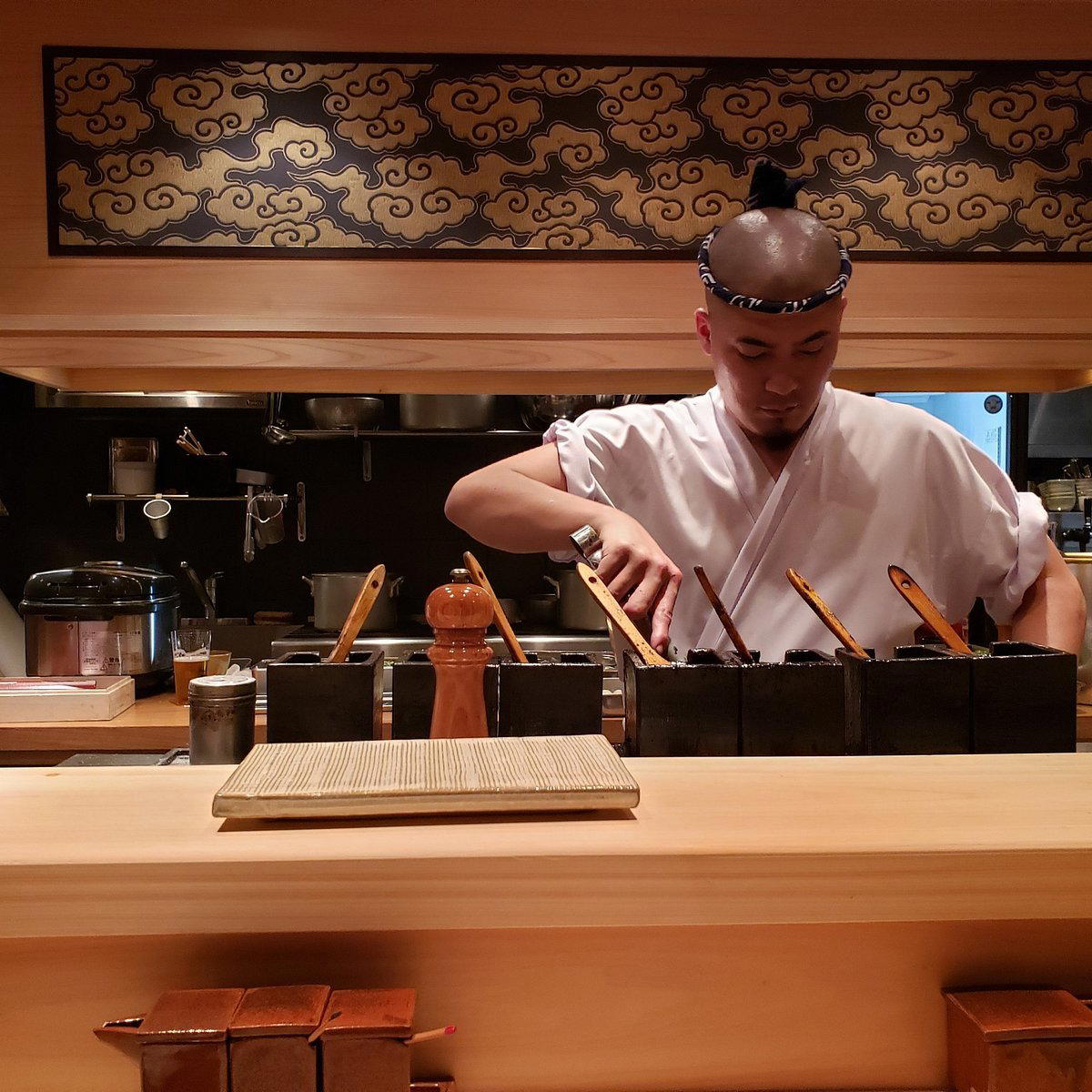
Eiki places Tokyo yakitori in its contemporary counter-dining phase: small scale, charcoal discipline, and a tighter relationship between sourcing, portioning, and waste than the old beer-hall model suggests. The Ebisu address has Tabelog Award Bronze recognition and repeated Tabelog Yakitori 100 selections, with a 15-seat counter format that puts the craft in close view.

Pearl is the En Primeur Club membership app, where members save venues, book tables and use the concierge.
The menu
What to order
- Seseri and Clam Takikomi Rice
- White Liver
- Thick Fried Tofu
Ebisu’s restaurant streets narrow quickly once the main station traffic drops away, and the mood suits yakitori’s current Tokyo moment: compact rooms, counter seating, and the sound of charcoal work replacing the older image of smoke-heavy drinking dens. In this setting, Eiki belongs to the city’s serious yakitori bracket, where poultry is treated less as casual bar food and more as a disciplined sequence built around heat control, timing, and the full use of the bird.
That last point matters. Yakitori has always carried an implicit sustainability logic, even when restaurants did not use the vocabulary. A skewer culture built around multiple cuts, offal, skin, cartilage, and small portions naturally resists the wastefulness of prime-cut dining. The contemporary version sharpens that ethic: procurement matters, pacing matters, and the counter becomes a place where diners see how little margin there is for careless cooking. Eiki’s format, listed as counter seating with 15 seats, puts that economy of movement at the centre of the meal rather than hiding it behind a kitchen door.
Yakitori as precision work, not late-night filler
Tokyo’s yakitori scene has split into several lanes. There are neighborhood shops built for beer and repetition, specialist counters that treat chicken with the seriousness of sushi, and hybrid rooms that add wine lists and tasting-menu pacing. Eiki sits in the specialist counter lane. Its Tabelog category is yakitori, its drink framing includes sake, shochu, and wine, and its public recognition places it among diners who follow the genre closely rather than those looking for a casual station-side stop.
The trust signals are unusually clear for a small counter. Eiki is a Tabelog Award 2026 Bronze winner, with Bronze recognition also listed for 2025, 2022, and 2021. It was selected for Tabelog Yakitori 100 in 2021, 2022, 2023, 2024, and the 2025 EAST list. Opinionated About Dining also includes it in the 2026 Japan recommended restaurant list. In Tokyo, where yakitori has enough depth to support several serious sub-scenes, repeated category recognition is more useful than a single burst of attention.
Price positioning reinforces that reading. The listed dinner budget of JPY 10,000 to JPY 14,999 places it above everyday yakitori and below the city’s more expensive tasting-counter tier. In Ebisu, that bracket matters. Nearby dining can range from casual skewers at Tori Nago Ebisu ten to French and Japanese formats such as La maison finistère, Oryori Ichiho, and MANSALVA; Eiki’s value proposition is narrower and more specific, focused on charcoal-grilled poultry rather than a broad luxury repertoire.
The sustainability argument is built into the format
Yakitori’s environmental case is not about decoration or slogan. It is structural. The cuisine rewards whole-bird thinking, careful butchery, and small-unit cooking over abundance for its own sake. A counter can serve a sequence in measured portions, reducing the pressure to over-order and allowing the kitchen to calibrate inventory around a small number of seats. That is a different model from large-format meat dining, where spectacle often depends on volume.
There is also a cultural discipline to charcoal cooking that discourages excess. Heat is expensive in attention as much as fuel: skewers move in and out of the hottest zones, fat becomes a cooking variable, and timing is visible to the diner. The attraction is not a long list of ingredients. It is how a limited set of materials can be handled with restraint. For readers trying to understand why Tokyo yakitori has become a serious reservation category, this is the core answer. The genre turns modest pieces into a meal that depends on skill rather than abundance.
Eiki’s counter format makes that argument legible. With 15 seats and no private rooms, the room’s hierarchy is clear: the grill and the diners face one another. That arrangement suits a cuisine where freshness, sequence, and temperature define the experience. It also makes waste harder to ignore. In a small counter restaurant, overproduction has fewer places to hide.
Where it fits in an Ebisu dining night
Ebisu has become one of Tokyo’s more useful dining districts for visitors who want depth without the ceremonial stiffness of Ginza or the volume of Shinjuku. The area supports serious Japanese counters, European dining, wine bars, and polished casual rooms within a walkable grid. Eiki fits that pattern: small, focused, and built around a single culinary language. It is not the right choice for diners seeking a long multi-cuisine menu; it is for those who want yakitori treated as the main event.
The practical reading is simple. This is a compact counter with recognised standing in a competitive category, and the format asks for diners who are comfortable with a chef-led rhythm. Public listing details indicate reservations are handled through Shokuoku rather than new phone reservations, and the room is non-smoking. Payment by major credit card is listed, while electronic money and QR payments are not. Those details may sound mundane, but they define the night as much as any award: small Tokyo counters reward planning.
For broader context around the city, see Our full Tokyo restaurants guide, plus adjacent planning guides for Tokyo hotels, Tokyo bars, Tokyo wineries, and Tokyo experiences. Within the restaurant index, useful contrasts include 124. KAGURAZAKA (Yakitori), 12/10 Shinjuku ten. 鮪と炭火焼き うお炭 秋葉原店, 2D Cafe, and 3 Chome no Curry Ya San. Japan-wide and overseas comparisons in the archive include -Grilled beef Sukiyaki- KAMAKURA TANUKIAN 鎌倉 たぬき庵 in Kamakura.cafe in Osaka.know in Kumamoto, (Shoku) Vietnam in Kawasaki, [Curry Senmon Ten] Maruyama Kyoju. in Sapporo, [ki:] in Kyoto, Jōdo Saké Bar in Los Angeles, and Onigiri Time in Pasadena.
The editorial case for Eiki is not that it makes yakitori luxurious by adding ornament. Its appeal is the opposite: a narrow format, repeated category recognition, a small counter, and a cuisine whose sustainability story is embedded in using the bird with intelligence. In a city crowded with expensive counters, that restraint gives the address its reason to matter.
Credentials Lens
Comparable venues to place this listing in its category.
| Venue | Cuisine | Price | Awards | Notes |
|---|---|---|---|---|
| EikiThis venue (the venue you are viewing) | Traditional Yakitori Omakase | $150–200 | Tabelog Bronze #59 | Not listed |
| Sushi Tsu | Edomae Omakase Sushi | $100–150 | Tabelog 100 #73 | Minato |
| Toricho | Authentic Yakitori | $50–100 | Not listed | Minato |
| Imaiya Honten | Premium Hinai Jidori Yakitori | $50–100 | Not listed | Shinjuku |
| 伯雲 | Modern Kaiseki Omakase | $300–500 | 2 Michelin Stars · Tabelog Bronze #93 | Minato |
| Togoshi Ginza Sushi Bando | Seasonal Edo-style Omakase Sushi | $100–150 | Tabelog 100 #68 | Shinagawa |
Recognition history
Dated appearances from independent guides and award organizations, with the underlying list record or original source where available.
Opinionated About Dining Top Restaurants in Japan Recommended
Opinionated About Dining
Tabelog Bronze #59
Tabelog
Full recognition history (4 entries)
Tabelog 100 #38 · No. 38
Tabelog · Tabelog 100 - Yakitori - EAST - 2025
Tabelog Bronze
Tabelog
Continue exploring
More in Tokyo
Restaurants in Tokyo
All restaurants in Tokyo →




Bars in Tokyo
All bars in Tokyo →





Details
- Intimate
- Elegant
- Classic
- Special Occasion
- Date Night
- Celebration
- Chefs Counter
- Open Kitchen
- Sake Program
- Byob
- Local Sourcing
- Omakase
- Counter Dining
- Sake
- Shochu
- Wine
Current opening hours
- Monday
- 6 PM–12 AM
- Tuesday
- 6 PM–12 AM
- Wednesday
- 6 PM–12 AM
- Thursday
- 6 PM–12 AM
- Friday
- 6 PM–12 AM
- Saturday
- 6 PM–12 AM
- Sunday
- Closed
Hours can change for holidays and private events. Hours as of .
Refreshing white wood counter space with Edo aesthetic, intimate 15-seat counter setting with open kitchen view.