A Kitashinchi counter address in Osaka's most storied hospitality corridor, 割鮮 入たに sits within a district where the gap between lunch and dinner service is as pronounced as anywhere in Japan. The format speaks to the kaiseki-adjacent tradition of hyper-seasonal Japanese cooking, where the time of day shapes not just the menu but the entire register of the meal.
Pearl is the En Primeur Club membership app — saves, bookings, and concierge access live there. Same editors, same standards.
- Address
- Japan, 〒530-0002 Osaka, Kita Ward, Sonezakishinchi, 1 Chome−8−6 北新地 山忠ビル1号館 1階
- Phone
- +818038671232
- Website
- kassen-iritani.com
- Directions
- Get directions
 Saves & bookings on Pearl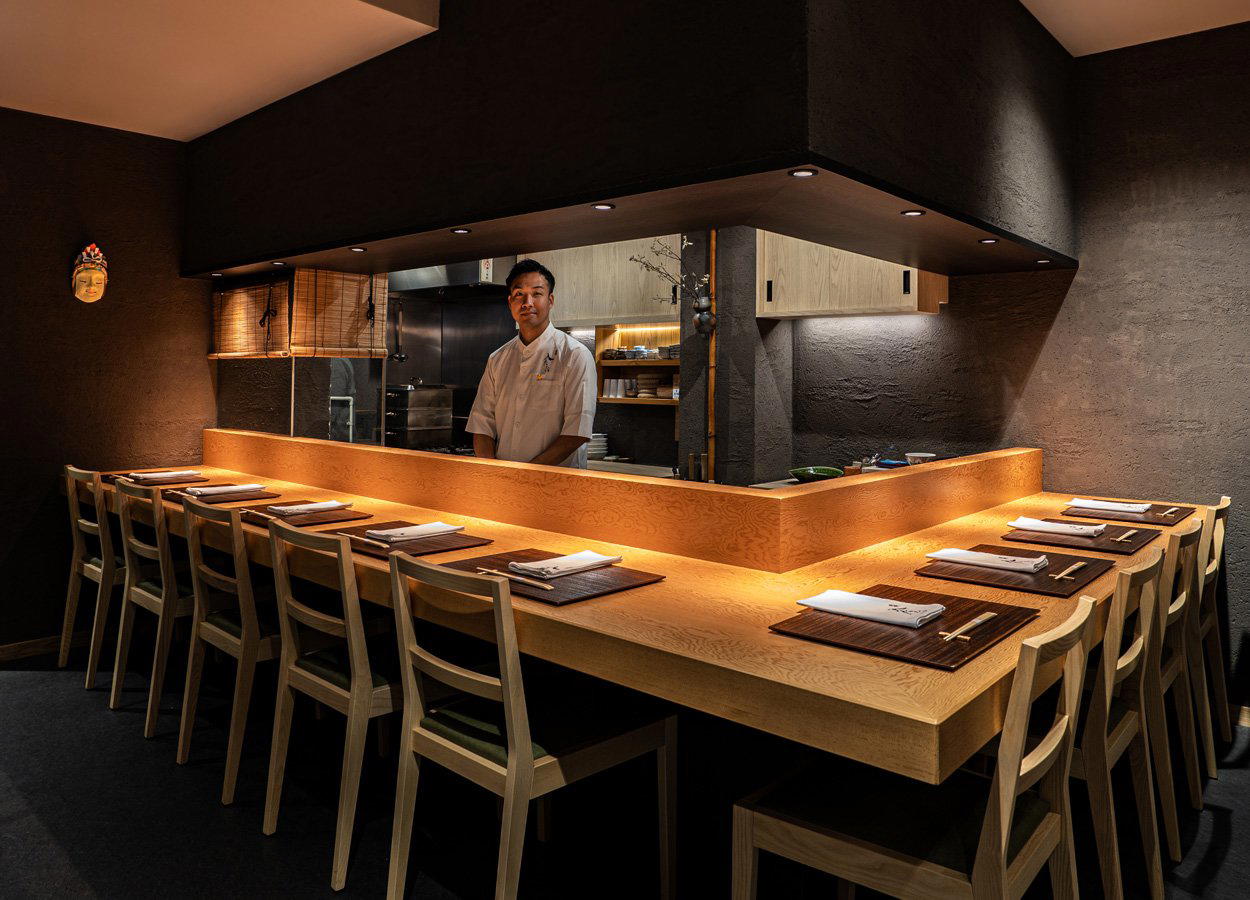
Kitashinchi, the dense grid of lanes north of Osaka Station, operates on a different rhythm from the city's more photogenic dining districts. By day, its restaurants serve a compressed, purposeful version of their evening ambitions. By night, the same rooms shift into something unhurried, where courses accumulate and the gap between courses becomes part of the experience. The restaurant is a Naniwa Kappo counter in Osaka's Kita Ward, with reservations essential and an average price of about $150 per person. 割鮮 入たに, on the ground floor of the Kitashinchi Yamachu Building on Sonezaki Shinchi 1-chome, occupies that territory with the quiet confidence of an address that knows its neighbourhood well.
Kitashinchi and the Architecture of a Divided Day
Few districts in Japan make the lunch-dinner divide as structurally legible as Kitashinchi. The area's history as an entertainment and hospitality zone for Osaka's business class means that evening bookings have long carried social weight: they are occasions in themselves, not just meals. Lunch, by contrast, emerged as a pragmatic extension of that tradition, offering the same technical kitchen in a format that respects the working clock. That split is visible across the district, from the smaller kappo counters on side alleys to the grander rooms on the main drag.
In this context, 割鮮 入たに reads as a counter-style address shaped around the same logic. The kanji in the name point directly at the food: 割鮮 signals a kitchen where the sourcing and treatment of raw ingredients is the organising principle. This is not an izakaya register, nor is it the formality of a full kaiseki progression. It sits in the middle ground that Osaka restaurants have historically occupied more comfortably than almost any other Japanese city, where technical rigour coexists with an atmosphere that does not demand ceremony from its guests.
What Daytime Service Signals in This Part of Osaka
The lunch market in Kitashinchi is genuinely competitive. Counters that run full omakase courses after dark often condense their proposition into a set format at midday, offering a more constrained menu at a price that reflects the shorter duration rather than a reduction in sourcing standards. That compression is actually useful information for a first visit: it is often the clearest window into how a kitchen thinks, because the choices made under constraint reveal priority. Which courses stay? Which ingredients are non-negotiable? What gets edited out?
Across Osaka's counter restaurants, the lunch set has become something of a trust-building mechanism. Regulars at addresses like Ajihei Sonezaki and Ajikitcho Bunbuan often trace their relationship with a room back to a first lunchtime encounter. The lower financial commitment of a daytime set lowers the activation energy for a first booking, which then creates the familiarity needed to move through the evening reservation system with confidence.
Evening in Kitashinchi: A Different Register Entirely
After dark, the district's character changes in ways that go beyond lighting. The clientele shifts, the pace slows, and the expectation of an extended, drink-accompanied meal becomes the norm. For a restaurant built around fresh-cut fish, the evening context matters because it allows the kitchen to work through a fuller sequence of preparations, from the raw and lightly dressed to the cooked and aged. It also allows the service team to moderate the meal's tempo rather than running against the grain of a guest who needs to be back at a desk.
This pattern is consistent across Osaka's premium counter segment. At Aka to Shiro and Az, evening formats are structured around the assumption that guests are present for the duration. The kitchen's ability to sequence dishes, hold temperatures, and respond to individual pacing becomes most apparent in that environment. Calendrier, similarly, deploys its most considered work across a longer evening arc.
Osaka's most decorated kitchens operate on the same principle at a higher price tier: HAJIME in Osaka represents the city's most formally structured end of the spectrum, while the broader Kansai region produces a range of approaches that includes Gion Sasaki in Kyoto and akordu in Nara. The 割鮮 tradition, in this company, represents a more direct, ingredient-forward mode of Japanese restaurant thinking, less interested in architectural courses than in the quality of what arrives on the cutting board.
Positioning Within the Osaka Counter Scene
Osaka's counter restaurant market has fragmented meaningfully over the past decade. The city that once clustered its serious dining into a small number of established rooms now has a distributed ecosystem of specialist counters, each oriented around a particular ingredient category or preparation philosophy. Fish-focused counters, in particular, have proliferated in the wake of the city's growing reputation as a seafood destination in its own right, separate from the kaiseki apparatus of Kyoto.
In that context, an address built around the precise cutting and presentation of fresh fish aligns with a tradition that has deep roots in Osaka's merchant culture. The city's proximity to major fish markets gives fish-focused counters in Osaka access to sourcing that supports seasonal, daily-adjusted menus. Comparable specialist orientations appear at addresses as geographically distributed as Harutaka in Tokyo and Goh in Fukuoka, where the fish counter format carries its own logic regardless of city.
For visitors mapping a Kansai itinerary that extends beyond the obvious, the counter scene also branches into less-covered territory, including 一本木 石川製 in Nanao, 湖畔荘 in Takashima, and 羽根屋 in Nishikawa Machi, all of which operate in a regional register that complements a Osaka anchor visit. 北大前 さかい in Sapporo and Birdland in Sakai round out the broader picture of Japan's specialist counter geography. Internationally, the fish-forward counter format finds its closest Western equivalents at Le Bernardin in New York City and, in a different register entirely, at Atomix in New York City.
Know Before You Go
- Address: 1-8-6 Sonezaki Shinchi, Kita Ward, Osaka (Kitashinchi Yamachu Building No.1, 1F)
- Nearest station: Kitashinchi Station (JR Tozai Line) or Higashi-Umeda Station (Osaka Metro Tanimachi Line)
- Booking: Advance reservation recommended for evening;
- Dress code: Smart casual is the Kitashinchi district norm for dinner counters
- Language: Japanese-language menus are standard at this category of Osaka counter.
Accolades, Compared
Comparable venues nearby, for context on price, style, and recognition.
| Venue | Cuisine | Price | Notes |
|---|---|---|---|
| 割鮮 入たにThis venue — the venue you are viewing | Naniwa Kappo | $$$ | Not listed |
| Unagi Nishihara | Kanto-Style Unagi (Eel) | $$$ | Chūō |
| 旬膳季らく | 浪速割烹 Japanese Kaiseki | $$$ | Chūō |
| Kushiage 010 | Creative Kushiage with Global Influences | $$$ | Kita |
| Sushi Kazuma | Traditional Japanese Omakase | $$$ | Kita |
| 十皿 | Traditional Japanese Kaiseki | $$$ | Kita |
Continue exploring
More in Osaka
Restaurants in Osaka
Browse all →




Bars in Osaka
Browse all →




Hotels in Osaka
Browse all →



Wineries in Osaka
Browse all →
At a Glance
- Elegant
- Intimate
- Classic
- Date Night
- Business Dinner
- Special Occasion
- Chefs Counter
- Open Kitchen
- Sake Program
- Local Sourcing
Current opening hours
- Monday
- 6 PM–12 AM
- Tuesday
- 12–2 PM, 6 PM–12 AM
- Wednesday
- 12–2 PM, 6 PM–12 AM
- Thursday
- 12–2 PM, 6 PM–12 AM
- Friday
- 12–2 PM, 6 PM–12 AM
- Saturday
- 12–2 PM, 6 PM–12 AM
- Sunday
- Closed
Hours can change for holidays and private events. Last verified .
Calm Japanese-style space with counter seating only, offering an intimate and refined atmosphere.